Practical information
Starting the vehicle with another battery
In this manual: Practical information
~2min read
If the battery is discharged, the engine can be started using an auxiliary battery (external or from another vehicle) with jump leads or a battery booster.
Never start the engine with a battery charger connected. Never use a battery booster with a voltage of 24 V or higher. First check that the auxiliary battery has a nominal voltage of 12 V and at least the capacity of the discharged battery. The two vehicles must not touch each other. Switch off all electrical consumers (radio, wipers, lights, etc.). Make sure the jump leads do not run near moving engine parts (fan, belt, etc.). Do not disconnect the (+) terminal while the engine is running.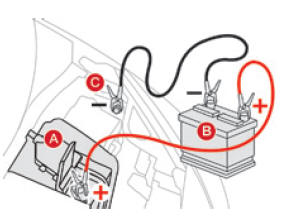
- Lift the plastic cover of the (+) terminal, if the vehicle is fitted with one.
- Connect the red lead to the (+) terminal of the discharged battery A (on the metal bent part), then to the (+) terminal of the auxiliary battery B or the booster.
- Connect one end of the green or black lead to the (-) terminal of the auxiliary battery B or the booster (or to an earth point on the vehicle with the auxiliary battery).
- Connect the other end of the green or black lead to the earth C of the vehicle with the discharged battery.
- Start the engine of the vehicle with the auxiliary battery and let it idle for several minutes.
- Operate the starter on the vehicle with the discharged battery and leave the engine running.
If the engine does not start immediately, switch off the ignition and wait a moment before trying again.
- Wait until the engine returns to idle, then disconnect the jump leads in the reverse order.
- Refit the plastic cover of the (+) terminal, if the vehicle is fitted with one.
- Let the engine run, while driving or stationary, for at least 30 minutes so that the battery can reach a sufficient state of charge.
Test yourself
A quick Citroen DS3 quiz: every answer comes with an explanation and a link to the manual page.
Was this page helpful?