Checking fluid levels
 Warning:
when topping up, do not mix up the different fluid types: they are not compatible with each other, and the vehicle could be seriously damaged.
 Note
Do not smoke when working in the engine compartment: flammable gases and vapours may be present: fire hazard!
1 Engine oil - 2 Battery - 3 Brake fluid - 4 Windscreen/rear window/headlight washer fluid - 5 Engine coolant
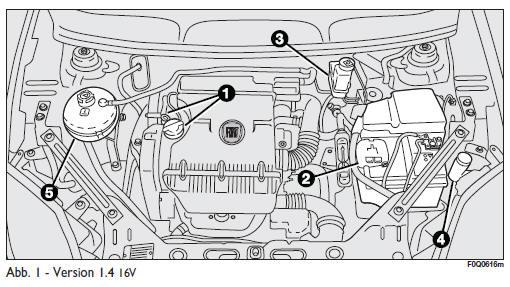

1 Engine oil - 2 Battery - 3 Brake fluid - 4 Windscreen/rear window/headlight washer fluid - 5 Engine coolant
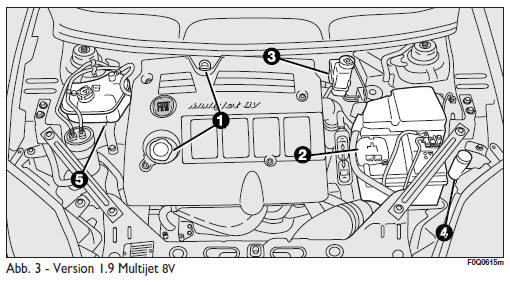
1 Engine oil - 2 Battery - 3 Brake fluid - 4 Windscreen/rear window/headlight washer fluid - 5 Engine coolant
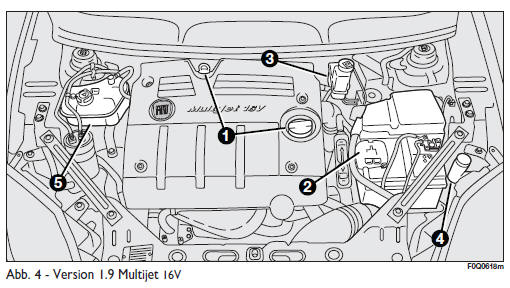
Engine oil fig. 5-6-7-8
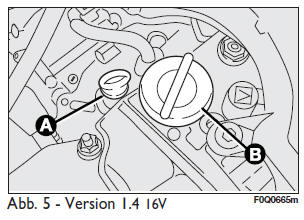
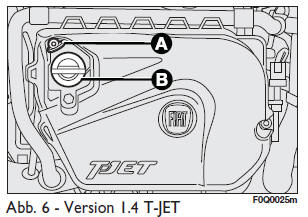
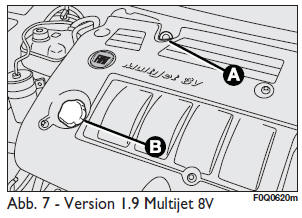
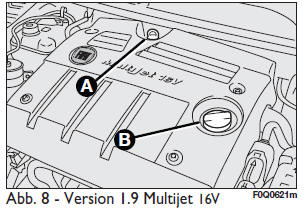
Checking the engine oil level
The oil level must be checked with the vehicle on level ground and a few minutes (approx. 5) after switching off the engine.
Pull out dipstick a, clean it, then reinsert it fully until it stops.
Pull it out again and check that the oil level is between the MIN and MAX marks on the dipstick. The distance between the MIN and MAX marks corresponds to approx. 1 litre of oil.
Topping up engine oilIf the oil is near or even below the MIN mark, top up oil through filler neck b until the MAX mark is reached.
The oil level must never be above the MAX mark.
Please note: if the engine oil level is regularly above the MAX mark, contact the Fiat Service Network to have the correct level restored.
Please note: after adding or changing oil, run the engine for a few seconds before measuring the oil level, and wait a few minutes after switching off before measuring.
Oil consumptionMaximum oil consumption is approx. 400 grams per 1000 km.
During the first period of use, the engine is in the running-in phase.
Oil consumption figures should therefore only be considered stable after the first 5000 to 6000 km.
Please note: oil consumption depends on driving style and the vehicle's conditions of use.
Please note: only top up with oil of the same specification as that already in the sump.
 Note
Take care inside the engine compartment when the engine is hot: risk of burns.
Please note that when the engine is hot, the electric cooling fan may start: risk of injury. Take care with scarves, ties and loose clothing: they could be caught by the moving parts.
 Used oil
and the replaced oil filter contain environmentally harmful substances. For oil and filter replacement, it is advisable to contact the Fiat Service Network. Engine coolant fig. 9-10
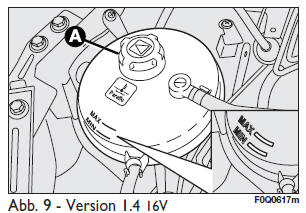
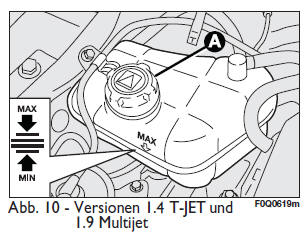
Check the coolant level when the engine is cold; it should not be below the MIN mark on the reservoir.
If the level is insufficient, slowly pour a mixture of 50% distilled water and Paraflu UP coolant from Selenia through the cap a of the reservoir.
The mixture of Paraflu UP and distilled water in a 50% ratio provides antifreeze protection down to -35°C.
In particularly severe climatic conditions, we recommend a mixture of 60% Paraflu UP and 40% demineralised water.
 The engine cooling system uses Paraflu UP as antifreeze. For any top-up, use the same product already in the cooling circuit. Paraflu UP must not be mixed with any other type of fluid. If this does happen, do NOT start the engine and contact the Fiat Service Network.
 Note
When the engine is very hot, do not open the reservoir cap: risk of burns! The cooling system is under pressure. If necessary, the cap may only be replaced with an original cap; otherwise the effectiveness of the system is compromised.
Windscreen/rear window/headlight washer fluid fig. 11
To top up fluid, remove cap a and pour in a mixture of water and Tutela Professional SC 35 in the following ratios:
- 30% Tutela Professional SC 35 and 70% water in summer;
- 50% Tutela Professional SC 35 and 50% water in winter.
At temperatures below -20°C, use Tutela Professional SC 35 undiluted.
Check the fluid level by visually inspecting the reservoir from outside.
On versions with a headlight washer system, remove the filter with the relevant dipstick. The dipstick shows how much fluid is in the tank.
 Note
Do not drive with an empty windshield washer fluid reservoir.
The effectiveness of the windshield washer system is a fundamental factor for good visibility.
NoteSome additives available on the market are flammable.
There are some hot components in the engine compartment which could ignite the fluid if it comes into contact with them.
Brake fluid fig. 12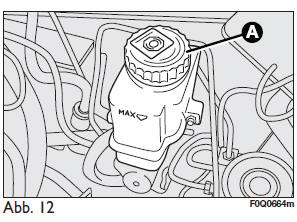
Unscrew cap A: check that the fluid level is at the maximum.
However, the fluid level in the reservoir must not exceed the MAX mark.
If fluid must be topped up, use the brake fluid specified in the "Fluids and Lubricants" table (see the "Technical Specifications" chapter). When opening filler cap A, take care to ensure that no foreign matter enters the reservoir.
When topping up, always use a funnel with a built-in filter with a mesh size of 0.12 mm or less.
Note: brake fluid absorbs water. If the vehicle is mainly used in areas of high humidity, the fluid must therefore be replaced more often than specified in the "Scheduled Maintenance Plan".
 When opening
the fuel filler cap, take care to prevent the highly corrosive fluid from coming into contact with painted parts. If this does happen, rinse immediately with water.
 Note
Avoid contact of this highly corrosive fluid with painted parts. If contact occurs, rinse immediately with water.
NoteThe symbol
The reservoir label indicates a synthetic brake fluid, which differs from mineral oil-based fluid.
Using a mineral oil-based brake fluid will irreversibly damage the special rubber seals of the brake system.
Air/pollen filterFor replacement of the air filter and pollen filter, please contact the Fiat Service Network.
Test yourself
A quick Fiat Bravo quiz: every answer comes with an explanation and a link to the manual page.