Gravity Control system
(Panda Cross 4x4 versions)
WARNING This function can only be engaged with the "Off Road" mode activated.
It is an integral part of the ESC system and its purpose is to keep the vehicle at a constant speed during a descent, acting autonomously and differentially on the brakes. In this way, the Gravity Control function assists the driver when tackling steep gradients in low-grip conditions and/or on rough road surfaces.
It is normal to hear noise and feel vibrations coming from the wheels (brakes) when the Gravity Control system is active.
WARNING The system does not relieve the driver of the responsibility for controlling the vehicle and does not replace the driver's attention. The driver of the vehicle assumes full responsibility for the consequences of their actions and for the consequences of inappropriate and irresponsible use of the vehicle.
Enabling the system
To enable the Gravity Control system, turn the knob in fig. 52 to the right while LED 2 is lit. Hold it in this position until LED 3 on the selector lights up. The warning light comes on in the instrument cluster and the display shows a dedicated message.
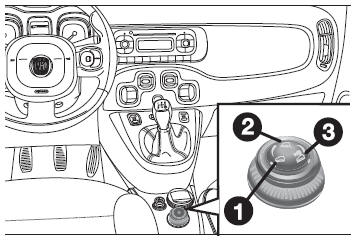
WARNING The system can only be enabled when "Off Road" mode is activated.
System intervention
For the system to activate, the speed must be below 25 km/h. Once the desired speed is reached, fully release the accelerator and brake pedals. To increase/decrease speed, press the accelerator/brake pedal again.
WARNING The system is also available at very low speeds between 5 km/h and 9 km/h. In this range, the transmission must be in neutral to prevent engine stalling.
WARNING For speeds above 9 km/h, the Gravity Control system must be used with a gear suitable for the set speed to prevent possible engine stalling.
You can regain control of the vehicle at any time while the Gravity Control system is operating by using the brake and accelerator pedals. If Gravity Control is not available when the system is enabled, this may be due to excessive brake temperature. In this case, wait a few minutes.
WARNING The Gravity Control system is available at speeds between 5 km/h and 25 km/h. It is advisable to use the system in low gears (first, second and third).
WARNING On flat city roads, it is advisable to disable the Gravity Control system, because at speeds below 25 km/h, under certain driving conditions such as pulling away, changing gears and driving over humps without using the accelerator pedal, the system may activate.
Disabling the system
To disable the system, turn the knob in fig. 52 to the left. Hold it in this position until LED 3 on the selector turns off.
WARNING If the braking system overheats, the system will deactivate by gradually releasing brake pressure, leaving control of the vehicle to the driver. When the Gravity Control system deactivates, the warning light flashes , a dedicated message appears on the display, and an audible warning sounds.
To re-enable the system, wait for the braking system to cool down, then turn the knob again.
WARNING Above 25 km/h and at speeds below 50 km/h, the Gravity Control system enable function deactivates but remains ready to resume when the speed drops below 25 km/h. In this case, the indicator in the instrument cluster turns off and the LED on the knob stays lit. If the vehicle speed exceeds 50 km/h, the Gravity Control system switches off completely and any independent braking action by the system is inhibited. To reactivate it, the knob must be turned again once the speed is brought back below 25 km/h.
T+ (Traction Plus) System
(depending on version/market, where fitted)
Traction Plus is a driving and pull-away aid on low-grip surfaces (snow, ice, mud, etc.). It distributes drive force optimally to the front axle when a wheel tends to spin.
Traction Plus works by braking the wheels that lose grip (or spin more than the others), thereby transferring drive force to those with better traction on the road.
Activation/deactivation
The system is deactivated at engine start.
To activate the Traction Plus system, press the T+ button in fig. 53. The LED on the button lights up and a dedicated message appears on the display.
To deactivate the system, press the T+ button again.
Operation
This function operates below 30 km/h. Above this speed, it deactivates automatically (the LED on the button stays lit) and reactivates as soon as the speed drops below 30 km/h.
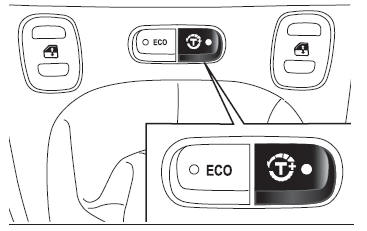
Activating the Traction Plus system applies a differential lock effect on the front axle through the braking system, to optimize traction on surfaces with uneven grip.
If there is a fault in the Traction Plus system, the ESC warning light will come on steadily in the instrument cluster.
CAUTION 44) The ABS makes the best use of the available grip, but it cannot increase it; therefore, caution is always required on slippery surfaces, without taking unjustified risks.45) When the ABS activates and you feel pulsations in the brake pedal, do not release the pressure. Keep the pedal firmly pressed without hesitation; this will bring the vehicle to a stop in the shortest possible distance, given the road surface conditions.
46) If the ABS activates, the limit of grip between the tyres and the road surface is being reached. Slow down and adjust your speed to the available grip.
47) For maximum braking system efficiency, a break-in period of about 500 km is required. During this period, avoid sudden, repeated and prolonged braking.
48) The ABS system cannot override the laws of physics, and it cannot increase the grip available under the road conditions.
49) The ABS system cannot prevent accidents, including those caused by excessive speed in corners, driving on low-grip surfaces, or aquaplaning.
50) The capabilities of the ABS system must never be tested irresponsibly or dangerously, in a way that endangers your own safety or that of others.
51) For the ABS system to work correctly, tyres must be of the same make and type on all wheels, in perfect condition, and above all of the specified type and size.
52) When the Mechanical Brake Assist activates, you may hear noises coming from the system. This behaviour is normal.
While braking, always keep the brake pedal firmly pressed.
53) For the ESC system to work properly, it is essential that the tyres are of the same make and type on all wheels, in perfect condition and, above all, of the specified type and size.
54) The ESC system continues to operate when the temporary-use spare wheel is fitted. Bear in mind, however, that the temporary-use spare wheel is smaller than a normal tyre and therefore offers less grip than the other tyres.
55) The performance of the ESC system must never encourage the driver to take unnecessary and unjustified risks. Driving style must always be adapted to road surface conditions, visibility and traffic. Responsibility for road safety always rests with the driver.
56) The ESC system cannot change the laws of physics, and cannot increase the grip that depends on road surface conditions.
57) The ESC system cannot prevent accidents, including those caused by excessive speed in bends and driving on low-grip surfaces or aquaplaning.
58) The capabilities of the ESC system must never be tested in an irresponsible or dangerous way that could compromise your own safety and that of others.
59) For the ASR system to work properly, it is essential that the tyres are of the same make and type on all wheels, in perfect condition and, above all, of the specified type and size.
60) The performance of the ASR system must never encourage the driver to take unnecessary and unjustified risks. Driving style must always be adapted to road surface conditions, visibility and traffic. Responsibility for road safety always rests with the driver.
61) The ASR system cannot overrule the laws of physics, and cannot increase the grip available from the road surface conditions.
62) The ASR system cannot prevent accidents, including those caused by excessive speed in bends, driving on low-grip surfaces or aquaplaning.
63) The capabilities of the ASR system must never be tested in an irresponsible or dangerous way that could compromise your own safety and that of others.
64) The HBA system cannot increase the grip of the tyres on the road beyond the limits imposed by the laws of physics: always drive with caution according to road surface conditions.
65) The HBA system cannot prevent accidents, including those caused by excessive speed in bends, driving on low-grip surfaces or aquaplaning.
66) The HBA system is a driving aid: the driver must never reduce their attention while driving. Responsibility for driving always rests with the driver. The capabilities of the HBA system must never be tested in an irresponsible or dangerous way that could compromise the safety of the driver, the other occupants of the vehicle and all other road users.
Test yourself
A quick Fiat Panda quiz: every answer comes with an explanation and a link to the manual page.