Inflation procedure
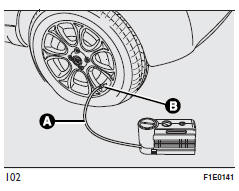
- Apply the parking brake. Unscrew the tyre valve cap, remove the flexible filler hose A in Fig. 102 and screw ring B onto the tyre valve;
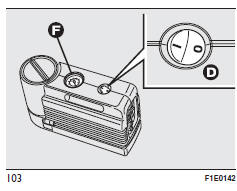
- make sure switch D in Fig.
103 of the compressor is in position 0 (off), start the engine, plug the compressor into the nearest power socket and switch the compressor on by setting switch D in Fig. 103 to position I (on);
- inflate the tyre to the required pressure given in "Tyre pressures" in the "Technical data" chapter. For a more precise reading, it is recommended to check the tyre pressure on gauge F in Fig. 103 with the compressor switched off. If a pressure of at least 1.8 bar is not reached within 5 minutes, disconnect the compressor from the valve and power socket, then move the vehicle forward about 10 metres so that the sealant spreads inside the tyre, and repeat the inflation procedure.
If, again, a pressure of at least 1.8 bar is not reached within 5 minutes of switching on the compressor, do not drive the vehicle. Contact the authorised Fiat service centre (ASO);
- after about 10 minutes of driving, stop and check the tyre pressure again. Remember to apply the parking brake and park the vehicle in a safe place. If the measured pressure is at least 1.8 bar, restore the correct pressure (with the engine running and the parking brake applied), drive off again and proceed very carefully to the nearest authorised Fiat service centre (ASO).
CAUTION
133) Hand the leaflet to the person who will repair the tyre using the fix&go tyre repair kit.
134) Damage to the sidewalls of the tyre cannot be repaired. Do not use the kit if the tyre has been damaged by driving without air.
135) If the wheel rim is damaged (deformed edge causing air leakage), repair is not possible. Do not remove foreign objects (screws or nails) embedded in the tyre.
136) Do not run the compressor continuously for more than 20 minutes.
Risk of overheating. The fix&go kit is not suitable for permanent repair, so the repaired tyre should be used only temporarily.
137) The bottle contains ethylene glycol.
Contains latex rubber emulsion: may cause allergic reactions. Harmful if swallowed. Causes eye irritation. May cause sensitisation by inhalation and skin contact. Avoid contact with eyes, skin and clothing. In case of contact, rinse the affected area immediately with plenty of water. If swallowed, do not induce vomiting; rinse mouth and drink plenty of water. Consult a doctor immediately.
Keep out of the reach of children. Do not use in the presence of asthmatics. Do not inhale vapours during filling and suction operations. If allergic reactions occur, consult a doctor immediately. Store the bottle in a suitable place, away from heat sources. The sealant has a shelf life. If it has expired, replace the bottle containing the sealant.
138) Put on the protective gloves supplied with the fix&go tyre repair kit.
139) Attach the sticker in a place clearly visible to the driver to indicate that the tyre has been repaired with the fix&go tyre repair kit. Drive carefully, especially through bends. Do not exceed 80 km/h. Do not accelerate or brake sharply.
140) If the pressure drops below 1.8 bar, do not continue driving: the fix&go kit cannot guarantee correct sealing because the tyre is too badly damaged. Contact the authorised Fiat service centre (ASO).
141) Always inform others that the tyre has been repaired with the fix&go tyre repair kit. Hand the leaflet to the person who will repair the tyre using the fix&go kit.
CAUTION
42) If a tyre is punctured by foreign objects, the tyre may be repaired provided the maximum puncture diameter on the tread and the rolling surface of the tyre does not exceed 4 mm.
CAUTION
3) Do not throw away the cans or pollute the environment with liquid sealant. Dispose of them in accordance with international and local regulations.
Test yourself
A quick Fiat Punto quiz: every answer comes with an explanation and a link to the manual page.