Suspension System
Wheel Alignment Repair Procedures
In this manual: Suspension System
~2min read
Inspection
When using a wheel alignment tester to check wheel alignment, make sure the vehicle is standing level and the front wheels are facing straight ahead. Make sure the suspension and steering are normal and the wheels are straight. Toe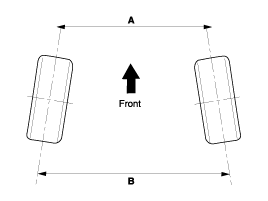
| Item | Description |
| A-B < 0 | Positive (+) toe (toe-in) |
| A-B > 0 | Negative (-) toe (toe-out) |
|

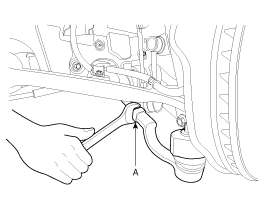
Tightening torque 49.0 ~ 64 N·m
|
Toe (Total/Individual)
2WD: 0.4° ± 0.2° / 0.2° ± 0.1°
4WD: 0.4° ± 0.2° / 0.2° ± 0.1°
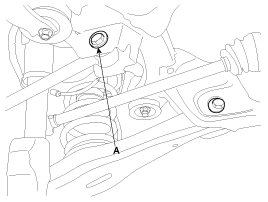
Turn the rear lower arm cam bolt to adjust toe.
LH cam bolt: Turn clockwise > toe-in
RH cam bolt: Turn clockwise > toe-in
Toe change per cam bolt scale graduation: Approx. 0.4°
After adjusting the cam bolt, tighten it to the specified torque.
Tightening torque 107.9 ~ 118 N·m
|
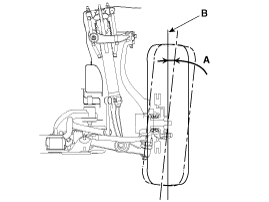
Camber refers to the inward or outward tilt of the wheel centerline. Camber [Front Wheel]
Camber: 2WD: -0.5° ± 0.5°
4WD: -0.5° ± 0.5°
| Item | Description |
| A | Positive camber |
| B | True vertical |
Camber: 2WD: -1.5° ± 0.5°
4WD: -1.5° ± 0.5°
Adjust camber by turning the rear lower arm cam bolt.LH cam bolt: Clockwise > camber (+)
RH cam bolt: Clockwise > camber (-)
Camber change per cam bolt rotation: Approx. 0.2°

Caster adjustment is not possible. Replace the strut if it does not meet the specified value.
Caster specification: 2WD: 8.35° ± 0.75°
4WD: 5.65° ± 0.75°
Test yourself
A quick Hyundai Genesis DH quiz: every answer comes with an explanation and a link to the manual page.
Was this page helpful?