Checking the Coolant Level
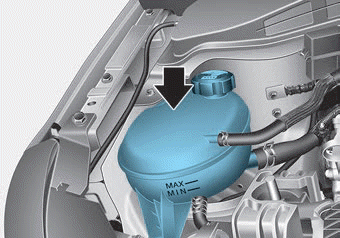
■ Engine coolant
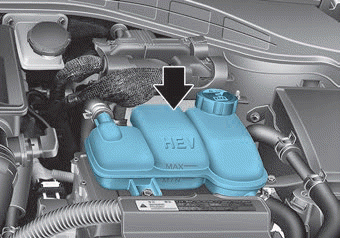
■ Inverter coolant
Inspect the condition and connections of all cooling system hoses and heater hoses. Replace any swollen or worn hoses.
The coolant level should be between the MAX and MIN marks on the side of the coolant reservoir when the engine is cold.
If the coolant level is low, add distilled (deionized) water up to the MAX mark, but do not overfill. If frequent addition is required, have the system checked by an authorized HYUNDAI dealer.

■ Engine coolant reservoir cap
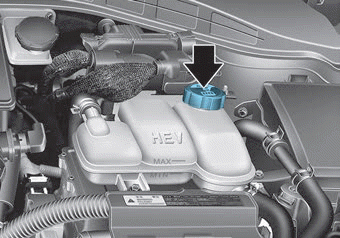
■ Inverter coolant reservoir cap
WARNING

Never remove the engine coolant reservoir cap and/or inverter coolant reservoir cap or the drain plug while the engine and radiator are hot. Hot coolant and steam may be ejected under pressure, which could cause serious injury.
Turn off the hybrid system and wait until the engine has cooled. Use extreme caution when removing the engine coolant reservoir cap and/or inverter coolant reservoir cap. Wrap a thick towel around it and slowly turn it counterclockwise to the first stop. Step back while the pressure in the cooling system is released. When you are sure all pressure has been released, press down on the cap using a thick towel and continue turning counterclockwise to remove it.
Information
The engine and/or inverter coolant level depends on the hybrid system temperature. Before checking or adding engine and/or inverter coolant, turn off the hybrid vehicle.
WARNING

The cooling fan motor may continue to run or start when the engine is off and may cause serious injury. Keep hands, clothing, and tools away from the rotating cooling fan blades.
The cooling fan motor is controlled by engine coolant temperature, refrigerant pressure, and vehicle speed. As the engine coolant temperature decreases, the cooling fan motor will turn off automatically. This is normal. If your vehicle is equipped with GDI, the cooling fan motor may start to run at any time and continue to run until you disconnect the negative battery cable.
WARNING
Make sure the coolant reservoir cap is tightly closed after adding coolant. Otherwise, the engine may overheat while driving.
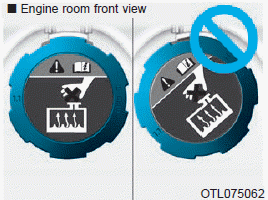
1. Make sure the mark on the coolant reservoir cap is facing straight forward.
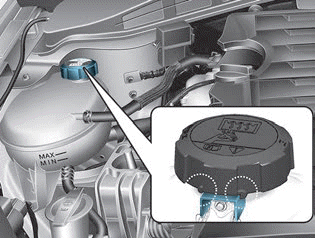
■ Engine compartment, rear view
2. Make sure the small tabs inside the coolant reservoir cap are securely engaged.
Recommended Coolant
- When adding coolant, use only distilled (deionized) water for your vehicle, and never mix hard water with the coolant factory-filled.
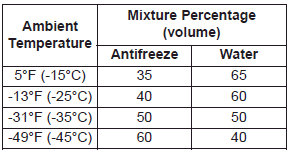
- An incorrect coolant mixture may cause serious engine or hybrid system damage. • Your vehicle's engine contains aluminum parts and must be protected with an ethylene glycol phosphate-based coolant to prevent corrosion and freezing. • Do not use alcohol- or methanol-based coolant, and do not mix them with the specified coolant. • Do not use a solution containing more than 60% antifreeze or less than 35% antifreeze, as this reduces the efficiency of the solution.
For the mixing ratio, refer to the following table:
Information
If you are unsure of the mixture ratio, a mixture of 50% water and 50% antifreeze is optimal and the easiest to prepare, since it uses equal amounts of each. It is suitable for most temperature ranges down to -31°F (-35°C).
Test yourself
A quick Hyundai Ioniq quiz: every answer comes with an explanation and a link to the manual page.