Steps to Determine the Correct Load Limit
1. Find the statement "The combined weight of occupants and cargo should never exceed XXX kg or XXX lbs." on your vehicle's label.
2. Determine the combined weight of the driver and passengers who will be riding in your vehicle.
3. Subtract the combined weight of the driver and passengers from XXX kg or XXX lbs.
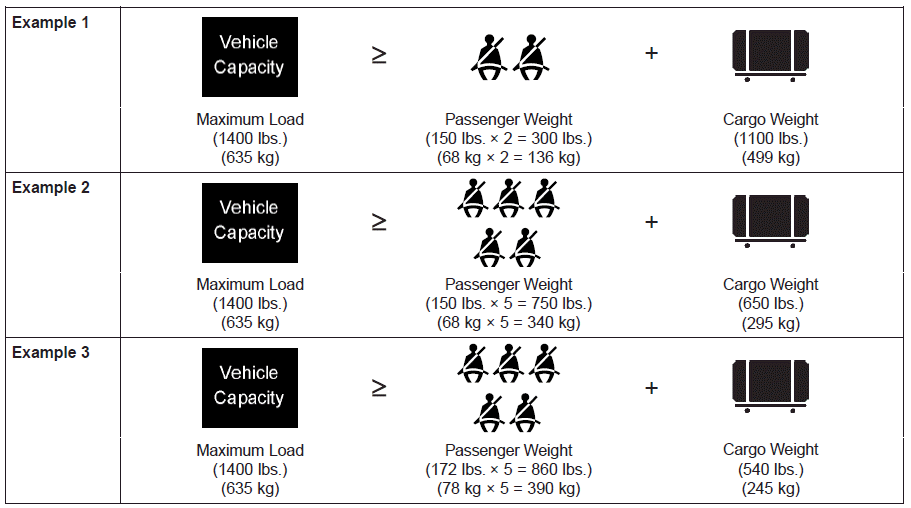
4. The resulting number equals the available cargo and luggage capacity. For example, if the "XXX" value is 1400 lbs, and there are five 150 lb passengers in your vehicle, the available cargo and luggage capacity is 650 lbs. (1400 - 750 (5 x 150) = 650 lbs.)
5. Determine the total weight of luggage and cargo to be loaded into the vehicle. This weight must not safely exceed the available cargo and luggage capacity calculated in step 4.
WARNING
Do not overload the vehicle. There is a limit to the total weight or load capacity that the vehicle can carry, including passengers and cargo. Overloading may shorten the life of the vehicle. If the GVWR or GAWR is exceeded, vehicle parts may break, and this may change the handling of your vehicle. This may cause you to lose control and result in an accident.
6. If your vehicle will tow a trailer, the load from your trailer will be transferred to your vehicle. Refer to this manual to determine how this reduces the available cargo and luggage capacity of your vehicle.
Test yourself
A quick Hyundai Ioniq quiz: every answer comes with an explanation and a link to the manual page.