Emission Control System
Repair Procedures
In this manual: Emission Control System
10steps
~60min
3/5difficulty
Done 0 of 10
Inspection
[System Inspection]- Disconnect the vapor hose from the intake manifold and connect a vacuum pump to the nipple on the intake manifold.
- With engine cold [engine coolant temperature < 60 °C]
Engine Status Applied vacuum Result Idle Min. 20 inHg
(min. 0.7 kgf/cm², min. 67.7 kPa)Vacuum is applied 3000 rpm - Check the following items when applying vacuum to the purge control solenoid valve (PCSV).
- With engine warm [engine coolant temperature > 80 °C]
Engine Status Applied vacuum Result Idle Min. 20 inHg
(min. 0.7 kgf/cm², min. 67.7 kPa)Vacuum is applied Within 3 minutes after starting the engine at 3000 rpm Try to apply vacuum Vacuum is released 3 minutes after starting the engine at 3000 rpm Min. 20 inHg
(min. 0.7 kgf/cm², min. 67.7 kPa)Vacuum will be held momentarily, then released - Turn the ignition switch OFF and disconnect the negative (-) battery cable.
- Disconnect the PCSV connector (A).
- Disconnect the vapor hose (B) connected to the intake manifold from the PCSV.
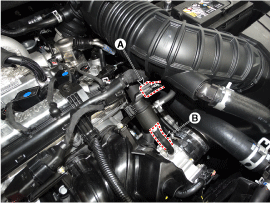
- Connect a vacuum pump to the nipple and apply vacuum.
- With the PCSV control line grounded, check valve operation by applying battery voltage to the PCSV (open) and removing it (closed).
Battery Voltage Valve Vacuum Connected Open Released Disconnected Close Supplied - Measure the resistance of the PCSV coil.
Specification: 22.0–26.0 Ω [20 °C]
- Select "Leak Test".
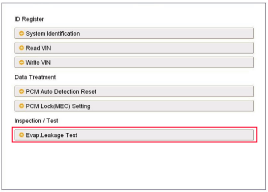
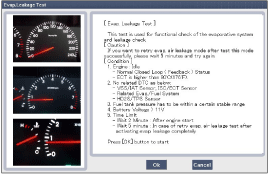
- Continue the test in accordance with the instructions on the screen.
Test yourself
A quick Hyundai Kona quiz: every answer comes with an explanation and a link to the manual page.
Was this page helpful?