Tire Pressure Monitoring System
WARNING
Excessive or insufficient pressure can shorten tire life, adversely affect vehicle handling, and cause sudden tire failure, which may result in loss of vehicle control and a crash.
Check each tire, including the spare (if provided), monthly when cold and inflate to the tire pressure recommended by the vehicle manufacturer on the vehicle placard or tire placard. (If your vehicle has tires of a different size than the size indicated on the vehicle placard or tire placard, you should determine the proper tire pressure for those tires.)
As an additional safety measure, your vehicle is equipped with a Tire Pressure Monitoring System (TPMS) that illuminates the Low Tire Pressure warning light when one or more of your tires is significantly under-inflated. Accordingly, when the low tire pressure warning light illuminates, stop as soon as possible and check your tires and inflate them to the proper pressure. Driving on a significantly under-inflated tire causes the tire to overheat and can lead to tire failure. Under-inflation also reduces fuel efficiency and tire tread life, and may affect the vehicle's handling and stopping ability.
Note that the TPMS does not replace proper tire maintenance. The driver is responsible for maintaining correct tire pressure, even if pressure has not dropped to the level that illuminates the TPMS low tire pressure warning light.
Your vehicle is also equipped with a TPMS malfunction indicator to indicate when the system is not functioning properly. The TPMS malfunction indicator is combined with the Low Tire Pressure telltale. When the system detects a malfunction, the indicator will flash for approximately one minute and then remain illuminated. This sequence will continue during subsequent vehicle start-ups until the malfunction is corrected. When the malfunction indicator is illuminated, the system may not be able to detect or signal low tire pressure as intended.
TPMS malfunctions may occur for a variety of reasons, including the installation of replacement or alternate tires or wheels on the vehicle that prevent the TPMS from functioning properly. Always check the TPMS malfunction indicator after replacing one or more tires or wheels on your vehicle to ensure that the replacement tires and wheels allow the TPMS to continue to function properly.
NOTICE
If any of the following occurs, we recommend that the system be inspected by an authorized HYUNDAI dealer.
1. The Low Tire Pressure/TPMS malfunction indicator does not illuminate for 3 seconds when the ignition switch is turned to the ON position or the engine is running.
2. The TPMS malfunction indicator continues to illuminate after flashing for approximately 1 minute.
3. The low tire pressure indicator remains on.
Low Tire Pressure Warning Light
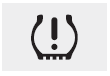
Low Tire Pressure Telltale and Tire Pressure Telltale
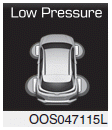
When the TPMS warning light and the warning message displayed on the cluster LCD illuminate, one or more of your tires is significantly under-inflated. The Low Tire Pressure telltale will illuminate and indicate which tire is significantly under-inflated by illuminating the corresponding position light.
If one of the telltales illuminates, immediately reduce your speed, avoid sharp turns and braking, and anticipate increased braking distance. You should stop and check your tires as soon as possible. Inflate the tires to the proper pressure as specified on the vehicle certification label or the tire pressure label located on the driver's side outer center pillar. If you cannot reach a service station or if the tire cannot hold the added air, replace the low-pressure tire with the spare tire.
If you drive the vehicle for about 10 minutes at a speed above 25 km/h after replacing the low-pressure tire with the spare tire, the following will occur:
- The TPMS malfunction indicator may flash for approximately 1 minute and then remain illuminated continuously because the TPMS sensor is not installed on the spare tire.
NOTICE
The spare tire is not equipped with a tire pressure sensor.
CAUTION
In winter or in cold weather, the low tire pressure warning light may illuminate if the tire pressure was adjusted to the recommended tire pressure in warm weather. This does not mean that your TPMS is malfunctioning. The drop in temperature causes a decrease in tire pressure.
When you drive the vehicle from a warm area to a cold area, or from a cold area to a warm area, or if the outside temperature changes significantly, you should check the tire pressure and adjust the tires to the recommended tire pressure.
WARNING
Low Tire Pressure Damage
Significantly low tire pressure makes the vehicle unstable and may contribute to loss of vehicle control and increased braking distance.
Continued driving on a low-pressure tire may cause the tire to overheat and fail.
TPMS (Tire Pressure Monitoring System) Malfunction Indicator

The TPMS malfunction indicator will illuminate after flashing for approximately one minute when there is a problem with the tire pressure monitoring system.
We recommend having the system checked by an authorized HYUNDAI dealer.
NOTICE
If there is a malfunction in the TPMS, the low tire pressure warning will not be displayed, even if a vehicle tire is under-inflated.
CAUTION
- The TPMS malfunction indicator may flash for approximately 1 minute and then remain illuminated continuously if the vehicle is driven near electrical power cables or radio transmitters, such as police stations, government and public agencies, broadcasting stations, military facilities, airports, or transmission towers, etc. This may interfere with the normal operation of the Tire Pressure Monitoring System (TPMS).
- The TPMS malfunction indicator may flash for approximately 1 minute and then remain illuminated continuously if snow chains or any aftermarket electronic devices, such as a laptop, mobile phone charger, remote starter, or navigation system, are used in the vehicle. This may interfere with the normal operation of the Tire Pressure Monitoring System (TPMS).
Test yourself
A quick Hyundai Kona quiz: every answer comes with an explanation and a link to the manual page.