Remove the turbocharger manifold. (Refer to Intake and Exhaust System - Turbocharger and Exhaust Manifold)
Inspection on Vehicle
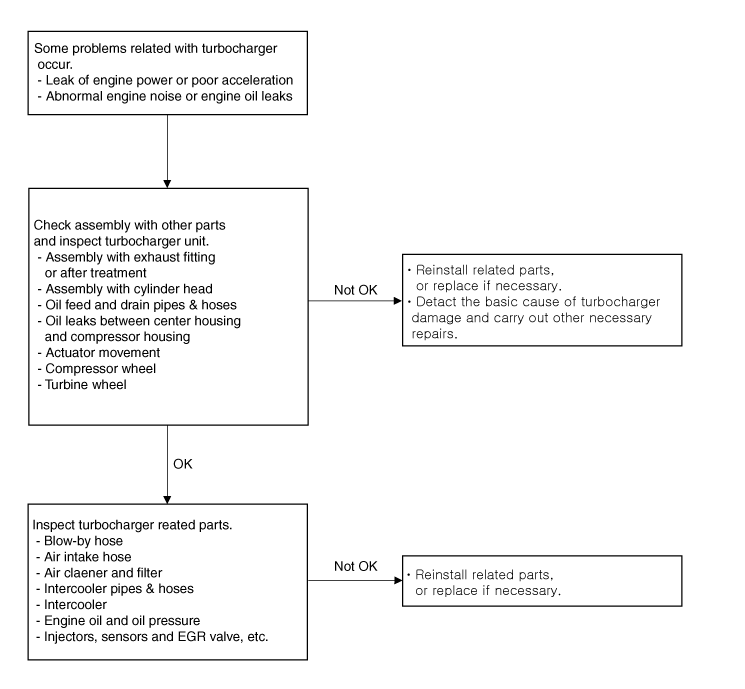
Turbocharger Diagnostic Flow
If there are any problems related to the turbocharger, such as insufficient engine power, poor acceleration, abnormal engine noise, or oil leakage, inspect the turbocharger according to the following procedure.
Inspect the turbocharger and exhaust pipe assembly (or after-treatment).
Check that the gasket is installed.
Make sure the mounting bolts (or nuts) are tightened properly.
Check for gas leakage.
Check the parts for damage, such as cracks.
Gas leakage due to a missing gasket or insufficiently tightened mounting bolts (or nuts) may cause abnormal engine noise. If the cause of the problem is found, tighten the mounting bolts (or nuts) to the specified torque, or replace the gasket or damaged parts with new ones if necessary.
Check the exhaust manifold and cylinder head assembly.
Check that the gasket is installed.
Make sure the mounting bolts (or nuts) are tightened properly.
Check for gas leakage.
Gas leakage due to a missing gasket or insufficiently tightened mounting bolts (or nuts) may cause abnormal engine noise. If the cause of the problem is found, tighten the mounting bolts (or nuts) to the specified torque, or install a new gasket if necessary.
Check the turbocharger oil supply pipe and hose, and the oil drain pipe and hose.
Check that the gasket is installed.
Check that the mounting bolts are tightened correctly.
Check that the clamps are in place.
Check the oil lines and hoses for damage (kinks, crushing, tears or cracks).
If gas leakage occurs because the gasket was not installed or the mounting bolts were tightened incorrectly, oil leakage may result. If the oil supply pipe and hose are damaged, engine oil will not be supplied to the turbocharger in sufficient quantity, which may damage the turbocharger. If the oil drain pipe and hose are damaged or clogged, engine oil will not drain smoothly, which may cause oil leakage from the turbocharger. If the cause of the problem is found, tighten the mounting bolts (or nuts) to the specified torque, or replace the gasket or damaged parts with new ones if necessary.
Check for oil leakage between the center housing and the compressor housing.
Make sure the mounting bolts are tightened properly.
Check for oil leakage.
A damaged O-ring (gasket) between the center housing and the compressor housing may cause oil leakage. If oil leakage is found, replace the turbocharger with a new one.
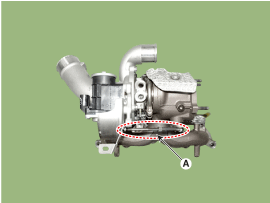
Inspect the electric wastegate actuator (EWGA) rod assembly.
Make sure the alignment marks (A) on the EWGA line up.
A damaged turbocharger actuator may cause reduced engine power and poor acceleration. If the actuator rod does not move, replace the turbocharger with a new one.
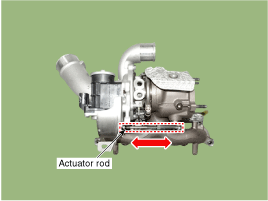
Check the electric wastegate actuator (EWGA).
Electric wastegate actuator (EWGA): check the actuator rod movement while performing the forced actuator operation using the GDS. (Refer to the Diagnostic Trouble Code manual)If the turbocharger actuator is damaged, it may cause loss of engine power and poor acceleration. If the actuator rod does not move, replace the turbocharger with a new one.
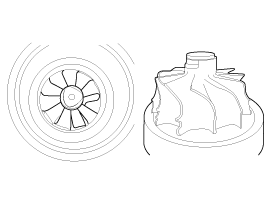
Check the turbocharger compressor wheel.
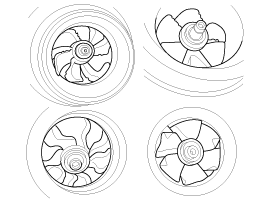
Check that the compressor wheel is not damaged (bent or deformed).
Make sure the compressor wheel rotates smoothly. For example
A damaged compressor wheel may cause abnormal noise from the turbocharger and poor acceleration. If the compressor wheel is damaged or deformed, replace the turbocharger with a new one.
Check the turbocharger turbine wheel.
Check that the turbine wheel is not damaged.
Make sure the turbine wheel rotates smoothly. For example
A damaged turbine wheel may cause abnormal noise from the turbocharger and poor acceleration. If the turbine wheel is damaged or deformed, replace the turbocharger with a new one.
Check the breather hose. (Refer to Group FL)
Check that the breather hose is not damaged (kinked or clogged).
Check whether the positive crankcase ventilation (PCV) valve is clogged.
If the breather hose is bent or clogged, the internal pressure will increase and engine oil will not flow smoothly into the turbocharger, causing turbocharger damage and oil leakage. If the cause of the problem is found, replace the breather hose or related parts with new ones.
Check the intake hose connected to the turbocharger.
Check whether the intake hose is damaged (bent, crushed, disconnected or torn).
If the cross-section of the intake hose is reduced because the intake hose is bent or crushed, air intake into the turbocharger will be reduced and the pressure before the turbocharger will drop, causing turbocharger damage or oil leakage. If the intake hose is disconnected or torn, foreign substances may enter the turbocharger and damage it. If the intake hose is damaged, replace it with a new one.
Check the air cleaner.
Check the air cleaner filter for contamination.
Check the air cleaner filter for water intrusion.
Check the air cleaner cover for contamination.
Make sure the air cleaner filter is a genuine part.
If the air cleaner filter is excessively wet or dirty, or a non-genuine part is used, air intake into the turbocharger will be reduced and the pressure before the turbocharger will drop, causing turbocharger damage and oil leakage. If the air cleaner filter is excessively wet or dirty, replace it with a new one.
Check the intercooler hoses and pipes.
Make sure the intercooler hoses and pipes are connected correctly.
Check whether the intercooler hoses and pipes are damaged (bent, disconnected or torn).
Check the intercooler hoses and pipes for damage such as cracks.
Make sure the clamps are in their proper positions.
If the intercooler hoses and pipes are damaged or disconnected, oil leakage may occur from the hoses and pipes, and the turbocharger may exceed the allowable speed, causing turbocharger damage. If the intercooler hoses and pipes are damaged, replace them with new ones.
Inspect the intercooler.
Check the intercooler hoses and tanks for damage (oil leakage or cracks).
If the intercooler is damaged, the turbocharger may exceed the allowable speed, causing damage to the turbocharger. If the intercooler is damaged, replace it with a new one.
Check the engine oil.
Check the engine oil level.
Check the engine oil for discoloration, water contamination, and degradation.
Check the engine oil grade.
If the engine oil level is low, the amount of engine oil supplied to the turbocharger will decrease, resulting in bearing seizure in the turbocharger due to insufficient lubrication and cooling. If the cause of the problem is found, add or replace the engine oil.
Check the engine oil pressure.
Engine oil pressure: Check the oil pressure using a pressure gauge after removing the oil pressure sensor and plugging the cylinder block.
Check the engine oil strainer in the oil pan if the engine oil level is low. Then check the injectors for gas leakage if foreign material has accumulated on the oil strainer.
If the engine oil level is low, the amount of engine oil supplied to the turbocharger will decrease, resulting in bearing seizure in the turbocharger due to insufficient lubrication and cooling. If the cause of the problem is found, add or replace the engine oil. If foreign material has accumulated on the oil strainer, clean the oil strainer and replace the injector washer with a new one after checking the injector for gas leakage. Inspect engine oil related parts, such as the oil pump, if necessary.
Check the injectors, sensors, etc. (Refer to Engine Control / Fuel System)
Check that the injectors operate correctly.
Make sure the sensors, such as the Mass Air Flow Sensor (MAFS), Intake Air Temperature Sensor (IATS), and Boost Pressure Sensor (BPS), operate correctly.
Malfunction of the injectors, sensors, EGR valve, etc. may reduce engine power. If the cause of the problem is found, replace the related parts with new ones.
If no problems are found with the turbocharger, inspect the turbocharger-related parts according to the following procedure.
?
Test yourself
A quick Hyundai Kona quiz: every answer comes with an explanation and a link to the manual page.