Automatic Transmission Operation
The automatic transmission has eight forward speeds and one reverse speed. Individual speeds are selected automatically in the D (Drive) position.
The indicator in the instrument cluster shows the position of the shift lever when the ignition switch is in the ON position.
WARNING
To reduce the risk of serious injury or death:
- ALWAYS check the area around your vehicle for people, especially children, before shifting to D (Drive) or R (Reverse).
- Before leaving the driver's seat, always make sure the shift lever is in P (Park), then set the parking brake and turn the ignition switch to the LOCK/OFF position. Unexpected and sudden vehicle movement may occur if these precautions are not followed.
- When using the paddle shifters (manual shift mode), do not use engine braking (downshifting from a high gear to a low gear) quickly on slippery roads. The vehicle may skid, causing an accident.
P (Park)
Always come to a complete stop before shifting to P (Park).
To move the shift lever out of P (Park), be sure to firmly depress the brake pedal and make sure your foot is completely off the accelerator pedal.
If you have done all of the above and still cannot move the shift lever out of the P (Park) position, refer to "Shift-Lock Release" in this chapter.
The shift lever must be in the P (Park) position before the engine is turned off.
WARNING
- Shifting to P (Park) while the vehicle is moving may cause loss of vehicle control.
- After stopping the vehicle, always make sure the shift lever is in the P (Park) position, apply the parking brake, and turn off the engine.
- When parking on a slope, shift into P (Park) and apply the parking brake to prevent the vehicle from rolling down the slope.
- Do not use the P (Park) position in place of the parking brake.
R (Reverse)
Use this position to drive the vehicle in reverse.
NOTICE
Always come to a complete stop before shifting into or out of R (Reverse). Shifting into R (Reverse) while the vehicle is moving may damage the transmission.
Also note that when the vehicle is in D (Drive) or R (Reverse) and you open the driver's door, a warning chime will sound and the warning message "Shift to Park" will appear on the LCD cluster display.
N (Neutral)
The wheels and transmission are disengaged.
Use N (Neutral) if you need to restart a stalled engine, or if you need to stop with the engine running. Shift to P (Park) if you need to leave the vehicle for any reason.
Always depress the brake pedal when shifting from N (Neutral) to another gear.
WARNING
Make sure your foot is firmly on the brake pedal when shifting the transmission. Also, keep your foot away from the accelerator pedal when shifting into a gear. Shifting at high engine speed may cause the vehicle to move suddenly. You may lose control of the vehicle and cause serious injury.
D (Drive)
This is the normal driving position. The transmission will shift automatically through the 8-speed sequence, providing the best combination of fuel economy and performance.
For additional power when passing another vehicle or driving uphill, keep the accelerator pedal depressed. You may notice the transmission downshift to the next lower gear or several gears as needed to accelerate the vehicle sufficiently.
The DRIVE MODE switch, located on the shift lever console, allows the driver to switch between NORMAL mode, SPORT mode, or SMART mode.
Manual Shift Mode
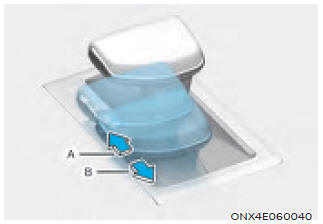
[A]: + (Up), [B]: - (Down)
Manual shift mode can be selected by moving the shift lever to the left (toward the driver) in the manual shift gate. If your vehicle is currently in D (Drive), the gear indicator on the instrument cluster will change from "D" to the current gear number.
In manual shift mode, move the shift lever forward and back to select the gear suitable for the current driving conditions.
+ (Up): Push the shift lever forward once to shift up one gear.
- (Down): Pull the lever back once to shift down one gear.
Information
- Only the eight forward gears can be selected. To reverse or park the vehicle, move the shift lever to R (Reverse) or P (Park) as needed.
- Downshifting occurs automatically when the vehicle decelerates. When the vehicle stops, 1st gear is automatically selected.
- When the engine speed approaches the red zone, the transmission will upshift automatically.
- If the driver pushes the lever to the + (up) or - (down) position, the transmission may not be able to complete the requested gear shift if the next gear is outside the allowable engine speed range. The driver should shift to a higher gear according to road conditions, making sure to keep the engine speed below the red zone.
- When driving on a slippery road, push the shift lever forward to the + (up) position. This causes the transmission to shift to 2nd gear, which is better for smooth driving on slippery roads. Move the shift lever toward the - (down) position to shift back to 1st gear.
Shift Lock Release
If the shift lever cannot be moved from P (Park) to R (Reverse) with the brake pedal depressed, continue depressing the brake pedal, then do the following:
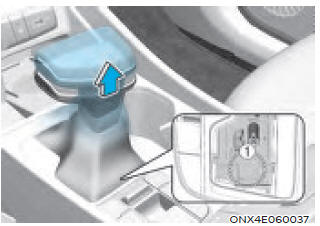
1. Turn the ignition key to the LOCK/OFF position.
2. Apply the parking brake.
3. Carefully remove the shift lever boot.
4. Move the shift lever while pressing the release button (1) with a tool (for example, a flat-blade screwdriver).
If you need to use the Shift-Lock release, have your vehicle checked by an authorized HYUNDAI dealer immediately.
Shift Lock System
For your safety, the automatic transmission has a shift lock system that prevents shifting from P (Park) to R (Reverse) unless the brake pedal is depressed.
To shift from P (Park) to R (Reverse):
1. Depress and hold the brake pedal.
2. Start the engine or turn the ignition switch to the ON position.
3. Move the shift lever.
Ignition Key Lock System
The ignition key cannot be removed unless the shift lever is in the P (Park) position.
AutoPark
Always come to a complete stop and keep pressing the brake pedal. Move the shift lever to the P (Park) position, apply the parking brake, and turn the ignition switch to the LOCK/OFF position. Take the key with you when leaving the vehicle.
WARNING
When you remain in the vehicle with the engine running, be careful not to depress the accelerator pedal for a long period of time. The engine or exhaust system may overheat and cause a fire. Exhaust gas and the exhaust system are very hot. Keep away from exhaust system components.
Do not stop or park over flammable materials such as dry grass, paper, or leaves. They may ignite and cause a fire.
Test yourself
A quick Hyundai Tucson quiz: every answer comes with an explanation and a link to the manual page.