Manual Heating and Air Conditioning Control
Heating and air conditioning can also be controlled manually by pressing buttons other than the AUTO button.
In this case, the system switches sequentially to the modes selected in the order their buttons are pressed.
When any button other than the AUTO button is pressed in automatic mode, the functions that were not selected manually will be controlled automatically.
1. Start the engine.
2. Use the button to set the operating mode as desired.
To improve heating and cooling efficiency:
- Heating:
- Cooling:
3. Set the temperature control knob as desired.
4. Set the air intake control switch to the fresh air position.
5. Adjust the blower speed as desired.
6. If necessary, turn on the air conditioner.
To return to automatic control, press the AUTO button.

Mode Selection
The mode selection button controls the direction of air flow through the ventilation system.
Air is discharged through the following outlets:

See the illustration in the section "Manual Climate Control System".
 Air discharge to the lower part of the passenger compartment and windshield - defroster vents
Most of the airflow is directed to the lower body and windshield, and a small amount is supplied to the side outlets to prevent glass fogging.
 Air discharge through the front panel ventilation outlets - face vents
Airflow is directed to the upper body and the face of the occupants.
In addition, the position of each vent can be adjusted to direct the airflow passing through it.
 Air discharge through the front panel ventilation outlets and to the lower part of the passenger compartment - bi-level vents
Airflow is directed to the occupants' face and the lower body.
 Air discharge to the lower part of the passenger compartment - floor vents
Most of the airflow is directed to the lower body, and a small amount is supplied to the windshield and side outlets to prevent glass fogging.
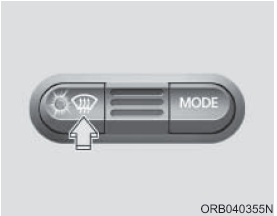
Air discharge to the windshield - defroster vents
Most of the airflow is directed to the windshield, and a small amount is supplied to the side outlets to prevent glass fogging.
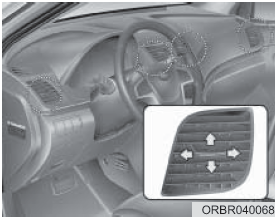
Instrument Panel Vents
The airflow direction through these vents can also be adjusted using the lever, as shown in the illustration.
• To close the vents, move the damper control lever in the direction indicated by the arrow on the lever.
• The airflow direction can be adjusted by moving the damper control lever in the desired direction.
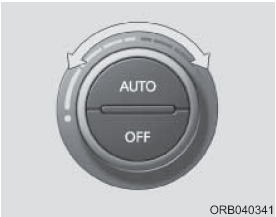
Temperature Control
The temperature will increase to the maximum if the temperature control knob is turned fully clockwise.
The temperature will decrease to the minimum if the temperature control knob is turned fully counterclockwise.
When the knob is turned, the temperature increases or decreases by 0.5 °C. When the lowest temperature setting is selected, the air conditioner will operate continuously.
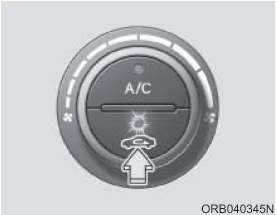
Air Intake Mode Switch
This control is used to select one of two air intake modes: fresh air intake or recirculation.
To change the air intake mode, press the button.
Recirculation
 When the switch is in the recirculation position, air from the passenger compartment enters the heating and ventilation system, where it is heated or cooled depending on the selected system operation mode.
Fresh Air Intake
 When the switch is in this position, outside air is supplied to the heating and ventilation system, where it is heated or cooled depending on the selected system mode.
NOTE
Note that prolonged operation of the heating system in recirculation mode causes the windshield and side windows to fog up. In addition, the air in the passenger compartment becomes stale.
Furthermore, during prolonged operation of the air conditioner in recirculation mode, the humidity level in the passenger compartment drops significantly.
WARNING
• Prolonged operation of the climate control system in recirculation mode may increase humidity inside the vehicle, which may cause the windows to fog and reduce visibility.
• Do not sleep in the vehicle with the air conditioning or heating system on. This may result in serious injury or death due to decreased oxygen content in the air and/or lowered body temperature.
• Prolonged operation of the climate control system in recirculation mode may cause the driver to become drowsy or sleepy and lose control of the vehicle.
Set the air intake mode switch to fresh air intake while driving as often as possible.

Blower Speed Adjustment
Adjust the blower speed to the required level by turning the corresponding knob.
The higher the blower speed, the greater the airflow.
Press the OFF button to turn off the blower.
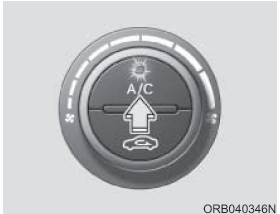
Air Conditioning
To turn on the air conditioner, press the A/C button (the indicator lamp in it will illuminate).
Press this button again to turn off the air conditioner.

Off mode
Press the OFF button to turn off the automatic climate control system. However, the mode selection buttons and air intake mode buttons remain operable when the ignition switch is in the ON position.
Test yourself
A quick Hyundai Solaris quiz: every answer comes with an explanation and a link to the manual page.