Fuel Tank Removal
Gasoline is extremely flammable and can be explosive under certain conditions, creating the potential for serious burns. Make sure the area is well-ventilated and free from any source of flame or sparks; this includes any appliance with a pilot light. Do not smoke. Turn the ignition switch OFF.
Disconnect the battery (–) terminal. To avoid fuel spills, draw it from the tank when the engine is cold. Be prepared for fuel spillage; any spilled fuel must be completely wiped up immediately.
- Turn the ignition switch to OFF.
- Wait until the engine cools down.
- Remove: Front Seat (see Front Seat Removal in the Frame chapter)
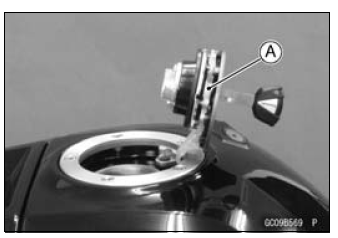
- Open the fuel tank cap [A] to lower the pressure in the tank.
During tank removal, keep the tank cap open to release pressure in the tank. This makes fuel spillage less.
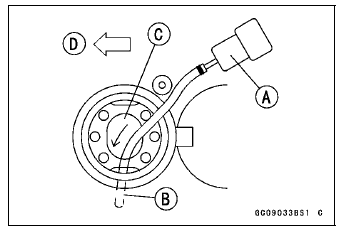
- Draw the fuel out from the fuel tank with a commercially available pump [A].
Use a soft plastic hose [B] as a pump intake hose in order to insert the hose smoothly.
Put the hose through the fill opening [C] into the tank and draw the fuel out.
Front [D]
WARNING
Spilled fuel is flammable and can be explosive under certain conditions. The fuel can not be removed completely from the fuel tank. Be careful for remained fuel spillage.
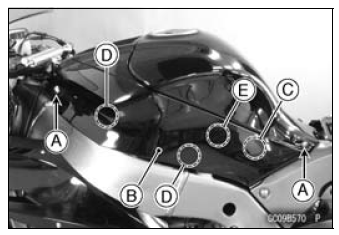
- Remove: Bolts [A] Fuel Tank Covers (Both Sides) [B]
Clear the hook fastener [C], projections [D] and hook portion [E].
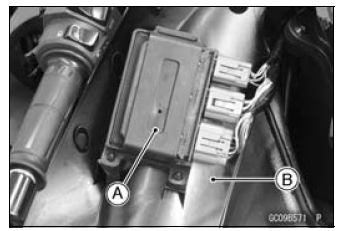
Remove the relay box [A] from the left fuel tank cover [B].
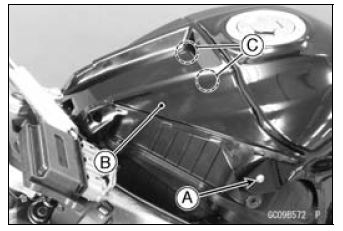
- Remove: Bolts (Both Sides) [A] Upper Fuel Tank Cover [B]
Clear the projections [C] from the holes.
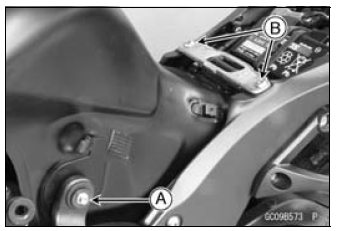
- Remove: Fuel Tank Bolts (Both Sides) [A] Fuel Tank Bracket Bolts [B]
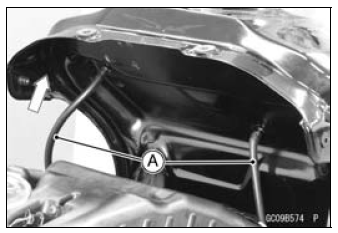
- Lift up the front portion of the fuel tank, and then disconnect the hoses [A].
- For the California and Southeast Asia models, disconnect the following.
- Disconnect: Battery (–) Terminal Fuel Pump Lead Connector [A]

- Be sure to place a piece of cloth around the fuel hose joint.
- Wipe off the dirt of the surface [A] around the connection using a cloth or a soft brush.
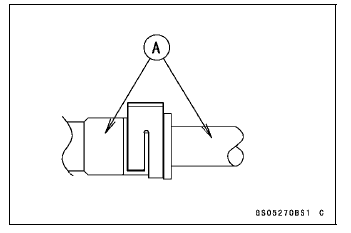
When removing with standard tip screwdriver
- Insert the standard tip screwdriver [A] into the slit on the joint lock [B].
- Turn the driver to disconnect the joint lock.
When removing with fingers
- Open and push up [C] the joint lock with your fingers.
NOTICE
Prying or excessively widening the joint lock ends for fuel hose removal will permanently deform the joint lock, resulting in a loose or incomplete lock that may allow fuel to leak and create the potential for a fire explosion. To prevent fire or explosion from a damaged joint lock, do not pry or excessively widen the joint lock ends when removing the fuel hose. The joint lock has a retaining edge that locks around the housing.
- Pull the fuel hose out of the pipe.
- Cover the delivery pipe with the vinyl bag to keep it clean.
Fuel is flammable and explosive under certain conditions and can cause severe burns. Be prepared for fuel spillage; any spilled fuel must be completely wiped up immediately. When the fuel hose is disconnected, fuel spills out from the hose and the pipe. Cover the hose connection with a clean shop towel to prevent fuel spillage.
- Close the fuel tank cap.
- Remove the fuel tank, and place a it on a flat surface.
Do not apply the load to the fuel outlet pipe of the fuel pump.
- For the California and Southeast Asia models, note the following.
NOTICE
For the California and Southeast Asia models, if gasoline, solvent, water or any other liquid enters the canister, the canister’s vapor absorbing capacity is greatly reduced. If the canister does become contaminated, replace it with a new one.
Be sure to plug the evaporative fuel return hose to prevent fuel spilling before fuel tank removal.
WARNINGSpilled fuel is flammable and can be explosive under certain conditions. For California and Southeast Asia models, be careful not to spill fuel through the return hose.
If liquid or gasoline flows into the breather hose, remove the hose and blow it clean with compressed air.
Be careful of fuel spillage from the fuel tank since fuel still remains in the fuel tank and fuel pump.
WARNINGGasoline is extremely flammable and can be explosive under certain conditions, creating the potential for serious burns. Store the fuel tank in an area which is well-ventilated and free from any source of flame or sparks. Do not smoke in this area. Place the fuel tank on a flat surface and plug the fuel pipes to prevent fuel leakage.
Test yourself
A quick Kawasaki Ninja ZX-10R quiz: every answer comes with an explanation and a link to the manual page.