Clutch
Spring Plate Free Play Measurement
In this manual: Clutch
~1min read
Insufficient clutch free play will cause the engine braking effect to be more sudden, resulting in rear wheel hop. On the other hand, if the free play is excessive, the clutch lever may feel “spongy” or pulsate when pulled.
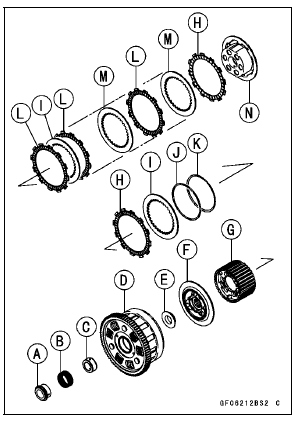
- Hold an extra drive shaft in a vise and install the following clutch parts on the shaft (see Clutch Installation).

#7) Spring Seat [J] Spring [K] Friction Plates (36 Lining Blocks) [L] (#2
 #9)
Steel Plates (T = 2.6) [M] (#8, #9) Clutch Spring Plate [N]
- Engage the clutch hub with the sub clutch hub.
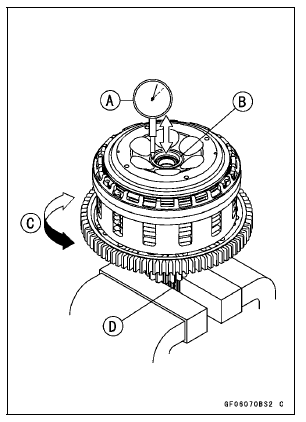
- To measure the free play, set a dial gauge [A] against the raised center [B] of the clutch spring plate.
- Move the clutch housing gear back and forth [C]. The difference between the highest and lowest gauge readings is the amount of free play.
Spring Plate Free Play Usable Range: 0.05  0.70 mm (0.002
 0.028 in.)
If the free play is not within the usable range, change all of the friction plate and measure the free play again.
If the free play is not within the usable range, adjust the free play (see Spring Plate Free Play Adjustment).
Test yourself
A quick Kawasaki Ninja ZX-10R quiz: every answer comes with an explanation and a link to the manual page.
Was this page helpful?