Body Electrical System
Description and Operation of Instrument Cluster
In this manual: Body Electrical System
6steps
~36min
2/5difficulty
Done 0 of 6
Description
Cluster Network Schematic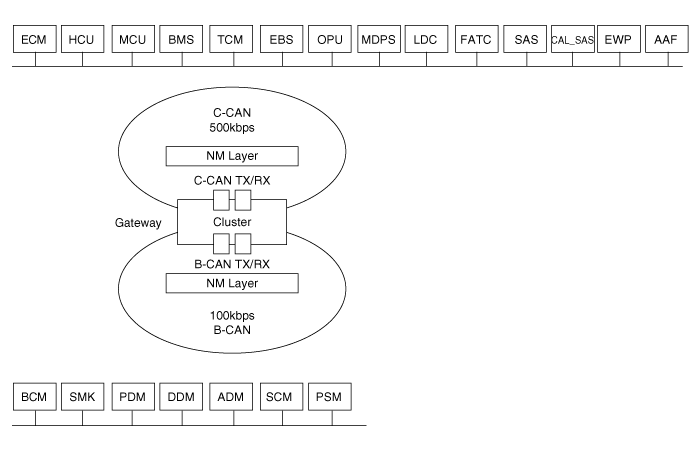
| ECM | Engine Control Module |
| HCU | Hybrid Control Module |
| MCU | Engine Control Module |
| BCM | Battery Management System |
| TCM | Transmission Control Module |
| ABS | Electronic Brake System |
| EPS | Oil Pump Unit |
| MDPS | Motor-Driven Power Steering |
| HCU | Low Voltage DC/DC Converter |
| FATC | Fully Automatic Temperature Control |
| EWP | Electric Water Pump |
| AAF | Active Air Flap |
| BCM | Body Control Module |
| SMK | Smart Key Unit |
| PDM | Power Distribution Module |
| DDM | Driver door module |
| ADM | Assist Door Module |
| SKM | Steering Wheel Module |
| PSM | Power Seat Module |
The Active ECO System is a function that improves fuel efficiency while driving. It is turned on and off with the switch on the steering wheel. Details of the ECO functions are listed below.
- Shift Pattern
- ECO Shift Pattern: Reduces shift pattern, prevents upshift tip-out
- Electrical Load
- Reduce LDC Electrical Load
- Drive Mode
- Torque Control: Increases regenerative energy by disengaging engine clutch over the entire deceleration range.
- Air Conditioner
- ECO A/C Mode: Adjusts temperature approximately 2~3 °C higher than in normal modes.
- Regenerative Braking
- Improved Regenerative Braking Efficiency
- Other
- Achieve effective SOC control by using drive modes that minimize power loss
Test yourself
A quick Kia Optima Hybrid Owner's Manual quiz: every answer comes with an explanation and a link to the manual page.
Was this page helpful?