Continuously Variable Valve Timing (CVVT) System
Description and Operation
Description
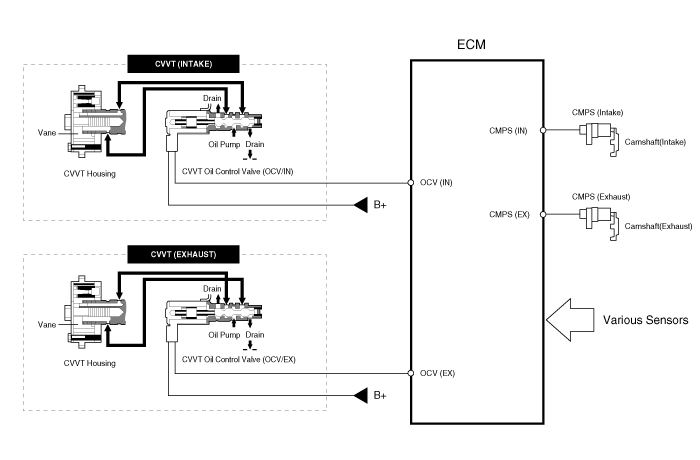
The Continuously Variable Valve Timing (CVVT) system advances or retards the intake and exhaust valve timing according to the control signal from the ECM, which is calculated based on engine speed and load.
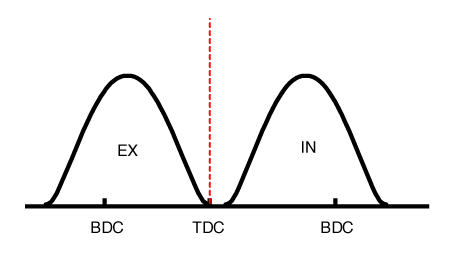
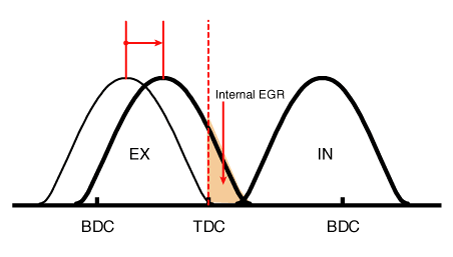
CVVT control provides valve overlap or underlap, which improves fuel economy and reduces exhaust emissions (NOx, HC). CVVT improves engine performance by reducing pumping losses, providing internal exhaust gas recirculation effect, improving combustion stability, improving volumetric efficiency, and increasing expansion work.
This system consists of:
CVVT Oil Control Valve (OCV), which supplies engine oil to the cam phaser or drains engine oil from the cam phaser according to the ECM PWM (Pulse Width Modulation) control signal,
and Cam Phaser, which changes the cam phase by hydraulic force of engine oil.
Engine oil flowing through the CVVT Oil Control Valve changes the camshaft phase in the advance direction (intake advance / exhaust retard) or in the opposite direction (intake retard / exhaust advance) relative to engine rotation, by rotating the rotor connected to the camshaft inside the phaser.
Operating Principle
CVVT has a rotor vane mechanism that is rotated by hydraulic force from engine oil supplied to the advance or retard chamber according to the control of the CVVT oil control valve.
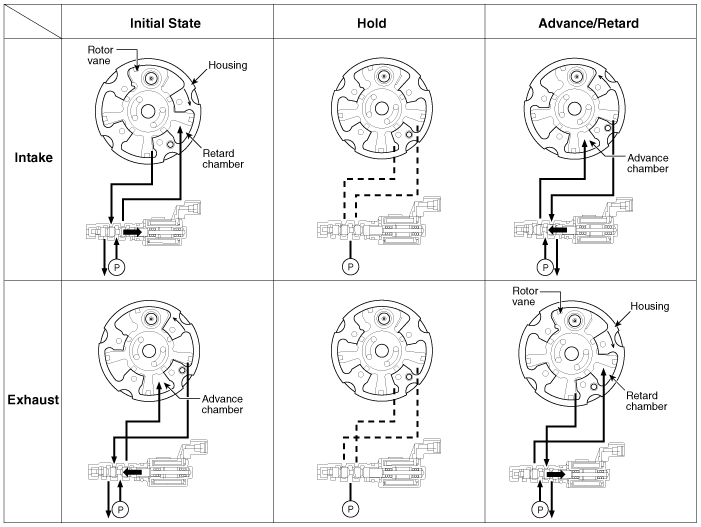
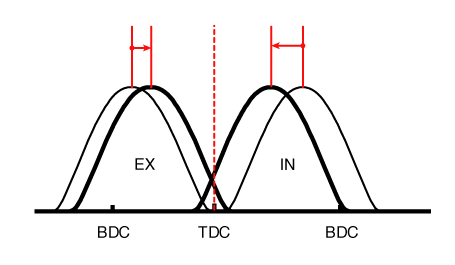
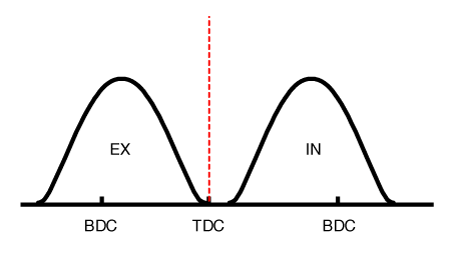
[CVVT System Mode]
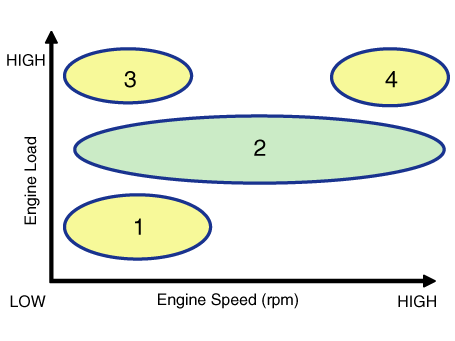
| (1) Low Speed/Low Load | (2) Partial Load |
 |
 |
| (3) Low Speed/High Load | (4) High Speed/High Load |
 |
 |
| Driving Condition |
Exhaust Valve | Intake Valve | ||
| Valve Timing |
Effect | Valve Timing |
Effect | |
| (1) Low Speed /Low Load |
Fully Advance |
* Lower valve overlap * Improved combustion stability |
Fully Retard |
* Lower valve overlap * Improved combustion stability |
| (2) Partial Load | Retard | * Increased expansion work * Reduced pumping losses * Reduced HC |
Retard | * Reduced pumping losses |
| (3) Low Speed /High Load |
Retard | * Increased expansion work | Advance | * Prevents intake backflow (improves volumetric efficiency) |
| (4) High Speed /High Load |
Advance | * Reduced pumping losses | Retard | * Improved volumetric efficiency |
Test yourself
A quick Kia Optima DL3 quiz: every answer comes with an explanation and a link to the manual page.