Low Tire Pressure Warning Light / TPMS Malfunction Indicator
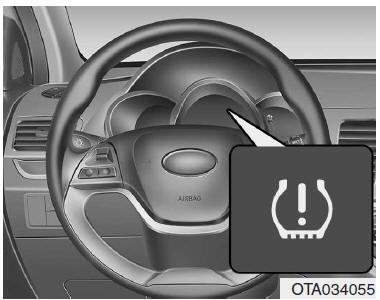
The tires, including the spare tire (if provided), must be checked monthly when cold and inflated to the pressure specified by the manufacturer, which is indicated on the vehicle placard or on the tire and loading information label. (If the tire size of your vehicle is different from the size indicated on the placard or label, the correct inflation pressure must be determined based on the tires).
As an additional safety feature, the vehicle has been equipped with a tire pressure monitoring system (TPMS) that illuminates a warning light when one or more tires are significantly under-inflated.
When this warning light illuminates, you should stop, check the tires as soon as possible, and inflate them to the correct pressure. Driving on significantly under-inflated tires causes them to overheat and can lead to tire damage.
Under-inflated tires also increase fuel consumption, reduce tread life, and may affect the vehicle's handling and braking distances.
Please note that the TPMS does not replace periodic tire pressure checks. It is the driver's responsibility to keep the tires at the correct pressure, even if the pressure has not yet dropped to a level that triggers the TPMS warning light.
Your vehicle also has an indicator that comes on when the TPMS is not functioning properly. The TPMS malfunction indicator is combined with the low tire pressure warning light. When the system detects a malfunction, the light flashes for about one minute, then remains on continuously. This sequence will repeat each time the engine is started until the malfunction is corrected.
When the malfunction indicator illuminates, the system is unable to detect low tire pressure or the low tire pressure signal may be unreliable. The TPMS may malfunction for several reasons, one of which may be the installation or rotation of different tires/wheels that prevents the system from functioning normally.
After replacing one or more tires/wheels, always check the TPMS malfunction indicator to make sure that the replacement or rotation has allowed the system to function correctly.
NOTE If the TPMS malfunction indicator and the low tire pressure warning light do not come on for 3 seconds when the ignition is turned on or the engine is started, or if they do not turn off after remaining on for about 1 minute, contact your nearest authorized Kia dealer to have the system checked.
 TPMS malfunction indicator (tire pressure monitoring system) The TPMS malfunction indicator comes on after flashing for about one minute when there is a fault in the tire pressure monitoring system.
If the system is able to correctly detect a low pressure signal at the moment a problem occurs in the system, the TPMS malfunction indicator remains on.
To determine the cause of the problem, it is recommended that the system be checked by an authorized Kia dealer.
WARNING
- The TPMS malfunction indicator may come on when the vehicle is near power transmission lines or radio transmitters, such as police stations, public offices, broadcasting stations, military installations, airports, radio towers, etc., as these can interfere with the normal operation of the tire pressure monitoring system (TPMS).
- The TPMS malfunction indicator may come on when electronic devices such as laptop computers, mobile phone chargers, navigation systems or remote starters are used in the vehicle.
These may interfere with the normal operation of the tire pressure monitoring system (TPMS).
Test yourself
A quick Kia Picanto JA quiz: every answer comes with an explanation and a link to the manual page.