Fuel and emission control systems
Foreword
In this manual: Fuel and emission control systems
~3min read
- When the customer reports a vehicle malfunction, check the malfunction indicator lamp (MIL) indication and diagnostic trouble code (DTC), then diagnose the malfunction according to following flowchart.
- If a DTC exists, diagnose the applicable DTC inspection. (See DTC TABLE.)
- If no DTC exists and the MIL does not illuminate or flash, diagnose the applicable symptom troubleshooting. (See ENGINE SYMPTOM TROUBLESHOOTING.)
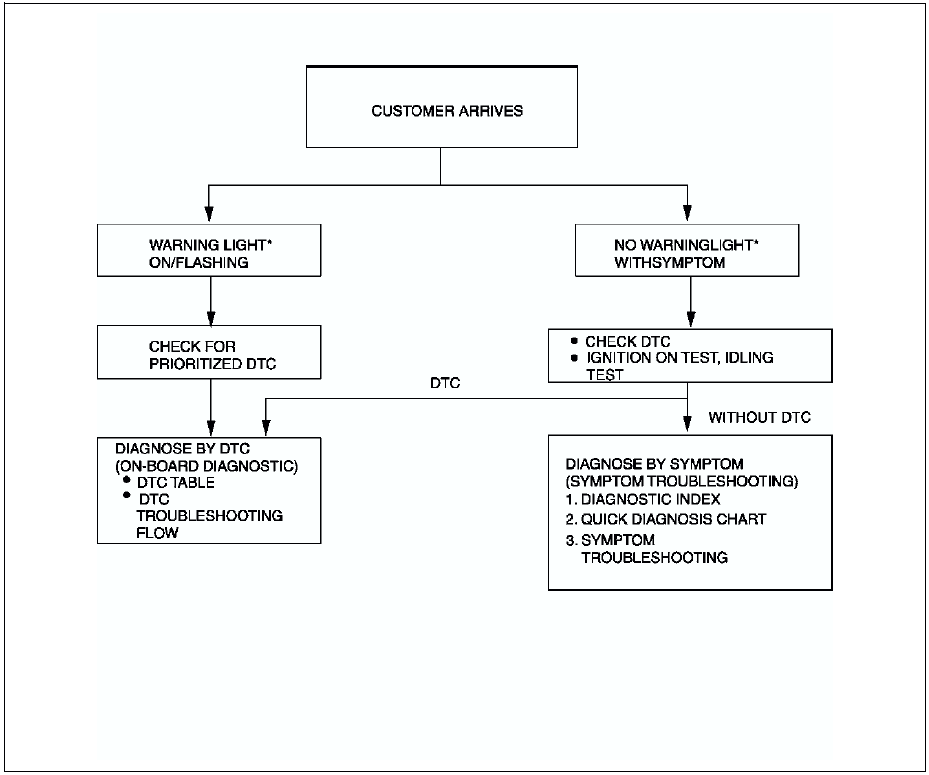
* : Malfunction Indicator lamp (MIL), Generator Warning Light, Security Light
OBD PENDING TROUBLE CODES- These appear when a problem is detected in a monitored system.
- The code for a failed system is stored in the PCM memory in the first drive cycle. If the problem is not found in the second drive cycle, the PCM judges that the system returned to normal or the problem was mistakenly detected, and deletes the pending code. If the problem is found in the second drive cycle too, the PCM judges that the system has failed, and stores the pending codes, and the DTCs.
- After pending codes are stored, if the PCM judges that the system is normal in any future drive cycle, the PCM deletes the pending codes.
- If any problems are detected in the first drive cycle, pending codes will be stored in the PCM memory, as well as DTCs.
- After pending codes are stored, if the PCM judges that the system is normal in any future drive cycle, the PCM deletes the pending codes.
- This is the technical data which indicates the engine condition at the time of the first malfunction. This data will remain in the memory even if another emission-related DTC is stored, with the exception of the Misfire or Fuel System DTCs. Once freeze frame data for the Misfire or Fuel System DTC is stored, it will overwrite any previous data and the freeze frame will not be overwritten again.
- This shows OBD system operating status. If any monitor function is incomplete, WDS or equivalent will identify which monitor function has not been completed. Misfires, Fuel System and Comprehensive Components (CCM) are continuous monitoring-type functions. The catalyst, EGR system and oxygen sensor will be monitored under drive cycles. The OBD diagnostic system is initialized by performing the DTC cancellation procedure or disconnecting the negative battery cable.
- These results from the intermittent monitor systems technical data, which are used to determine whether the system is normal or not. They also display the system thresholds and diagnostic results. The intermittent monitor system monitors the oxygen sensorand the catalyst.
- his retrieves all stored DTCs in the PCM and clears the DTCs, Freeze Frame Data, On-Board Readiness Test Results, Diagnostic Monitoring Test Results and Pending Trouble Codes.
- The PID mode allows access to certain data values, analog and digital inputs and outputs, calculated values and system status information. Since PID values for output devices are PCM internal data values, inspect each device to identify which output devices are malfunctioning.
Test yourself
A quick Mazda 6 quiz: every answer comes with an explanation and a link to the manual page.
Was this page helpful?