How to Park Using the Predicted Course Lines
WARNING
- Always look behind you before reversing to make sure the path is clear. Always reverse slowly.
- Use the displayed lines as a reference only. Factors such as the number of occupants, fuel level, vehicle position, road conditions and road incline affect the lines.
- If you replace the tires with tires of a different size, the predicted course lines may not be displayed correctly.
- On snowy or very slippery roads, there may be a difference between the predicted course line and the actual course line.
- If the vehicle battery is disconnected or discharged, the predicted course lines may not be displayed correctly. In such a situation, perform the following procedure:
- Turn the steering wheel from lock to lock while the engine is running.
- Drive the vehicle on a straight road for more than 5 minutes.
- If you turn the steering wheel while the ignition switch is in the ACC (Accessory) position, the predicted course lines may not be displayed correctly.
- Use the vehicle width and distance guide lines as a reference only when the vehicle is on a flat, paved surface. The distance shown on the screen is for reference only and may differ from the actual distance between the vehicle and the displayed objects.
- When the vehicle reverses uphill, objects shown on the screen appear farther away than they actually are. When the vehicle reverses downhill, objects shown on the screen appear closer than they actually are. Use the inside rear view mirror or look over your shoulder to correctly judge the distance to objects.
The vehicle width lines and predicted course lines are wider than the actual vehicle width and course.
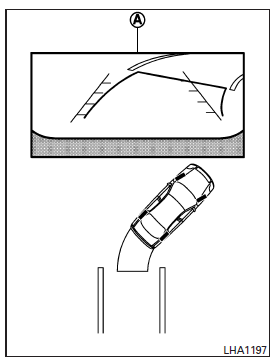
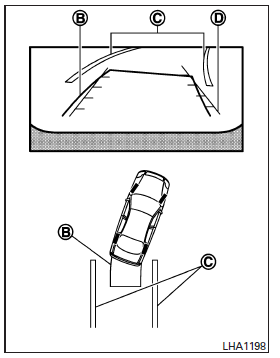
- Visually confirm that the parking space is safe before parking your vehicle.
- The view of the rear of the vehicle is displayed on screen A when the selector lever is placed in the R (reverse) position.
- Reverse slowly while turning the steering wheel so that the predicted course lines B enter the parking space C.
- While using the predicted course lines as a reference, turn the steering wheel so that the vehicle width guide lines D are parallel to the parking space C.
- Once the vehicle is completely parked in the space, place the selector lever in the P (park) position and apply the parking brake.

Difference between the displayed distance and the actual distance
Reversing on a steep uphill slope:
Use the distance and vehicle width guide lines for reference only when the vehicle is on a flat, paved surface. The distance shown on the screen is for reference only and may differ from the actual distance between the vehicle and the displayed objects.
When the vehicle reverses uphill, the distance and vehicle width guide lines appear closer than they actually are.
For example, the screen shows a distance of 1 m (3 ft) to plane A, but the actual 1 m (3 ft) distance on the slope is at plane B.
Note that any object on the slope appears farther away on the screen.
Reversing down a steep slope
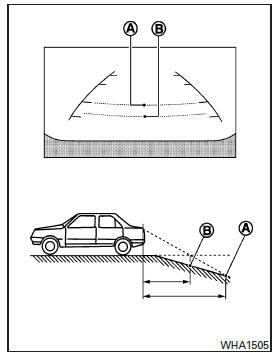
When the vehicle reverses down a slope, the distance and vehicle width guide lines appear farther away than they actually are. For example, the screen shows 1.0 m (3 ft) to plane A , but the actual distance of 1.0 m (3 ft) down the slope is at plane B . Note that objects displayed on the screen are actually closer on the slope.
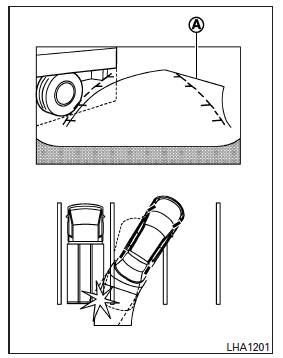
Reversing near a protruding object
The predicted course lines A do not touch the object on the screen. However, the vehicle may strike the object if it protrudes above the actual reversing path.
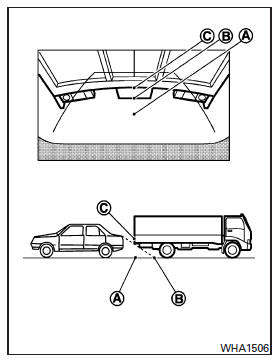
Reversing behind a protruding object
Position C appears farther away than position B shown on the screen. However, position C is at the same distance as position A .
The vehicle may strike the object when reversing to position A if the object protrudes above the actual reversing path.
Test yourself
A quick Nissan Altima quiz: every answer comes with an explanation and a link to the manual page.