Tips: emissions control, fuel economy
Your vehicle meets the recycling and recovery criteria for end-of-life vehicles, which come into force in 2015.
Some parts of your vehicle have therefore been designed for later recycling.
These parts are easily removable so that they can be recovered and processed through recycling channels.
In addition, by design, its original settings and moderate fuel consumption, your vehicle complies with the emissions regulations in force. It actively contributes to reducing pollutant emissions and saving energy. However, the level of pollutant emissions and fuel consumption of your vehicle also depends on you. Make sure it is properly maintained and used correctly.
Fuel economy assistance
Depending on the vehicle, to optimise fuel consumption, a warning light on the instrument panel tells you the best moment to shift up or down:
 shift to
a higher gear;
 shift to
a lower gear.
Maintenance
It is important to note that failure to comply with emissions regulations may lead to legal proceedings against the vehicle owner. In addition, replacing engine, fuel system or exhaust parts with parts other than those specified by the manufacturer changes your vehicle's compliance with emissions regulations.
Have the settings and checks on your vehicle carried out by a brand Representative, in accordance with the instructions in the maintenance schedule: they have all the equipment needed to guarantee your vehicle's original settings.
Engine settings
- ignition: this requires no adjustment.
- spark plugs: optimum fuel consumption, efficiency and performance require strict compliance with the specifications established by our Engineering Departments.
When replacing spark plugs, use the brands, types and gaps specified for your engine. For this, consult a brand Representative.
Exhaust emissions monitoring
The exhaust emissions monitoring system detects malfunctions in the vehicle's emissions control system.
These malfunctions may cause the release of harmful substances or mechanical damage.
 This warning light on the
instrument panel indicates any system faults. It comes on when the ignition is switched on, then goes out when the engine starts.
- If it stays on continuously, contact a Brand Representative as soon as possible;
- if it flashes, reduce engine speed until the flashing stops.

Driving
- Rather than warming the engine up while stationary, drive gently until it has reached its normal operating temperature.
- Speed is expensive.
- “Sporty” driving is expensive: prefer “smooth” driving.
- Do not push engine speed in the intermediate gears.
Therefore always use the highest gear possible without straining the engine.
- Avoid sudden acceleration.
- Brake as little as possible. By anticipating obstacles or bends sufficiently in advance, you only need to lift off the accelerator.
- On uphill gradients, rather than trying to maintain your speed, do not accelerate any more than on flat ground. Preferably keep the same pedal position.
- Double-declutching and blipping the accelerator before stopping the engine are no longer necessary on modern vehicles.
- Bad weather, flooded roads:
 Do not drive through
water if its depth exceeds the lower edge of the wheel rims.
 Driveability
problem
On the driver’s side, only use floor mats suited to the vehicle that attach to the pre-installed fixing points, and regularly check their attachment. Do not stack several mats.
Risk of pedal entrapment
Usage tips
- Electricity is “like oil”: switch off any electrical device when it is no longer really needed. But (safety first), keep your lights on whenever visibility requires it (see and be seen).
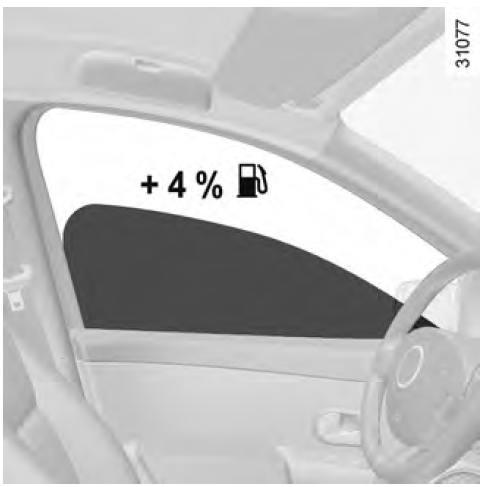
- Use the ventilation instead. Driving with the windows down increases fuel consumption by 100 km/h: +4 %.
- On vehicles fitted with air conditioning, an increase in fuel consumption (especially in urban driving) is normal while it is in use.
On vehicles fitted with air conditioning without automatic mode, switch the system off when you no longer need it.
Tips to minimise fuel consumption and help protect the environment: If the vehicle has been parked in intense heat or full sun, remember to ventilate it for a few minutes to expel the hot air before starting.
- Avoid filling the tank to the brim, as this prevents any overflow.
- Do not keep an empty roof rack fitted.
- Prefer ECO mode.
Refer to the “Eco-driving” section.
- To transport bulky items, use a trailer instead.
- When towing a caravan, remember to use an approved deflector and do not forget to adjust it.
- Avoid “door-to-door” use (short trips with frequent long stops). The engine never reaches its ideal temperature.
Tyres
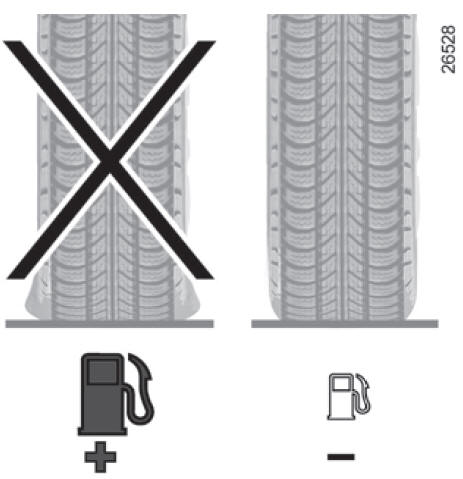
- Insufficient tyre pressure increases fuel consumption.
- Using tyres other than those recommended may increase fuel consumption.
Test yourself
A quick Renault Clio quiz: every answer comes with an explanation and a link to the manual page.