Cruise control
Cruise control is a function that helps you maintain your driving speed at a constant value that you have chosen, called the set speed.
This set speed can be continuously adjusted from 30 km/h.
 The
cruise control function does not act on the braking system under any circumstances.
This function is an additional driving aid.
However, the function does not take the place of the driver.
It therefore cannot, under any circumstances, replace compliance with speed limits, attentiveness (always be ready to brake in all circumstances), or the driver’s responsibility.
Cruise control must not be used in heavy traffic, on winding or slippery roads (ice, aquaplaning, loose gravel) or in adverse weather conditions (fog, rain, crosswinds, etc.).
Risk of accident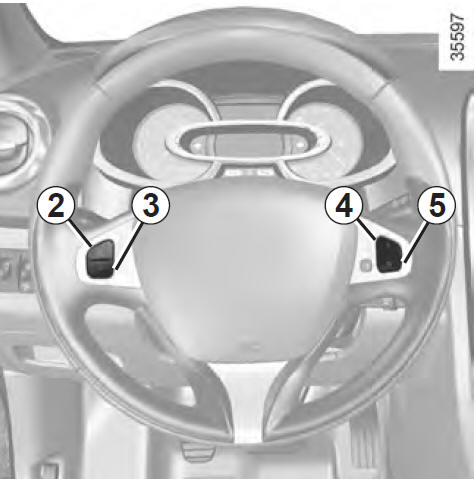
Controls
- Main ON/OFF switch.
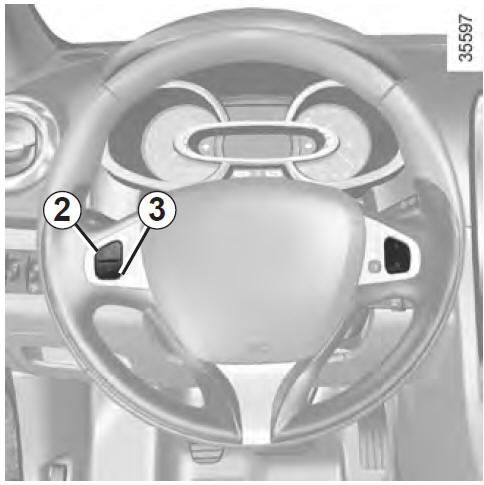
- Activation, memorising and incremental increase of the set speed (+).
- Decremental change of the set speed (-).
- Activation with recall of the memorised set speed (R).
- Standby of the function (with memorising of the set speed) (O).
Activation
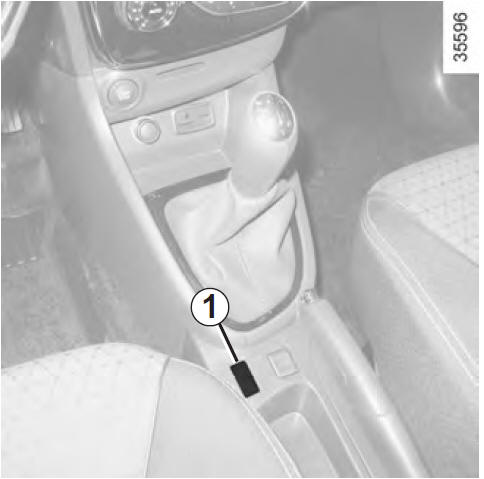
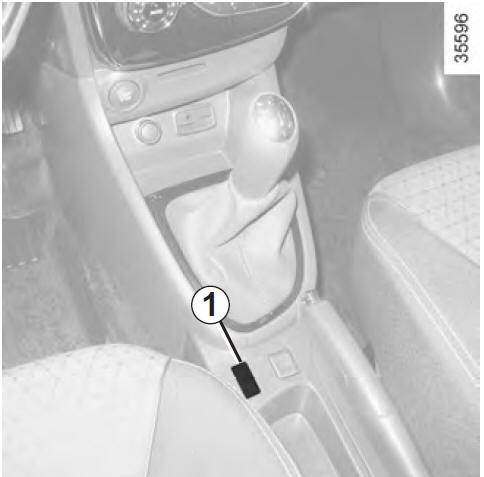
Press switch 1 on the side .
Indicator 6 lights up green and the message “CRUISE” appears on the instrument panel, with dashes to show that the cruise control function is on and waiting for a set speed to be stored.

Engaging cruise control
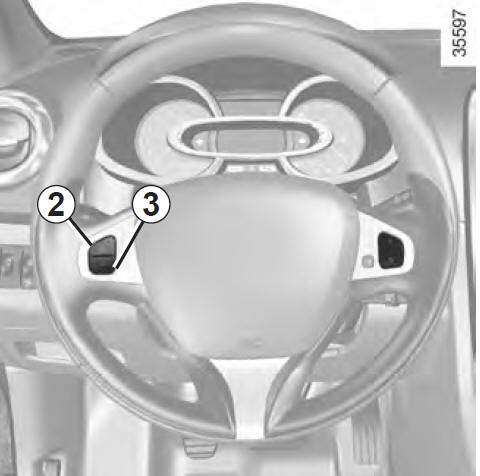
At a stabilised speed (above approximately 30 km/h), press switch 2 (+): the function is activated and the current speed is memorised.
The set speed replaces the dashes, and cruise control is confirmed by indicator 7 lighting up green in addition to indicator 6.
Driving
When a set speed is memorised and cruise control is activated, your foot can be removed from the accelerator pedal.
 Warning,
however, it is advisable to keep your feet close to the pedals so that you are ready to act in an emergency.
Changing the set speed
You can change the cruise control speed by repeatedly pressing:
- switch 2 (+) to increase the speed,
- switch 3 (-) to decrease the speed.
 The
cruise control function does not act on the braking system under any circumstances.
Exceeding the cruise control speed
You can exceed the cruise control speed at any time by pressing the accelerator pedal. While the speed is exceeded, the cruise control speed flashes on the instrument panel.
Then release the accelerator pedal: after a few seconds, the vehicle automatically resumes the original cruise control speed.
Cruise control unable to maintain the speed
On a steep downhill, the system cannot maintain the cruise control speed: the stored speed flashes on the instrument panel to warn you.

Standby of the function
The function is placed on standby when you operate:
- switch 5 (O);
- the brake pedal;
- the clutch pedal, or selecting neutral on vehicles with automatic transmission.
In all three cases, the cruise control speed remains stored and the message “in memory” appears on the instrument panel.
Standby is confirmed by the indicator light going off. .
Resuming the cruise control speed
If a speed is stored, it can be resumed after making sure that traffic conditions are suitable (traffic, road surface, weather conditions…).
Press switch 4 (R) if the vehicle speed is above 30 km/h.
When resuming the stored speed, activation of the cruise control is confirmed by the indicator light coming on .
Note: if the previously stored speed is much higher than the current speed, the vehicle will accelerate strongly until it reaches that speed.
When the cruise control function is on standby, pressing switch 2 (+) reactivates the cruise control function without taking the memorised speed into account: the speed at which the vehicle is currently travelling is used instead.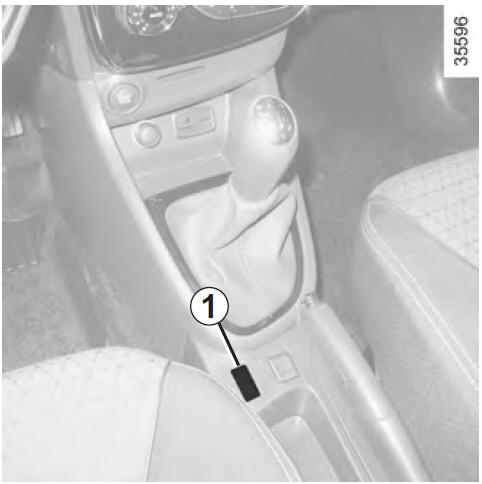
Switching off the function
The cruise control function is cancelled when you operate switch 1. In this case, no speed is stored. The green indicator lights going off and
 on the instrument panel confirm that the function has stopped.
 Putting cruise control on standby or switching it off does not cause a rapid reduction in speed: you must brake by pressing the brake pedal.
Test yourself
A quick Renault Clio quiz: every answer comes with an explanation and a link to the manual page.