Parking assistance
Operating principle
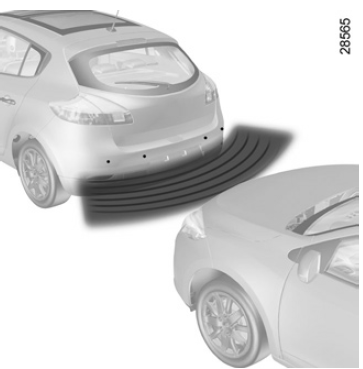
Ultrasonic sensors, fitted (depending on vehicle) in the rear and/or front bumper of the vehicle, "measure" the distance between the vehicle and an obstacle.
This produces beeps whose frequency increases as the obstacle gets closer, until they become a continuous tone when the obstacle is approximately 25 centimetres from the vehicle.
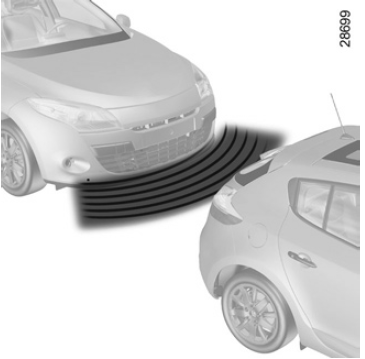
 This function is an additional aid that indicates, by audible signals, the distance between the vehicle and an obstacle when reversing.
It can therefore in no way replace the driver's attention or responsibility when reversing.
The driver must always be alert to sudden events that may occur while driving: always make sure there are no moving obstacles (such as a child, an animal, a stroller, a bicycle...) or obstacles that are too small or too thin (medium-sized stone, very thin post...) when maneuvering.
Front parking aid (depending on vehicle)
Operation
The parking aid system is only activated when the vehicle is travelling at a speed below approximately 10 km/h.
Most objects within approximately 60 centimetres of the front of the vehicle are detected and a beep sounds.
Automatic activation/deactivation of front parking assist
The system deactivates:
- when the assisted parking brake is applied;
- when the vehicle speed is above approximately 10 km/h;
- when the vehicle has been stationary for approximately five seconds or more and an obstacle is detected (for example, in a traffic jam...);
- when you are in neutral or in positions N and P with an automatic gearbox.
Rear parking assist
Operation
When reverse gear is selected, most objects within approximately 1.50 metres of the rear of the vehicle are detected and a beep sounds.
If an obstacle is present at both the front and the rear of the vehicle, only the closest one is taken into account and its corresponding beep sounds.
If an obstacle is detected at both the front and the rear within a detection zone of less than 30 centimetres, front and rear beeps will sound alternately.
 If the underbody of the vehicle is struck during a maneuver (e.g. contact with a bollard, a raised curb or any other street furniture), you may damage the vehicle (e.g. deformation of an axle).
To avoid any risk of an accident, have your vehicle checked by a Brand Representative.
Automatic activation/deactivation of rear parking assist
The system deactivates:
- when the assisted parking brake is applied;
- when the vehicle speed is above approximately 10 km/h;
- when the vehicle has been stationary for approximately five seconds or more and an obstacle is detected (for example, in a traffic jam...);
- when you are in neutral or in positions N and P with an automatic gearbox.
Adjusting the parking assist volume
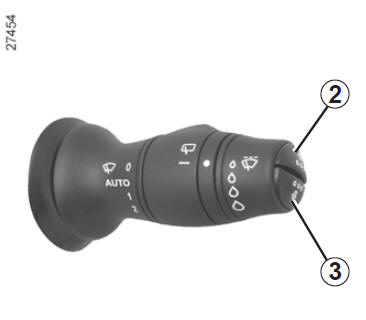
From the vehicle settings personalisation menu (refer to the "Vehicle settings personalisation menu" section in chapter 1), select the "parking assist volume" line to adjust the volume of the parking assist and confirm by pressing button 2 or 3.
Temporary deactivation of the system (depending on vehicle)
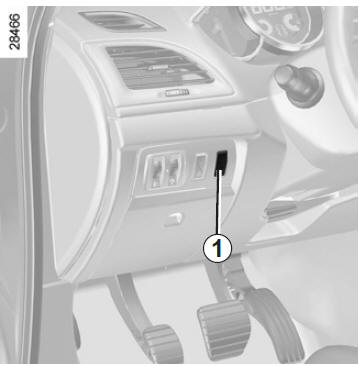
Press switch 1 to deactivate the system.
The message "Parking assist deactivated" is displayed to remind you that the system is switched off.
Press again to reactivate the system; the indicator light goes out.
The system reactivates automatically each time the engine is switched off.
Permanent deactivation of the system
You can deactivate the front or rear parking aid separately on a permanent basis.
From the vehicle settings personalisation menu (refer to the "Vehicle personalisation menu" section in chapter 1), select the "front parking assist" or "rear parking assist" line, then activate or deactivate the system:
 function deactivated;
 function activated.
Special notes
Make sure the ultrasonic sensors are not obstructed (dirt, mud, snow...).
Malfunction
If the system detects a malfunction, a beep sounds for approximately 5 seconds to warn you. Consult a brand representative.
When the vehicle is travelling below approximately 10 km/h, certain noise sources (motorcycle, truck, jackhammer, etc.) may trigger beeps.Test yourself
A quick Renault Megane quiz: every answer comes with an explanation and a link to the manual page.