Engine Mechanical System
Coolant Repair Procedures
In this manual: Engine Mechanical System
17steps
~102min
4/5difficulty
Done 0 of 17
Coolant Replacement and Air Bleeding
|
|
- Make sure the engine and radiator are cold to the touch.
- Remove the radiator cap (A).
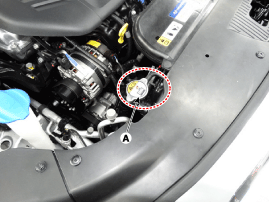
- Remove the under cover.
- Loosen the drain plug (A) and drain the coolant.

- Tighten the radiator drain plug securely.
- After draining the engine coolant, clean the reservoir tank.
- Fill the radiator with water through the radiator cap and tighten the cap.
For the most effective air bleeding, slowly fill with water and squeeze the upper/lower radiator hoses.
- Start the engine and let it reach normal operating temperature. Wait until the cooling fan operates several times. Increase engine speed to help purge trapped air. Stop the engine.
- Wait until the engine has cooled down.
- Repeat steps 1 through 8 until the drained water is clean.
- Fill the mixture of coolant and water (55~60%) (except for North America, Europe and China: 45~50%) slowly through the radiator cap. Squeeze the upper/lower radiator hoses to easily bleed the air.
- Use only genuine antifreeze/coolant.
- For best corrosion protection, the coolant concentration should be maintained year-round at a minimum of 55% (except North America, Europe and China: 45%). Coolant concentrations below 55% (except North America, Europe and China: 45%) may not provide sufficient corrosion or freeze protection.
- Coolant concentration above 60% reduces cooling efficiency and is not recommended.

- Do not mix antifreezes/coolants of different brands.
- Do not use additional rust inhibitors or anti-corrosion products; they may be incompatible with the coolant.
- Start the engine and let it run until the coolant begins to circulate. When the cooling fan operates and coolant circulates, add coolant through the radiator cap.
- Repeat step 11 until the cooling fan has switched on 3~5 times and sufficient air has been bled from the cooling system.
- Install the radiator cap and fill the coolant reservoir to the "MAX" (or "F") mark.
- Run the vehicle at idle until the cooling fan has cycled 2–3 times.
- Stop the engine and wait for the coolant to cool down.
- Repeat steps 10-15 until the coolant level stops dropping, bleeding air from the cooling system.
Coolant capacity: 7.1 L (1.87 US gal, 7.50 US qt, 6.24 L qt)
It takes time to bleed all air from the cooling system. Add coolant when the engine is completely cool. Recheck the coolant level in the reservoir tank 2-3 days after coolant replacement.
Test yourself
A quick Hyundai Sonata LF quiz: every answer comes with an explanation and a link to the manual page.
Was this page helpful?