Body Electrical System
Power Window Switch Description and Operation
In this manual: Body Electrical System
54steps
~324min
4/5difficulty
Done 0 of 54
Description
System Diagram

Driver Door Module (DDM)
The Driver Door Module (DDM) is part of the CAN configuration; it communicates with the BCM, SMK, SJB, PSM and ADM via CAN, and handles wired signal inputs/outputs for the power windows. Operate the DDM buttons located on the inside of the driver door to perform any functions related to the power windows, power mirrors and door lock/unlock. Its main functions are as follows:- Controls the up/down operation of the 4 power windows, respectively.
- Locks/unlocks the central door.
- Controls folding/unfolding of the outside mirrors.
- Controls the outside mirror (up/down and right/left).
- Automatically lowers the outside mirror when reversing (Auto Reverse).
- Stores and recalls the mirror position using the memory switch.
- Controls the interior lamp.
- Manual up/down and automatic up/down operation for the power windows from the driver's seat.
A. Driver's seat: Signals are output via hard wire in response to inputs from the rear door window up/down switches at the driver's seat. Passenger seat: CAN messages are sent to the ADM based on signals from the passenger seat window manual and automatic up/down switches and the passenger seat rear door window up/down switches. B. Driver Side Safety Specification: Manual and automatic up/down signals are output to the driver's seat window safety module in response to the driver's seat window up/down switches. C. Front Passenger Safety Specification: Manual and automatic up/down signals are output to the window safety module in response to the passenger seat window up/down switches. - Window Lock
A. When the power window lock is on, a window lock signal is sent to lock the movement of the passenger seat and rear seat windows. - Timer
A. When the ignition is switched from ON to OFF, the power windows operate for 30 seconds after receiving an operation command from the BCM. 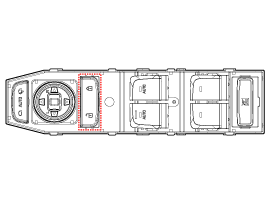
- A corresponding signal is sent to the BCM by the power door lock/unlock switches at the driver's seat. The BCM locks or unlocks the door based on the received switch signals.

- Using the DDM fold switch, the DDM sends folding, unfolding or automatic mode information to the BCM. The BCM will fold, unfold or automatically operate the mirror based on the received switch signals.

- Driver Seat Outside Mirror Manual Operation
A. With ACC or IGN on and the mirror selector switch set to the driver's seat, the mirror control switch (up/down and right/left) on the DDM at the driver's seat activates the mirror drive in the selected direction. - Passenger Seat Outside Mirror Manual Operation
A. With ACC or IGN on and the mirror selector switch set to the passenger seat, the mirror control switch (up/down and right/left) on the DDM at the passenger seat sends an operation signal to the passenger seat power window switch module (ADM) via the CAN bus. The ADM activates the passenger mirror drive in the selected direction.
| No | Power | Selector Switch | Current Shift Lever Position | Outside Mirror | Operating Condition | Operation Details | |
| Left | Right | ||||||
| 1 | ON | Driver seat | Shift Lever in Any Position Other Than R | Position | B Position | Move the shift lever to the R position. | Mirror (Left): Output to lower the mirror to position A (Auto Reverse) Mirror (Right): Output to lower the mirror to position B (Auto Reverse) |
| 2 | ON | Passenger Side | Shift Lever in Any Position Other Than R | Position | B Position | Move the shift lever to the R position. | Mirror (Left): Output to lower the mirror to position A (Auto Reverse) Mirror (Right): Output to lower the mirror to position B (Auto Reverse) |
| 3 | ON | Neutral | Shift Lever in Any Position Other Than R | Position | B Position | Move the shift lever to the R position. | Mirror (Left): No change Mirror (Right): No change |
| 4 | ON | Driver seat | R Position | After performing Function 1 | Move the shift lever from the R position to another shift position. | Mirror (Left): Return to position A Mirror (Right): Return to position B |
|
| 5 | ON | Passenger Side | R Position | After performing Function 2 | Move the shift lever from the R position to another shift position. | Mirror (Left): Return to position A Mirror (Right): Return to position B |
|
- With the engine running, the mirror selector switch set to the driver's seat, and the shift lever in R (reverse), the driver's and passenger's side mirrors lower by 5 degrees.
- With the engine running, the mirror selector switch set to the passenger seat, and the shift lever in R (reverse), the driver's and passenger's side mirrors lower by 5 degrees.
- With the mirrors lowered by 5 degrees, moving the shift lever from R to another position returns the mirror to its original position.
- With the mirrors lowered by 5 degrees, turning the engine off returns the mirrors to their original position.
- Description of the System
A. IMS switch input signals are received by the Power Seat Module (PSM). B. After receiving input from the IMS switch, the PSM sends information to the DDM and ADM through the CAN communication line. C. After receiving information from the PSM, the DDM and ADM store and recall it. - 2. The memory storage and recall operation is performed when the following conditions are met:
A. ON B. Transmission selected in P (Park) C. Vehicle speed is "0 km/h" based on information transmitted from the BCM via the CAN bus. - Save Mirror Position
A. Move the driver and passenger side mirrors to the desired position. B. Press the SET switch on the IMS switches. C. Press switch 1 or 2 within the specified time. D. Mirror positions are stored in IMS switches 1 or 2 for the DDM and ADM. - The BCM receives the status of the multifunction switch (MFSW) light. The BCM sends an interior lighting ON command to the DDM over the CAN bus communication, only if the light switch is not in the OFF position. Upon receiving the interior lighting ON command, the DDM outputs an interior light signal.
Auxiliary Door Module (ADM)
The Assist Door Module (ADM) is part of the CAN configuration. It communicates with the BCM, SMK, SJB, PSM and DDM via CAN and, during operation, uses hard-wired inputs/outputs to control the power windows and window motors safely. Its main functions are as follows:- Controls the up/down operation of the front passenger power window.
- The driver can control the passenger side outside mirror.
- Controls the auto-reverse function of the passenger side outside rearview mirror.
- Stores and recalls the passenger side mirror position using the memory switch.
- Controls the interior lamp.

- Manual and automatic up/down operation for the passenger side power windows
A. The ADM receives the CAN message sent by the DDM to control the passenger window glass. B. Driver safety specification: The passenger window has up/down function only, without any safety function. C. Front safety specification: Manual and automatic up/down signals are output to the safety window module in accordance with the passenger window up/down switches. - Window Lock
A. Upon receiving the power window lock ON signal from the DDM via CAN communication, the ADM disables operation of the passenger seat and rear window on the front passenger side. - Timer
A. When the ignition is switched from ON to OFF, the power windows operate for 30 seconds after receiving an operation command from the BCM. - With ACC or IGN on and the mirror select switch set to the passenger seat, the mirror direction switch (up/down and left/right) on the DDM driver seat transmits the movement signal to the passenger window regulator (ADM) via CAN bus. The ADM activates the passenger mirror motor in the selected direction.
- With the engine running, set the DDM mirror select switch to the driver seat and select R (reverse). The DDM transmits a 5-degree mirror down message to the ADM via CAN communication. Upon receiving the CAN message, the ADM lowers the passenger side mirror accordingly.
- With the engine running, set the DDM mirror select switch to the passenger seat and select R (reverse). The DDM transmits a 5-degree mirror down message to the ADM via CAN communication. Upon receiving the CAN message, the ADM lowers the passenger side mirror accordingly.
- With the mirrors lowered by 5 degrees, moving the shift lever from R to another position returns the mirror to its original position.
- With the mirrors lowered by 5 degrees, turning the engine off returns the mirrors to their original position.
- Description of the System
A. IMS switch input signals are received by the Power Seat Module (PSM). B. After receiving input from the IMS switch, the PSM sends information to the DDM and ADM through the CAN communication line. C. After receiving information from the PSM, the DDM and ADM store and recall it. - The memory and recall operations are performed if the following conditions are met:
A. ON B. Transmission selected in P (Park) C. Vehicle speed is "0 km/h" based on information transmitted from the BCM via the CAN bus. - Save Mirror Position
A. Move the driver and passenger side mirrors to the desired position. B. Press the SET switch on the IMS switches. C. Press switch 1 or 2 within the specified time. D. Mirror positions are stored in IMS switches 1 or 2 for the DDM and ADM. - The BCM receives the status of the multifunction switch (MFSW) light. The BCM sends an interior lighting ON command to the DDM over the CAN bus communication, only if the light switch is not in the OFF position. Upon receiving the interior lighting ON command, the DDM outputs an interior light signal.
Driver seat power window switch
Driver Seat Window Switch inputs and outputs: signals to/from the power window safety module and window motor are hard-wired. Window, mirror and door lock/unlock functions on the passenger seat can be controlled by the driver's seat window switches. The front passenger can operate the passenger window.- Controls the up/down operation of the four power windows respectively.
- Locks/unlocks the central door.
- Controls folding/unfolding of the outside mirrors.
- Controls the outside mirror (up/down and right/left).
- Controls the interior lamp.
- Manual up/down and automatic up/down operation for the power windows from the driver's seat.
A. Controls the manual up/down switch of the passenger window, the automatic up/down switch, and the right/left rear seat door window up/down switch. B. Driver safety specification: Manual and automatic up/down signals are output to the driver window safety module in accordance with the driver window up/down switches. C. Front safety specification: Manual and automatic up/down signals are output to the safety window module in accordance with the passenger window up/down switches. - Window Lock
A. When the power window lock is on, a window lock signal is sent to lock the movement of the passenger seat and rear seat windows. - Timer
A. When the ignition is switched from ON to OFF, the power windows operate for 30 seconds after receiving an operation command from the BCM. - The corresponding status is output to the Smart Junction Block (SJB) through the driver seat power window door lock/unlock switches. Upon receiving the switch input, the SJB locks or unlocks the central door depending on the switch status.
- Driver Seat Outside Mirror Manual Operation
A. With ACC or IGN on and the mirror select switch set to the driver seat, the mirror direction switch (up/down and left/right) on the driver power window switch, located on the driver seat, activates the driver mirror motor in the selected direction. - Passenger Seat Outside Mirror Manual Operation
A. With ACC or IGN on and the mirror select switch set to the passenger seat, the mirror direction switch (up/down and left/right) on the passenger power window switch, located on the driver seat, activates the passenger mirror motor in the selected direction. - Using the Fold switch, the power window switch transmits the fold, unfold, or automatic status to the BCM. The BCM folds, unfolds, or automatically controls the mirror based on the received switch signals.
- The BCM receives the status of the multifunction switch (MFSW) light. The BCM sends an interior lighting ON command to the Smart Junction Block (SJB) over the CAN bus, only if the light switch status is OFF, and the SJB outputs a signal to turn on the light inside the power window switch.
Passenger seat power window switch
Power Window Operation- Manual up/down and automatic up/down operation for the passenger side power windows
A. Controls the manual up/down switch of the passenger window, the automatic up/down switch, and the right/left rear seat door window up/down switch. B. Driver safety specification: The passenger window has up/down function only, without any safety function. C. Front safety specification: Manual and automatic up/down signals are output to the safety window module in accordance with the passenger window up/down switches. - Timer
A. When the ignition is switched from ON to OFF, the power windows operate for 30 seconds after receiving an operation command from the BCM.
Test yourself
A quick Hyundai Sonata LF quiz: every answer comes with an explanation and a link to the manual page.
Was this page helpful?