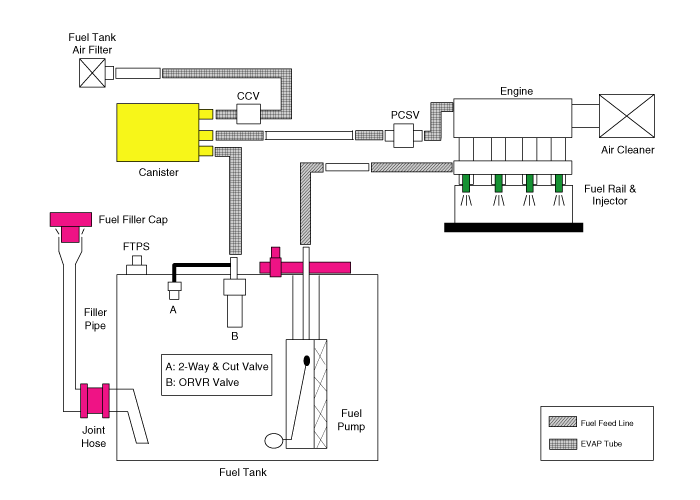
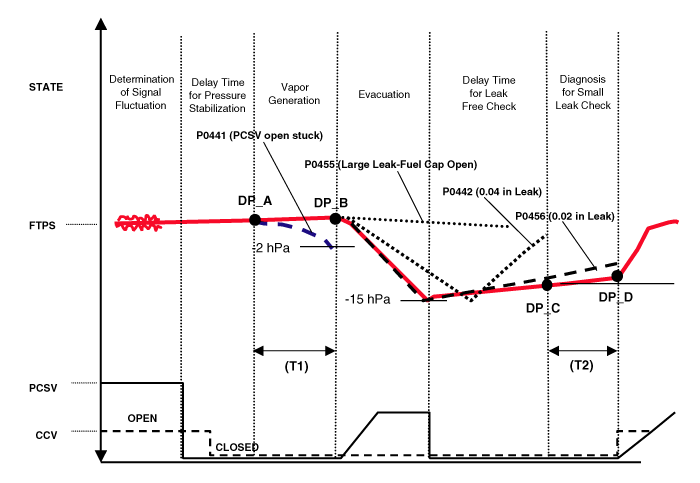
The canister is filled with activated charcoal and absorbs fuel vapor evaporating from the fuel tank. The collected fuel vapor in the canister is drawn into the intake manifold by the ECM/PCM when conditions are met. The Purge Control Solenoid Valve (PCSV) is installed in the passage connecting the canister to the intake manifold. It is a duty-type solenoid valve and is controlled by a signal from the ECM/PCM. To draw the absorbed vapor into the intake manifold, the ECM/PCM opens the PCSV; otherwise, the passage remains closed. Fuel Filler Cap. The ratchet tightening device in the fuel filler cap reduces the possibility of improper installation when sealing the fuel filler neck. After the gasket on the fuel filler cap and the filler neck flange make contact, the ratchet clicks audibly, indicating the cap is installed and sealed. Fuel Tank Pressure Sensor (FTPS). The Fuel Tank Pressure Sensor (FTPS) is an integral part of the monitoring system. The FTPS checks the Purge Control Solenoid Valve (PCSV) and leaks in the EVAP system. It monitors fuel tank pressure and vacuum level during PCSV operating cycles. Canister Close Valve (CCV). The Canister Close Valve (CCV) is located between the canister and the fuel tank air filter. It closes the air inlet to the canister for the EVAP system and prevents fuel vapor from escaping from the canister when the vehicle is not operating. EVAP System Monitoring. The EVAP monitor checks for vapor generation, vacuum, and leak check phases. First, the OBD-II system checks whether vapor generation due to fuel temperature is small enough to start monitoring. Then it evacuates the EVAP system through the PCSV with a ramp to maintain a specified vacuum level. The final step is to check that there is no loss of vacuum due to any leak in the system. Vapor Generation Check. During the stabilization period, the PCSV and CCV are closed. The system pressure is measured as the initial pressure (DP_A). After a specified period (T1), the system pressure (DP_B) is measured again, and the difference from the initial pressure is calculated. If this difference (DP_B - DP_A) is greater than the threshold value, the vapor pressure must be excessive, and the monitor is aborted for the next check. Conversely, if the difference is less than the negative threshold, the PCSV is considered faulty, for example, stuck open. Large Leak Detection. The EVAP PCSV opens with a specified ramp to reduce pressure. If pressure cannot be reduced below the threshold value, the system is considered to have an open fuel filler cap or a large leak. Leak Check. The PCSV closes, and the system waits for a period of time to obtain stabilized pressure. During the check period (T2), the system measures the start and end pressure in the system (DP_C, DP_D). The diagnostic value is the pressure difference corrected by the natural vapor generation level (DP_B - DP_A) from the vapor generation check step. EVAP System MonitoringThe evaporative system and ORVR (Onboard Refueling Vapor Recovery) emission control system consist of a fill valve, fuel cut-off valve, roll-over valve, two-way valve (pressure/vacuum relief), fuel liquid/vapor separator installed near the filler neck, charcoal canister installed under the rear floor on the left side member and protector, hoses, and various connections. During refueling, ambient air is drawn into the filler neck, so fuel vapor is not released into the air. Fuel vapor in the tank is then forced into the canister through the vent valve. The fuel liquid/vapor separator isolates liquid fuel and passes clean vapor to the charcoal canister. While the engine is running, vapor stored in the canister is drawn into the intake manifold and then into the combustion chamber. Through this purge process, the charcoal canister is cleaned and restores its absorption capacity.
1. Fuel Tank Cap 2. Filler Neck 3. Fuel Cut-Off Valve 4. Fuel Tank 5. ORVR Valve 6. 2-Way and Roll-Over Valve 7. Evaporative Hose
8. Evaporative Hose 9. Charcoal Canister 10. Canister Close Valve (CCV) 11. Fuel Feed Line 12. Fuel Tank Pressure Sensor (FTPS) 13. Purge Control Solenoid Valve (PCSV)
?
Test yourself
A quick Hyundai Sonata LF quiz: every answer comes with an explanation and a link to the manual page.