PCS (Pre-Collision System)
The Pre-Collision System uses the front sensor to detect vehicles ahead of your vehicle. If the system detects a high possibility of a frontal collision with a vehicle, the warning prompts the driver to take action to avoid it, and increases the brake pressure potential.
If the system detects an extremely high possibility of a frontal collision, the brakes will be applied automatically to avoid the collision or reduce the impact.
The Pre-Collision System can be turned off/on and the warning timing can be changed.
◆ Pre-Collision System warning
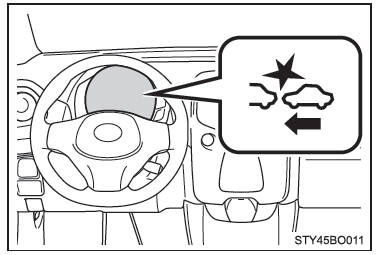
If the system detects a high possibility of a frontal collision, a buzzer sounds and the PCS indicator flashes to prompt the driver to take action.
◆ Pre-Collision braking assist
When a high risk of a frontal collision with a vehicle is detected, the system applies greater braking force in proportion to the pressure applied to the brake pedal.
◆ Pre-Collision braking
When the system detects a high possibility of a frontal collision with a vehicle, it warns the driver. If the system detects an extremely high possibility of a collision, the brakes will be applied automatically to avoid the collision or reduce the impact speed.
WARNING
■ Pre-Collision System limitations
- The driver always remains solely responsible for safe driving. Always drive in compliance with safety rules and pay attention to what is happening on the road.
Never use the pre-crash safety system in place of normal braking.
The system does not prevent collisions in any way, nor does it reduce damage or injuries caused by a collision. Do not rely excessively on the system. Failure to observe this may cause accidents resulting in serious or fatal injuries.
- Conditions in which the system may activate even if there is no risk of collision:
- Conditions in which the system may not operate correctly:
- Do not attempt to test the operation of the pre-crash safety system, as the system may not operate correctly, with the risk of causing an accident.
■ Pre-crash braking
- The pre-crash braking function may not activate if the driver performs certain operations. If the accelerator pedal is pressed forcefully, or if the steering wheel is operated, the system may determine that the driver is taking action to avoid a collision and may prevent the pre-crash braking function from activating.
- In certain situations, while the pre-crash braking function is operating, if the accelerator pedal is pressed forcefully, or if the steering wheel is operated, activation of the function may be cancelled, and the system will determine that the driver is taking action to avoid a collision.
- While the pre-crash braking function is operating, considerable braking force is applied. Also, since the pre-crash braking function deactivates after the vehicle has been stopped for approximately 2 seconds, if the vehicle comes to a stop while the function is active, the driver should press the brake pedal as necessary.
- If the brake pedal is being pressed, the system may determine that the driver is taking action to avoid a collision and delay activation of the pre-crash braking function.
- While driving, for example when crossing a railway crossing, the system may detect a high possibility of collision with an object, such as the barrier arms of a railway crossing, and activate the pre-crash braking function.
- If the vehicle has stopped, do not press the accelerator pedal.
- If the vehicle is decelerating, do not fully press the accelerator pedal.
- Turn off the pre-crash safety system.
■ When to turn off the pre-crash safety system In the following situations, it is advisable to turn off the system, as it may not operate correctly and cause an accident, resulting in serious or fatal injuries:
- When the vehicle is being towed
- When the vehicle is towing another vehicle
- When the vehicle is being transported by truck, ship, train or similar means of transport
- When the vehicle is raised, the engine is running and the tyres can rotate freely
- During a vehicle inspection using, for example, a brake drum tester, a chassis dynamometer or a speedometer tester, or when using a wheel balancer on the vehicle itself
- If the vehicle cannot proceed stably, for example in the event of an accident or malfunction
- When driving sportily or off-road
- When the tyre condition is poor and their performance is not optimal
- When tyres of a different size than specified are installed
- When snow chains are used
- When a temporary spare wheel or a tyre repair emergency kit is used in case of a puncture
Changing the pre-crash safety system settings
■ Activating/deactivating the pre-crash safety system Press and hold the PCS switch for at least 3 seconds.
When the system is deactivated, the PCS warning light comes on and a message appears on the multi-information display.
Press the PCS switch again to activate the system.
The pre-crash safety system is activated each time the engine is started.
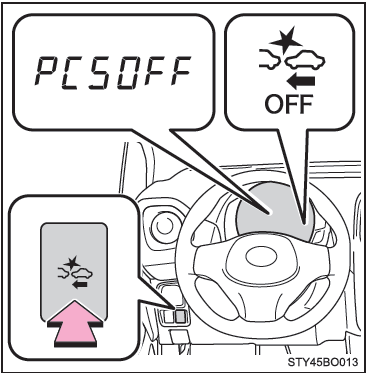
■ Changing the pre-crash warning timing Press the PCS switch to illuminate the PCS indicator and display the current collision warning timing on the multi-information display. Each time the PCS switch is pressed in the displayed state, the warning timing changes as described below. If the operating timing settings have been changed, they will be retained the next time the engine is started.
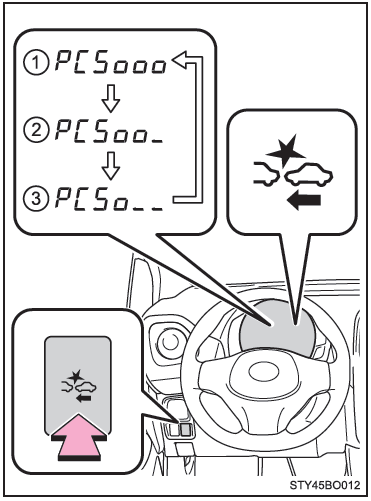
- Far
The warning will activate earlier than the default timing. - Medium
This is the default setting. - Near
The warning will activate later than the default timing.
■ Operating conditions The pre-crash safety system is turned on and detects a high possibility of a frontal collision with a vehicle.
Each function operates at the following speeds:
- Pre-crash safety system warning:
- The vehicle speed is approximately between 15 and 140 km/h.
- The relative speed between your vehicle and the vehicle ahead is approximately equal to or greater than 15 km/h.
- Pre-crash brake assist:
- The vehicle speed is approximately between 30 and 80 km/h.
- The relative speed between your vehicle and the vehicle ahead is approximately equal to or greater than 30 km/h.
- Pre-crash braking:
- The vehicle speed is approximately between 10 and 80 km/h.
- The relative speed between your vehicle and the vehicle ahead is approximately equal to or greater than 10 km/h.
The system may not operate in the following situations:
- If the battery terminal has been disconnected and reconnected and the vehicle has been left stationary for an extended period
- If the shift lever is in the R position
- If the VSC system is turned off (only the pre-collision warning function is operational)
■ Cancellation of the pre-collision braking function
- If any of the following situations occur while the pre-collision braking function is operating, the function will be cancelled:
- The accelerator pedal is pressed firmly.
- The steering wheel is turned fully or with a sudden movement.
- If the vehicle is brought to a stop while the pre-collision braking function is activated, the function will be deactivated approximately 2 seconds after the vehicle has stopped.
■ Conditions in which the system may activate even when there is no risk of collision
- In some situations, such as those listed below, the system may detect the possibility of a frontal collision and activate.
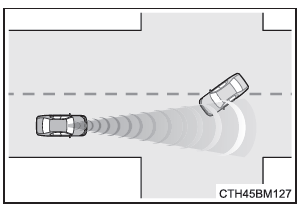
- When passing a vehicle in the oncoming lane while it is stopped to make a right or left turn
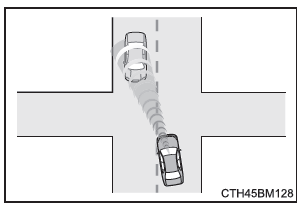
- When passing an oncoming vehicle on a right or left curve
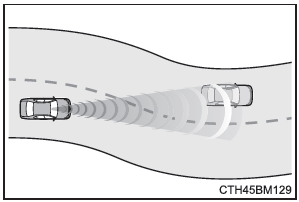
- When driving on a road where the relative position with respect to a vehicle ahead in a parallel lane may change, such as on a winding road
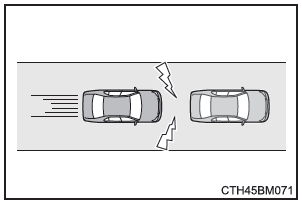
- When approaching a vehicle ahead too quickly
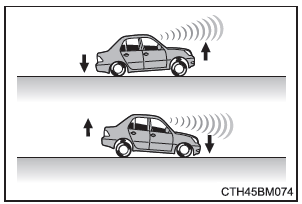
- When the front of the vehicle is raised or lowered, for example when the road surface is uneven or undulating
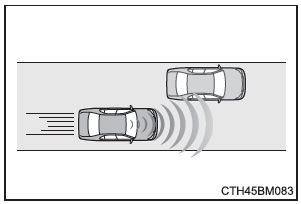
- When passing too close to a vehicle or a structural object
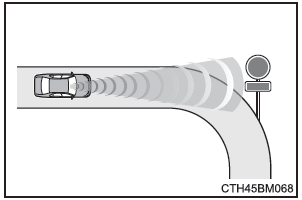
- When there is a vehicle or an object at the roadside at the entry point of a curve
- When driving along a narrow route surrounded by structures, such as a tunnel or an steel bridge
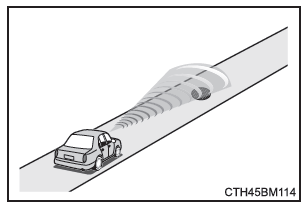
- When there are reflective objects (manhole covers, steel plates, etc.), irregularities, depressions or protrusions on the road surface or at the roadside
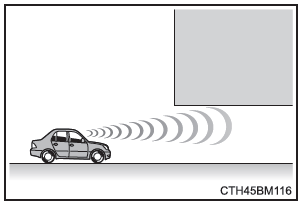
- When passing through an area with a low structure above the road (low ceiling, road sign, etc.)
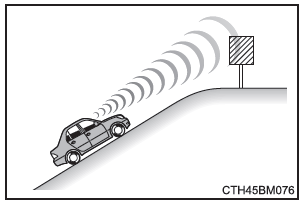
- When there is a structural object (overpass, road sign, billboard, traffic light, etc.) at the top of an uphill road
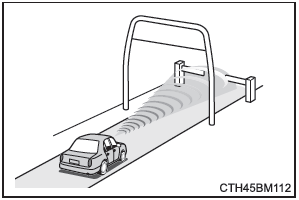
- When approaching an electronic toll gate, an automatic parking barrier, or other barriers that open and close too quickly
- When taking the vehicle through an automatic car wash
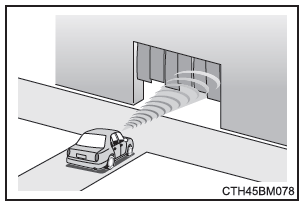
- Near a suspended object that may touch the vehicle, such as a sign, tree branches or tall grass
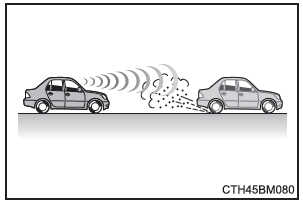
- When the vehicle is hit by water, snow, dust, etc. thrown up by a vehicle ahead
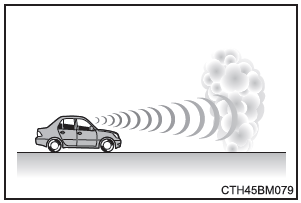
- When driving in steam or smoke
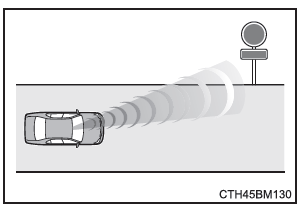
- When road markings or vertical signs could be mistaken for a vehicle
- When the front of the vehicle is raised or lowered
- When the sensor is misaligned due to a strong impact against the sensor, etc.
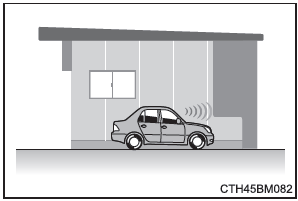
- When parking the vehicle in a location where a suspended object reaches the height of the front sensor
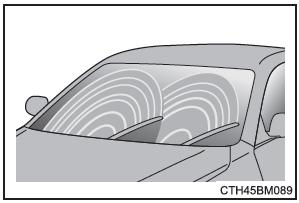
- When the windshield is covered with raindrops, etc.
■ Situations in which the system may not operate correctly
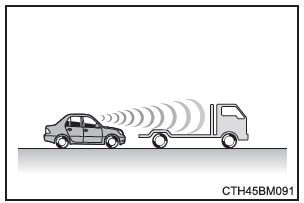
- In some situations, such as those described below, the front sensor may not detect the vehicle, preventing the system from operating correctly:
- When a vehicle approaching from the opposite direction is coming toward your vehicle
- When approaching a vehicle from the side or from the front
- When the vehicle ahead has a small rear section, such as an unladen truck
- When the vehicle ahead has a low rear section, such as a low-bed trailer
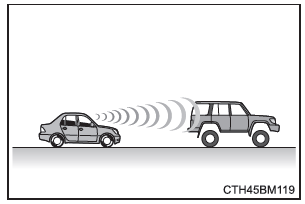
- When the vehicle ahead is carrying a load that protrudes beyond its rear bumper
- When the vehicle ahead is extremely high above the ground
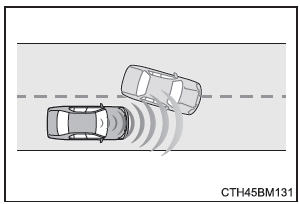
- When the vehicle ahead has an irregular shape, such as a tractor or sidecar
- When the sun or other lights are shining directly onto the vehicle ahead
- When another vehicle cuts in ahead of or beside the vehicle you are driving
- When the vehicle ahead performs a sudden maneuver (e.g. sharp steering, sudden acceleration or deceleration)
- When cutting in suddenly behind the vehicle ahead
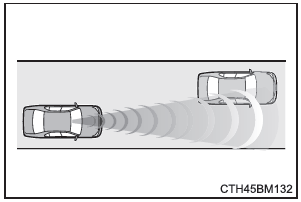
- When a vehicle ahead is not directly in front of your vehicle
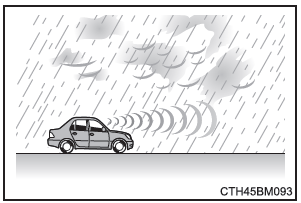
- When driving in adverse weather conditions, such as heavy rain, fog, snow or sandstorms
- When the vehicle is hit by water, snow, dust, etc. thrown up by a vehicle ahead
- When driving in steam or smoke that may reduce visibility of the vehicles ahead
- When driving in an area with sudden changes in brightness, such as entering or exiting a tunnel
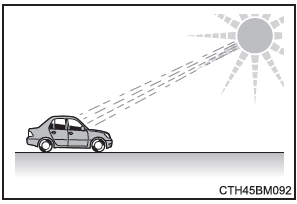
- When very strong light, such as sunlight or the headlights of oncoming traffic, shines directly onto the front sensor
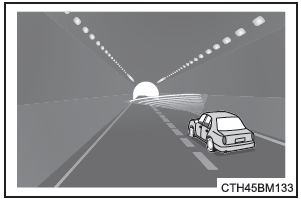
- When the surrounding area is poorly lit, for example at dawn or dusk, at night or in a tunnel
- When negotiating a curve, or for a certain period after negotiating a curve
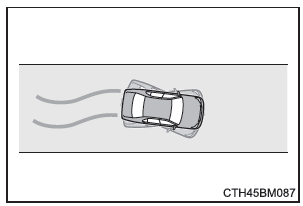
- When your vehicle skids
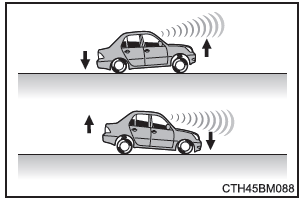
- When the front of the vehicle is raised or lowered
- If the wheels are misaligned
- If a windshield wiper blocks the operation of the front sensor
- The vehicle is moving erratically.
- The vehicle is travelling at extremely high speed.
- When driving on roads with sharp curves or uneven surfaces
- When the vehicle ahead reflects the laser weakly
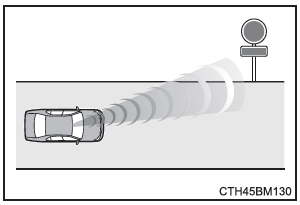
- When the sensor is misaligned due to a strong impact against the sensor, etc.
- In situations such as the one described below, it may not be possible to obtain sufficient braking force, which prevents the system from operating correctly:
- If the braking functions cannot be performed correctly, for example if the brake components are excessively cold, hot or wet
- If the vehicle has not been subjected to regular maintenance (brakes or tyres excessively worn, incorrect tyre inflation pressure, etc.)
- When the vehicle is driven on gravel or slippery roads
■ If the PCS warning light flashes or comes on The Pre-Collision System may be temporarily unavailable or may be malfunctioning.
- In the following situations, the warning light will turn off and the system will become operational once the operating conditions are restored:
- When the area around the front sensor has reached a high temperature, for example after the vehicle has been parked in the sun
- When the windshield is fogged up or covered with condensation or ice
- If the area in front of the front sensor is obstructed, for example when the hood is open
- When the front sensor or the area around the sensors is cold, for example in extremely cold conditions
- If the PCS warning light continues to flash or remains on, the system may be malfunctioning. Have the vehicle inspected immediately by any Toyota dealer or repair shop, or another suitably qualified and equipped professional.
■ If the VSC system is turned off
- If TRC and VSC are turned off, the Pre-Collision Braking Assist and Pre-Collision Braking are also disabled. However, the Pre-Collision Warning function is still operational.
- The PCS warning light comes on.
Test yourself
A quick Toyota Aygo quiz: every answer comes with an explanation and a link to the manual page.