Toyota Safety Sense
Toyota Safety Sense consists of the following two driving assist systems and contributes to safe and comfortable driving:
◆ PCS (Pre-Collision System)
◆ LDA (Lane Departure Alert)
WARNING
■ Toyota Safety Sense Toyota Safety Sense is designed to reduce the impact on occupants and the vehicle in the event of a collision, or to assist the driver under normal driving conditions, provided the driver adopts a safe driving style.
Since the level of accuracy of the detection and control functions is limited, do not rely excessively on the system. The driver must always pay attention to the surrounding environment and drive safely at all times.
Vehicle data recording
The Pre-Collision System is equipped with a sophisticated computer that records certain data, such as:
- Accelerator status
- Brake status
- Vehicle speed
- Operating status of the Pre-Collision System functions
- Information (such as the distance and relative speed between your vehicle and the vehicle ahead or other objects)
Use of data Toyota may use the data recorded by this computer to diagnose malfunctions and to conduct research and development aimed at improving its vehicles.
Toyota will not disclose the recorded data to third parties except in the following cases:
- With the consent of the vehicle owner, or the lessee in the case of a leased vehicle
- In response to an official request from the police, a court or a government agency
- For use by Toyota in legal proceedings
- For research purposes, where the data is not linked to a specific vehicle or owner
Front sensor
The front sensor is located on the upper side of the windshield.
It consists of two types of sensor, each of which detects the information needed to operate the driving assist systems.
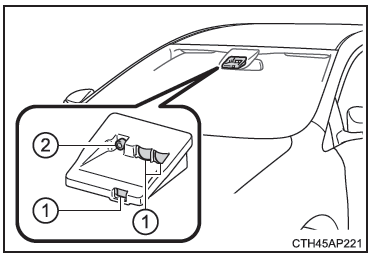
- Laser sensors
- Monocular camera sensor
WARNING
■ Front sensor The front sensor uses lasers to detect vehicles ahead. The front sensor is classified as a Class 1M laser product under the IEC 60825-1 standard. Under normal use, these lasers are not hazardous to the naked eye. However, the following precautions must be observed.
Failure to observe these precautions could cause loss of sight or serious eye injury.
- To avoid exposure to hazardous laser radiation, never attempt to disassemble the front sensor (for example, by removing the lenses). When disassembled, the front sensor is classified as a Class 3B laser product under the IEC 60825-1 standard. Class 3B lasers are hazardous and present a risk of eye injury if the beam is directly viewed.
- Do not attempt to look inside the front sensor using a magnifying glass, microscope or other optical instrument from a distance of less than 100 mm.
Laser classification label
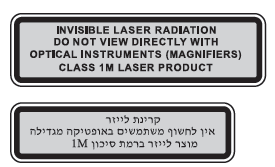
Laser explanation label
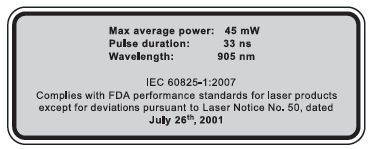
Laser emission data
Average maximum power: 45 mW
Pulse duration: 33 ns
Wavelength: 905 N·m
Divergence (horizontal x vertical): 28° x 12°
WARNING
■ How to prevent the front sensor from malfunctioning Observe the following precautions.
Otherwise, the front sensor may not operate correctly and may cause an accident, resulting in serious or fatal injury.
- Always keep the windshield clean. If the windshield is dirty or has oily particles, rain, snow, etc. adhering to it, clean it. If the inside of the windshield in front of the front sensor is dirty, for detailed information contact any Toyota authorized dealer or repairer, or another suitably qualified and equipped professional.
- Do not attach objects such as stickers, even transparent ones, etc. to the outside of the windshield in front of the front sensor (shaded area in the illustration).
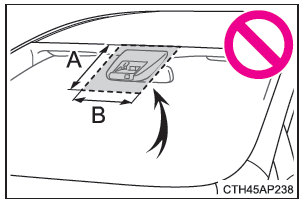
- From the top of the windshield to approximately 10 cm below the lowest point of the front sensor
- Approximately 20 cm (approximately 10 cm to the right and left of the center point of the front sensor)
- Do not install or attach objects to the inside of the windshield below the front sensor (shaded area in the illustration).
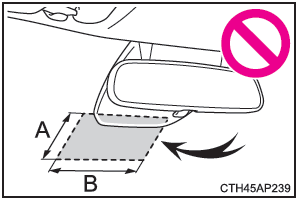
- Approximately 10 cm (from the lowest point of the front sensor)
- Approximately 20 cm (approximately 10 cm to the right and left of the center point of the front sensor)
- On winter days, when the difference between the cabin temperature and the outside air temperature is large, the windshield may fog up more easily. If the windshield in front of the front sensor is fogged up or covered with condensation or ice, the PCS warning light may come on and the system may temporarily stop functioning. In this case, use the windshield defroster to defog the windshield, etc.
- If water droplets collect on the area of the windshield in front of the front sensor, use the wiper blades to remove them.
Otherwise, the performance of the front sensor may be affected.
If the wiper inserts or blades need to be replaced, contact any Toyota authorized dealer or repairer, or another suitably qualified and equipped professional.
If the windshield needs to be replaced, contact any Toyota authorized dealer or repairer, or another suitably qualified and equipped professional.
When cleaning the inside of the windshield, take care that glass cleaner does not come into contact with the lens. Also, do not touch the lens.
If the lens is dirty or damaged, contact any authorized Toyota dealer or repairer, or another suitably qualified and equipped professional.■ Front sensor installation area on the windshield When the windshield fogs up easily, the glass around the front sensor may become very hot due to the operation of the heater.
Touching the glass may cause burns.
Test yourself
A quick Toyota Aygo quiz: every answer comes with an explanation and a link to the manual page.