If the vehicle battery is discharged
If the vehicle's battery is discharged, you can start the engine by following the procedure below.
You can also contact any authorized Toyota dealer or repairer, or another suitably qualified and equipped professional.
If you have a set of jumper (booster) cables and a second vehicle with a 12-volt battery, you can start your vehicle by following the procedure described below.
- Open the hood.
- Connect the jumper cables in the following order:
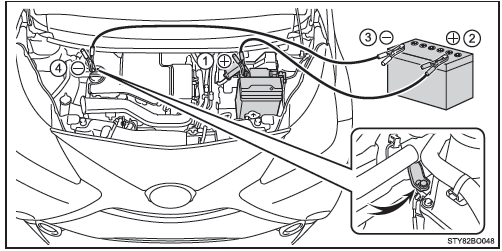
1KR Engine
HM01 engine
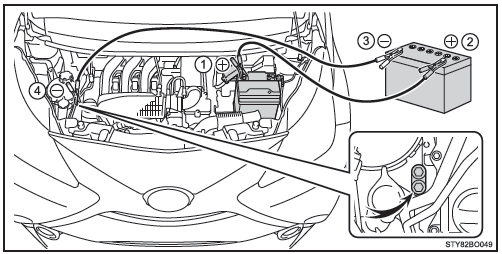
- Connect one positive jumper cable clamp to the positive (+) terminal of your vehicle's battery.
- Connect the clamp at the other end of the positive cable to the positive (+) terminal of the battery on the second vehicle.
- Connect one negative cable clamp to the negative (-) terminal of the battery on the second vehicle.
- Connect the clamp at the other end of the negative cable to a solid, fixed, unpainted metal point away from the battery and any moving parts, as shown in the illustration.
- Start the engine of the second vehicle. Slightly increase the engine speed and keep it at that level for about 5 minutes to allow your vehicle's battery to recharge.
- Vehicles with smart entry and start system only: Open and close any door of the vehicle with the engine switch off.
- Vehicles without smart entry and start system: Keep the engine speed of the second vehicle constant and start the engine of your vehicle.
Once the engine has started, have the vehicle inspected as soon as possible by any authorized Toyota dealer or repairer, or another suitably qualified and equipped professional.
■ To prevent battery discharge
- Turn off the headlights and audio system when the engine is off.
- Turn off all unnecessary electrical components when driving at low speed for a long time, such as in heavy traffic.
■ Battery charging The electricity stored in the battery will gradually discharge even when the vehicle is not in use, due to natural discharge and the leakage effects of certain electrical devices. If the vehicle is left unused for a long time, the battery may discharge and the engine may not start. (The battery recharges automatically while driving.)
■ Precautions when the battery is discharged (vehicles with smart entry and start system)
- In some cases, it may not be possible to unlock the doors using the smart entry and start system when the battery is discharged. Use the remote control or the mechanical key to lock or unlock the doors.
- The engine may not start on the first attempt after the battery has been recharged; however, it will start normally from the second attempt onward. This does not indicate a malfunction.
- The engine switch mode is stored by the vehicle. When the battery is reconnected, the system will return to the mode it was in before the battery discharged. Before disconnecting the battery, turn off the engine switch.
WARNING
■ To prevent battery fire or explosion Observe the following precautions to prevent flammable gas that may escape from the battery from being accidentally ignited:
- Make sure each jumper cable is connected to the correct terminal and does not accidentally touch parts other than the terminal in question.
- Prevent the other end of the jumper cable connected to the "+" terminal from contacting any other metal part or surface in the area, such as brackets or unpainted metal parts.
- Prevent the + and - clamps of the jumper cables from contacting each other.
- Do not smoke, use matches or lighters, or expose the battery to open flames.
■ Battery precautions The battery contains toxic and corrosive acid electrolyte, and other parts contain lead and lead compounds. When handling the battery, observe the following precautions:
- When working near the battery, always wear protective eyewear and take care to prevent electrolyte (acid) from contacting skin, clothing, or the vehicle body.
- Do not lean over the battery.
- If electrolyte comes into contact with skin or eyes, immediately flush the affected area with water and consult a doctor.
■ To prevent vehicle damage Do not start the vehicle by towing or pushing it, as the three-way catalytic converter may overheat and cause a fire.
NOTE
■ When handling jumper cables When connecting jumper cables, make sure they do not get caught in the cooling fan or engine drive belt.
Test yourself
A quick Toyota Aygo quiz: every answer comes with an explanation and a link to the manual page.