Automatic High Beam System
The automatic high beam system uses an onboard camera sensor to assess the brightness of street lighting, the lights of vehicles ahead, etc., and switches the high beams on or off as needed.
WARNING■ Limitations of the automatic high beam system Do not rely too heavily on the automatic high beam system.
Always drive carefully, watch the area around the vehicle closely, and switch the high beams on or off manually when necessary.
■ To prevent incorrect operation of the automatic high beam system Do not overload the vehicle.
Activating the automatic high beam system
1. Push the lever forward with the light switch set to or .
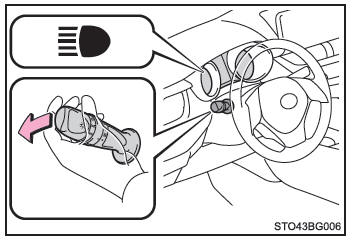
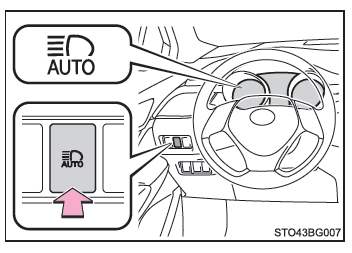
2. Press the automatic high beam button.
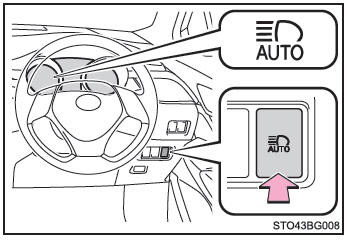
The automatic high beam indicator comes on when the headlights are on, to show that the system is active.
Left-hand drive vehicles
Right-hand drive vehicles
Manually switching the high beams on/off
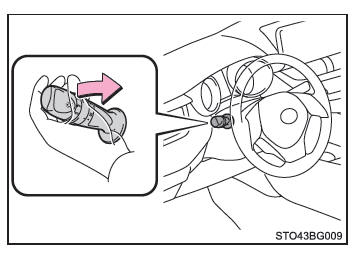
■ Selecting the low beams Pull the lever back to its original position.
The automatic high beam indicator turns off.
Push the lever forward to reactivate the automatic high beam system.
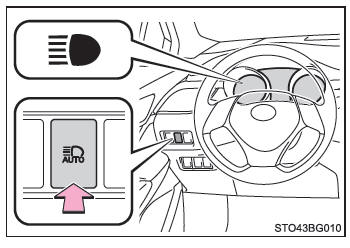
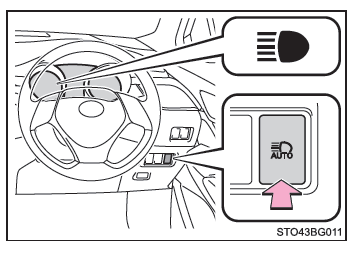
■ Selecting the high beams Press the automatic high beam button.
The automatic high beam indicator turns off and the high beam indicator comes on.
Press the button to reactivate the automatic high beam system.
Left-hand drive vehicles
Right-hand drive vehicles
■ Conditions for automatic high beam on/off
- When all of the following conditions are met, the high beams turn on automatically (after approximately 1 second):
- The vehicle is traveling at more than approximately 40 km/h.
- The area ahead of the vehicle is dark.
- There are no vehicles ahead with their headlights or tail lights on.
- There is little street lighting on the road.
- If any of the following conditions is met, the high beams turn off automatically:
- The vehicle slows to below approximately 30 km/h.
- The area ahead of the vehicle is not dark.
- There are vehicles ahead with their headlights or tail lights on.
- There is a lot of street lighting on the road.
■ Useful information about the detection camera
- The high beams may not turn off automatically in the following situations:
- When a vehicle suddenly emerges from a curve in the oncoming lane
- When another vehicle crosses the road in front of you
- When the vehicles ahead of you are hidden by a series of curves, a median strip or roadside trees
- When vehicles ahead of you appear from a distant lane on a wide road
- When the vehicles ahead of you have no lights
- The high beams may turn off if a vehicle is detected ahead of you with the fog lights on but the headlights off.
- The headlights may switch from high beam to low beam, or remain in low beam, because of household lighting, street lighting, traffic lights, billboards or illuminated signs.
- The delay before the high beams turn on or off depends on the following factors:
- The light intensity of the headlights, fog lights and taillights of the vehicles ahead of you
- The movement and direction of travel of the vehicles ahead of you
- When a vehicle ahead of you has only one side's lights working
- When a vehicle ahead of you is a two-wheeler
- The condition of the road (gradient, curves, road surface condition, etc.)
- The number of passengers and the luggage load
- The high beams may turn on or off without the driver expecting it.
- Bicycles and similar vehicles may not be detected.
- In the situations described below, the system may not accurately detect the ambient brightness level. As a result, the headlights may remain in low beam, or may switch to high beam and dazzle pedestrians, vehicles ahead of you or other road users. In these cases, switch manually between low beam and high beam.
- In bad weather (rain, snow, fog, sandstorms, etc.)
- The windshield is obscured by fog, condensation, frost, mud, etc.
- The windshield is cracked or in poor condition.
- The detection camera is deformed or dirty.
- The temperature of the detection camera is extremely high.
- The ambient brightness level is similar to that of the headlights, taillights or fog lights.
- The headlights of vehicles ahead of you are off, dirty, of varying color or misaligned.
- When driving through an area where shadow and light alternate intermittently.
- When driving on a road with frequent consecutive uphill and downhill sections, or a road with a deformed, bumpy or poor surface (cobblestones, dirt, etc.).
- When driving on a winding road or a road with many tight curves.
- An highly reflective object ahead of the vehicle, such as a road sign or a mirror.
- The rear of the vehicle ahead is highly reflective, such as the trailer of a heavy truck.
- The headlights of your vehicle are dirty or in poor condition.
- The vehicle leans to one side or pitches up, due to a flat tire or towing a caravan/trailer, etc.
- Repeated switching between high beam and low beam at an abnormal frequency.
- The driver feels the high beams may dazzle other road users or pedestrians along the road.
■ If the message "Headlight system malfunction. See dealer." is displayed on the multi-information display The system may be malfunctioning. Have the vehicle inspected by a Toyota dealer, a Toyota-authorized repairer, or any reliable repairer.