Vehicles with high-voltage system (hybrid vehicles) Observe the additional warning instructions for working on vehicles with high-voltage system → Electrical system; Rep. gr.93.
 WARNING Risk of injury due to unexpected engine start When working on a high-voltage vehicle, switch off the ignition, and deposit the ignition key somewhere outside the passenger compartment. |
WARNING
Handling high-voltage cables:
| l |
Do not support yourself or your tools on high-voltage cables and their components --> risk of damage to the insulation. |
| l |
High-voltage cables must not be extensively bent or kinked --> risk of damage to the insulation. |
| l |
The round high-voltage connectors are colour-coded with a coloured ring on the outside and mechanically coded with respective guide lugs. Always observe the coding when connecting the round high-voltage connectors in order to prevent any mechanical damage to the high-voltage connectors. |
|
DANGER! Hazardous voltage resulting from damaged high-voltage components Observe the following when working in the vicinity of high-voltage components and cables: Work involving metal-removing, deforming and sharp-edged tools or heat sources such as welding, soldering, hot air and thermal bonding is not permitted. Before starting work, carry out a visual check on the high-voltage components in the area of work. When working in the engine compartment, carry out a visual check on the power and control electronics for electric drive -JX1-, the electric drive motor -V141-, the air conditioner compressor -V470- and the high-voltage cables. When working on the underbody, carry out a visual check on the high-voltage cables and covers. When working on the rear end, carry out a visual check on the high-voltage cables and the maintenance connector for high-voltage system - TW -. Carry out a visual check on all potential equalisation lines.
When carrying out the visual check, observe the following:
The high-voltage components must not reveal any external damage. The insulation of the high-voltage cables and the potential equalisation lines must not be damaged. The high-voltage cables must not show any unusual deformations. Each high-voltage component must be clearly identified with a red warning sticker. |
If repair work in the vicinity of high-voltage components and cables is necessary, “carry out a visual check for damage on high-voltage components and cables”, and “observe the general warning instructions for work on the high-voltage system” → Electrical system; Rep. gr.93. If repair work on high-voltage components is necessary, de-energise the high-voltage system → Electrical system; Rep. gr.93, and “observe the general warning instructions for work on the high-voltage system” → Electrical system; Rep. gr.93.
 Caution If there is evidence to suggest that chemical substances have been added in the vehicle to seal leaks, do not connect the air conditioner service station and do not extract the refrigerant. Chemical substances used to seal leaks form deposits in the refrigerant circuit. These can impair the function of the air conditioning system and cause the air conditioning system (and your air conditioner service station) to fail. Make your customer aware of the fact that there are substances in his/her air conditioning system that do not have VW approval and therefore the refrigerant circuit cannot be purged. The refrigerant circuit can only be repaired by replacing all components that have come into contact with this substance. . |
 Note Volkswagen rejects the use of chemical substances for purposes of sealing leaks in refrigerant circuits. Chemical substances used for sealing leaks in refrigerant circuits often react with the surrounding air and the humidity contained within. They cause deposits to build up in the refrigerant circuit (and your air conditioner service station), valves to malfunction and defects in other components with which they come into contact. These deposits cannot be completely removed from the components (not even by purging). The refrigerant circuit can only be repaired by replacing all components that have come into contact with this substance. It is often not possible to detect from the outside whether chemical substances have been used to seal leaks in the refrigerant circuit. The adhesive label that serves to identify its use can usually not be found. Therefore, exercise caution on vehicles for which you have no service or repair record. To work as cleanly as possible and avoid the task becoming labour intensive when removing contaminants (e.g. friction dust and particles from defective air conditioner compressor) and old refrigerant oil, the refrigerant circuit must be purged using refrigerant R134a. On vehicles with electrical air conditioner compressor, observe the notes on renewing the electrical air conditioner compressor -V470-. If the electronics of the air conditioner compressor are damaged, the refrigerant circuit does not always need to be cleaned. → Chapter The refrigerant circuit must be purged with refrigerant R134a if:
Dirt or other contaminants are in the refrigerant circuit. If during evacuation of a leak-tight refrigerant circuit the vacuum display is not constant on gauge (moisture in the refrigerant circuit, which generates vapour pressure). If the refrigerant circuit has been left open for longer than normally required for repairs (e.g. following an accident). Pressure and temperature measurements in the refrigerant circuit indicate that there is moisture in the refrigerant circuit. There is doubt about the amount of refrigerant oil in the refrigerant circuit. If the air conditioner compressor is to be reinstalled, drain refrigerant oil out of air conditioner compressor via the drain plug. To facilitate this process, turn the air conditioner compressor over by hand at the poly V-belt pulley or coupling disc of the magnetic coupling. After purging, fill refrigerant circuit with total amount of refrigerant oil (50 g direct into air conditioner compressor) according to → vehicle-specific workshop manual. Observe additional oil requirements for systems with second evaporator. The air conditioner compressor has to be exchanged because of internal damage (e.g. noisy or no output). the vehicle-specific repair manual deems it necessary after replacement of certain components. a different air conditioner compressor with other refrigerant oil is to be fitted. Tools required Air conditioner service station with purging device -VAS 6381- or air conditioner service station with purging device -VAS 6337-. These air conditioner service stations feature an additional function for “purging the refrigerant circuit with R134a” and the purging device for refrigerant circuits necessary for this procedure → Workshop equipment and special tools catalogue. Adapter case VW/Audi passenger vehicle set -VAS 6338/1- → Chapter and → Workshop equipment and special tools catalogue. Adapter case commercial vehicle set -VAS 6338/50- → Chapter and → Workshop equipment and special tools catalogue. Note If the above mentioned air conditioner service stations are not available in the workshop, the rinsing device for refrigerant circuits -VAS 6336/1- or rinsing device for refrigerant circuits -VAS 6337/1- can be used to purge the refrigerant circuit, depending on the type of air conditioner service station in service (min. 7 kg refrigerant R134a in refrigerant bottle). The purging process must then be carried out manually → Anchor. On vehicles with threaded connections on the refrigerant circuit, adapter -V.A.G 1785/1- to adapter -V.A.G 1785/8- from adapter case VW/Audi passenger vehicle set -VAS 6338/1- or adapter case commercial vehicle set -VAS 6338/50- can be used. On vehicles with threaded connections on the air conditioner compressor and on the reservoir, the adapter -V.A.G 1785/8- is required two-fold. In the adapter case there is also a charging hose -VAS 6338/31- with 5/8 - 18 UNF connections and large internal diameter to bridge components (commercially available type). Preliminary measures
- Drain refrigerant circuit → Chapter.
- Remove air conditioner compressor → Heating, air conditioning.
On vehicles with restrictor and reservoir.
- Remove restrictor (vehicle-specific) and join the refrigerant lines together again → Heating, air conditioning.
- Remove reservoir (vehicle-specific) → Heating, air conditioning and join refrigerant pipes together again (to do this, use adapter and charging hose -VAS 6338/31- from adapter case VW/Audi passenger vehicle set -VAS 6338/1-) → Chapter.
Note The collector could be purged but due to its large inner volume it would require too much refrigerant. During extraction, the refrigerant ices up the reservoir heavily and the extraction procedure takes much longer as a result. On vehicles with expansion valve and receiver.
- Remove the receiver → Heating, air conditioning (vehicle-specific, not necessary on all vehicles) and join the refrigerant lines together (use the adapter and the charging hose -VAS 6338/31- to do this) → Chapter.
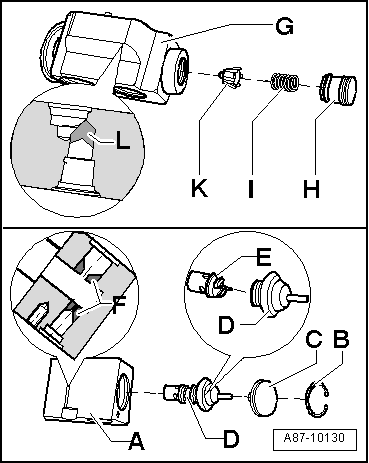
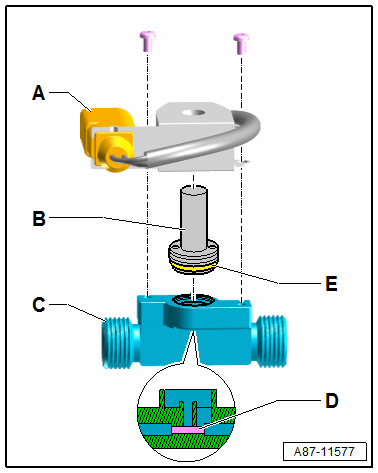
- Remove the expansion valve → Heating, air conditioning (vehicle-specific) and insert an adapter in its place → Chapter.
Note If there is not a suitable adapter for the expansion valve in the adapter case VW/Audi passenger vehicle set -VAS 6338/1- or adapter case commercial vehicle set -VAS 6338/50-, the removed expansion valve can also be drilled out (the old expansion valve must be subsequently renewed).
Caution When drilling out, ensure that the sealing surfaces on the expansion valve are not damaged. Refrigerant would otherwise escape. |
Note |
|
|