HD Radio ™
HD Radio is a brand name registered by the DTS, Inc.1. They are the developer of a broadcasting technology called IBOC or In Band On Channel, which refers to the method of transmitting a digital radio broadcast signal centered on the same frequency as the AM or FM station's present frequency.
Introduction
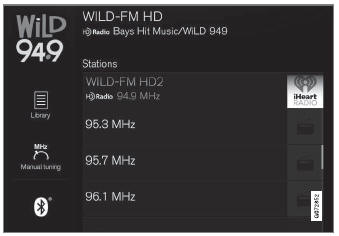
Display when the radio is receiving an HD Radio broadcast (generic illustration)
The IBOC system is called "hybrid" because it is both analog and digital. During hybrid operation, receivers still continue to receive the analog (non-digital) signal. HD Radio receivers incorporate both modes of reception, where the receiver will automatically switch to the analog signal if the digital signal cannot be decoded or is lost by the receiver.
When you have tuned to an HD Radio station, the  symbol will appear in the infotainment system display. The symbol will be displayed in different colors:
- Grey symbol: no HD Radio broadcast reception
- White symbol: the radio is actively receiving an HD broadcast
- Orange symbol: the radio is receiving an HD broadcast with digital sound
More information about HD Radio and IBOC can be found on DTS, Inc.'s website, www.dts.com.
Artist Experience ™
The station logo and album art can be displayed. If a station opts to provide this information, it is broadcast once every 12 minutes, which means that there may be a delay before the logo/album art appears on the screen. The radio can store 100 station logos, so the next time the radio is tuned to the same station, the logo will be displayed immediately. Album art is synchronized with the artist that you are currently listening to.
Play-along mode
This feature means that a main FM station (HD1) will broadcast live events, where the content of the programming is more important than sound quality, in analog mode only to help prevent the delay between analog and digital broadcasting. The HD Radio symbol will be white during live broadcasts and "Live" will be displayed next to the symbol.
Advantages of digital broadcasting
- Better sound quality (FM sounds close to CD quality).
- Some FM frequencies offer a greater number of listening choices through multicasting (consisting of a frequency's main channel and any sub-channels that may also be available on that particular frequency.)
- When receiving a digital signal there is no multipath disturbance or hisses/pops/ crackling due to outside influences.
How HD Radio™ digital broadcasting technology works.
HD Radio works similarly to conventional radio, and broadcasts of this type are available in many areas of the United States. However, there are several key differences:
- Instead of transmitting one analog signal, stations send out a bundled signal – both analog and digital.
- An HD Radio receiver can receive both digital and analog broadcasts. Depending on the terrain and location of the vehicle (which influence the signal strength), the receiver will determine which signal to receive.
1 HD Radio™ technology is manufactured under license from DTS, Inc. U.S. and foreign patents. HD Radio™ and the HD and HD Radio logos are proprietary trademarks of DTS, Inc.
Test yourself
A quick Volvo XC90 quiz: every answer comes with an explanation and a link to the manual page.