Measuring the compression pressure
NOTE:
Insufficient compression pressure will result in a loss of performance.
1. Measure:
Valve clearance Out of specification →Adjust.
Refer to "ADJUSTING THE VALVE CLEARANCE" on page 3-3.
2. Start the engine, warm it up for several minutes, and then turn it off.
3. Remove:
- Rider seat
- Right upper side cowling Refer to "GENERAL CHASSIS" on page 4-1.
4. Remove:
- Fuel tank Refer to "FUEL TANK" on page 7-1.
5. Disconnect:
- Coolant temperature sensor coupler "1"
- Spark plug cap "2"

6. Remove:
- Spark plug
Before removing the spark plug, use compressed air to blow away any dirt accumulated in the spark plug well to prevent it from falling into the cylinder.
7. Install:
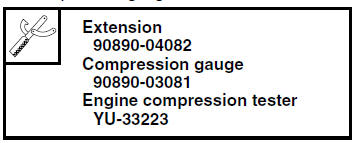
- Extension "1"
- Compression gauge "2"
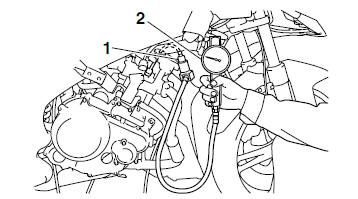
8. Measure:
- Compression pressure Out of specification Refer to steps (c) and (d).

a. Set the main switch to "ON".
b. With the throttle wide open, crank the engine until the reading on the compression gauge stabilizes.
c. If the compression pressure is above the maximum specification, check the cylinder head, valve surfaces and piston crown for carbon deposits.
Carbon deposits Eliminate.
d. If the compression pressure is below the minimum specification, pour a teaspoonful of engine oil into the spark plug bore and measure again.
Refer to the following table.
9. Remove:
- Extension
- Compression gauge
10.Install:
- Spark plug

11.Connect:
- Spark plug cap
- Coolant temperature sensor coupler
12.Install:
- Fuel tank Refer to "FUEL TANK" on page 7-1.
13.Install:
- Right upper side cowling
- Rider seat Refer to "GENERAL CHASSIS" on page 4-1.
Test yourself
A quick Yamaha YZF-R125 quiz: every answer comes with an explanation and a link to the manual page.