Sensor de peso
The Occupant Weight Sensor (OWS) is designed to meet the regulatory requirements of Federal Motor Vehicle Safety Standard (FMVSS) 208 and is designed to disable (will not inflate) the passenger's side front airbag under certain conditions.
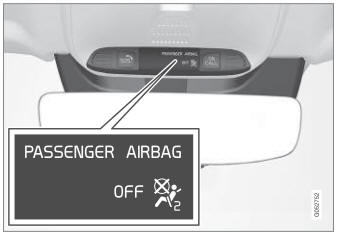
Indicador del sensor de peso (OWS)
Desactivación del airbag lateral del pasajero
Volvo recommends that ALL occupants (adults and children) shorter than 140 cm (4 feet 7 inches) be seated in the back seat of any vehicle with a front passenger side airbag and be properly restrained for their size and weight.
The OWS works with sensors that are part of the front passenger's seat and seat belt. The sensors are designed to detect the presence of a properly seated occupant and determine if the passenger's side front airbag should be enabled (may inflate) or disabled (will not inflate).
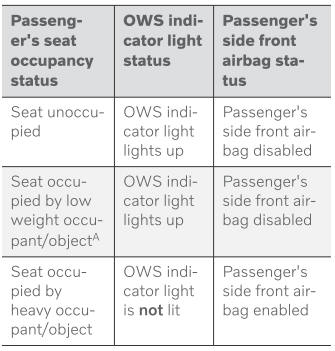
El OWS desactivará (no inflará) el airbag frontal lateral del pasajero cuando:
- the front passenger's seat is unoccupied, or has small/medium objects in the front seat,
- the system determines that an infant is present in a rear-facing infant seat that is installed according to the manufacturer's instructions,
- the system determines that a small child is present in a forward-facing child restraint that is installed according to the manufacturer's instructions,
- El sistema detecte que un niño pequeño está sentado en un asiento elevador,
- Un niño o una persona de baja estatura ocupe el asiento del pasajero delantero.
The OWS uses a PASSENGER AIRBAG OFF indicator lamp which will illuminate and stay on to remind you that the passenger's side front airbag is disabled. The PASSENGER AIRBAG OFF indicator lamp is located in the overhead console, near the base of the rearview mirror.
Sin embargo, si el sistema detecta un fallo:
- El indicador OWS permanecerá encendido.
- The SRS warning light will come on and stay on and a text message will be displayed.
- Nunca intente abrir, retirar ni reparar ningún componente del sistema OWS. Esto puede causar un mal funcionamiento del sistema. El mantenimiento o las reparaciones solo deben ser realizados por un técnico de servicio Volvo capacitado y calificado.
- El asiento del pasajero delantero no debe modificarse de ninguna manera. Esto podría reducir la presión sobre el cojín del asiento, lo que podría interferir con el funcionamiento del sistema OWS.
Volvo recomienda que los niños siempre vayan debidamente sujetos con sistemas de retención infantil adecuados en los asientos traseros. No suponga que el airbag frontal del lado del pasajero está desactivado a menos que la luz indicadora PASSENGER AIRBAG OFF esté encendida. Asegúrese de que el sistema de retención infantil esté instalado correctamente. Si existe alguna duda sobre el estado del airbag frontal del lado del pasajero, traslade el sistema de retención infantil al asiento trasero.
The OWS is designed to enable (may inflate) the passenger's side front airbag in the event of a collision anytime the system senses that a person of adult size is sitting properly in the front passenger's seat. The PASSENGER AIRBAG OFF indicator lamp will be off and remain off.
Si una persona de tamaño adulto está sentada en el asiento del pasajero delantero, pero la luz indicadora PASSENGER AIRBAG OFF está encendida, es posible que la persona no esté sentada correctamente en el asiento. Si esto ocurre:
- Turn the vehicle off and ask the person to place the backrest in an upright position.
- Have the person sit upright in the seat, centered on the seat cushion, with the person's legs comfortably extended.
- Restart the vehicle and have the person remain in this position for about two minutes. This will allow the system to detect that person and enable the passenger's frontal airbag.
- If the PASSENGER AIRBAG OFF indicator lamp remains on even after this, the person should be advised to ride in the rear seat.
Esto indica limitaciones en la clasificación del OWS. No indica un mal funcionamiento del OWS.
Modificaciones
If you are considering modifying your vehicle in any way to accommodate a disability, for example by altering or adapting the driver's or front passenger's seat(s) and/or airbag systems, please contact Volvo at:
En los Estados Unidos
Volvo Car USA, LLC
Centro de atención al cliente
1 Volvo Drive
P.O. Box 914
Rockaway, Nueva Jersey 07647
1-800-458-1552
En Canadá
Volvo Car Canada Ltd.
Centro de atención al cliente
9130 Leslie Street, Suite 101
Richmond Hill, Ontario L4B 0B9
1-800-663-8255
- No objects that add to the total weight on the seat should be placed on the front passenger's seat. If a child is seated in the front passenger's seat with any additional weight, this extra weight could cause the OWS system to enable the airbag, which might cause it to deploy in the event of a collision, thereby injuring the child.
- El cinturón de seguridad nunca debe enrollarse alrededor de ningún objeto en el asiento del pasajero delantero. Esto puede interferir con el funcionamiento del sistema OWS.
- The front passenger's seat belt should never be used in a way that exerts more pressure on the passenger than normal. This could increase the pressure exerted on the weight sensor by a child, and could result in the airbag being enabled, which might cause it to deploy in the event of a collision, thereby injuring the child.
- Tenga en cuenta los siguientes puntos con respecto al sistema OWS. No seguir estas instrucciones podría afectar negativamente el funcionamiento del sistema y causar lesiones graves al ocupante del asiento del pasajero delantero.
- The full weight of the front seat passenger should always be on the seat cushion. The passenger should never lift him/herself off the seat cushion using the armrest in the door or the center console, by pressing the feet on the floor, by sitting on the edge of the seat cushion, or by pressing against the backrest in a way that reduces pressure on the seat cushion. This could cause OWS to disable the front, passenger's side airbag.
Pon a prueba tus conocimientos
Un test rápido sobre el Volvo XC90: cada respuesta trae una explicación y un enlace a la página del manual.