Seguridad infantil
Los niños siempre deben viajar sentados de forma segura en el vehículo.
Información general
Volvo recommends the proper use of restraint systems for all occupants including children. Remember that, regardless of age and size, a child should always be properly restrained in a vehicle.
Your vehicle is also equipped with ISOFIX/LATCH attachments, which make it more con- venient to install child seats.
Some restraint systems for children are designed to be secured in the vehicle by lap belts or the lap portion of a lap-shoulder belt. Such child restraint systems can help protect children in vehicles in the event of an accident only if they are used properly. However, children could be endangered in a crash if the child restraints are not properly secured in the vehicle. Failure to follow the installation instructions for your child restraint can result in your child striking the vehicle's interior in a sudden stop.
Holding a child in your arms is NOT a suitable substitute for a child restraint system. In an accident, a child held in a person's arms can be crushed between the vehicle's interior and an unrestrained person. The child could also be injured by striking the interior, or by being ejected from the vehicle during a sudden maneuver or impact. The same can also happen if the infant or child rides unrestrained on the seat. Other occupants should also be properly restrained to help reduce the chance of injuring or increasing the injury of a child.
Todos los estados y provincias tienen legislación que regula cómo y dónde deben transportarse los niños en un vehículo. Infórmese de las normas vigentes en su estado o provincia. Las estadísticas de accidentes recientes han demostrado que los niños están más seguros en las plazas traseras que en las delanteras cuando están correctamente sujetos. Un sistema de retención infantil puede ayudar a proteger a un niño en el vehículo. Esto es lo que debe buscar al seleccionar un sistema de retención infantil:
It should have a label certifying that it meets applicable Federal Motor Vehicle Safety Standards (FMVSS 213) - or in Canada, CMVSS 213.
Make sure the child restraint system is approved for the child's height, weight and development - the label required by the standard or regulation, or instructions for infant restraints, typically provide this information.
In using any child restraint system, we urge you to carefully look over the instructions that are provided with the restraint. Be sure you understand them and can use the device prop- erly and safely in this vehicle. A misused child restraint system can result in increased injuries for both the infant or child and other occupants in the vehicle.
Cuando el niño haya superado el sistema de retención infantil, debe utilizar el asiento trasero con el cinturón de seguridad estándar abrochado. La mejor manera de proteger al niño en este caso es colocarlo sobre un cojín para que el cinturón de seguridad quede correctamente colocado sobre las caderas. La legislación de su estado o provincia puede exigir el uso de un asiento infantil o un cojín junto con el cinturón de seguridad, según la edad o la estatura del niño. Consulte las normas locales.
Puede obtener un cojín elevador y un respaldo especialmente diseñados y probados en su distribuidor Volvo. Consulte también el artículo «Cojín elevador integrado».
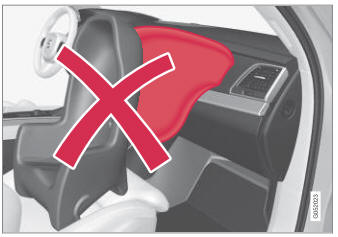
- Do not use child safety seats or child booster cushions/backrests in the front passenger's seat. We also recommend that children under 140 cm (4 feet 7 inches) in height who have outgrown these devices sit in the rear seat with the seat belt fastened.
- En días calurosos, la temperatura del habitáculo puede subir muy rápidamente. La exposición a estas altas temperaturas, incluso durante un período corto, puede causar lesiones o la muerte por golpe de calor. Los niños pequeños son especialmente vulnerables. Nunca deje a los niños sin vigilancia en el vehículo.
Los asientos infantiles siempre deben estar registrados.
Recomendaciones de Volvo
¿Por qué Volvo considera que ningún niño debe viajar en el asiento delantero del vehículo? La razón es bastante sencilla. El airbag frontal es un dispositivo muy potente diseñado, por ley, para proteger a un adulto.
Debido al tamaño del airbag y a su velocidad de inflado, un niño nunca debe colocarse en el asiento delantero, incluso si está correctamente sujeto con el cinturón o en un sistema de retención infantil. Volvo ha sido pionero en el campo de la seguridad desde su fundación. Y no pensamos conformarnos con lo logrado. Pero necesitamos su ayuda. Recuerde colocar a sus hijos en el asiento trasero y abrocharles el cinturón.
- El vehículo ha estado involucrado en una colisión, por leve que sea
- Su historial es desconocido
- Ha superado la fecha de caducidad fijada por el fabricante
Volvo tiene recomendaciones muy específicas
- Use siempre el cinturón de seguridad.
- Los airbags son un dispositivo de seguridad COMPLEMENTARIO que, cuando se usa junto con un cinturón de seguridad de tres puntos, puede ayudar a reducir lesiones graves en determinados tipos de accidentes. Volvo le recomienda no desactivar el sistema de airbags de su vehículo.
- Volvo recomienda encarecidamente que todos los ocupantes del vehículo viajen debidamente sujetos.
- Volvo recommends that ALL occupants (adults and children) shorter than 140 cm (4 feet 7 inches) be seated in the rear seat of any vehicle with a front passenger side airbag.
- ¡Viaje con seguridad!
Pon a prueba tus conocimientos
Un test rápido sobre el Volvo XC90: cada respuesta trae una explicación y un enlace a la página del manual.