JUMP STARTING FROM AN AUXILIARY BATTERY
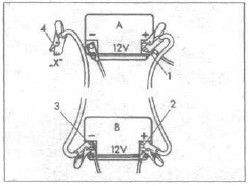
A — discharged battery.
B — auxiliary battery supplying voltage.
The battery is located in the engine compartment.
If the engine will not start from a discharged battery, it can be started from another vehicle's battery using jumper cables.
To do this, follow these recommendations:
- Both batteries must have the same rated capacity (Ah). It is especially important that the capacity of the battery supplying voltage is not lower than the rated capacity of the discharged battery.
- Use a factory-made jumper cable of appropriate cross-section with clamps for opposite-polarity terminals.
- A discharged battery freezes at a temperature of about -10°C. If this has happened, it must be thawed first, otherwise it may explode.
- The vehicles must not touch each other. The discharged battery is connected to the vehicle's electrical system as normal. Start the engine of the vehicle supplying voltage. Connect the jumper cable in the following sequence:
1. Connect the end of the positive (+) cable, marked red, to the positive (+) terminal of the discharged battery.
2. Connect the other end of this (red) cable to the positive (+) terminal of the battery supplying voltage.
3. Connect the end of the negative (-) cable, most often black, to the negative (-) terminal of the battery supplying voltage.
4. Hook the other end of this cable onto a ground point firmly bolted to the engine block, or directly onto the engine.
Do not connect the cable to the negative (-) terminal of the discharged battery, because a stray spark could ignite the explosive hydrogen gas released by the battery.
 Do not touch the uninsulated cable clamps! The cable connected to the positive (+) terminal of the battery must under no circumstances come into contact with any electrically live component or mechanism of the vehicle, as a short circuit may occur.
The jumper cable must be kept away from moving parts in the engine compartment. Do not lean over the batteries, as there is a risk of acid burns! Keep all open flames and sources of ignition (lit cigarettes, etc.) at a safe distance from the batteries, as they can cause an explosion.
Start the engine following the procedure described in the section "Starting the Engine".
If the engine does not start within 10 seconds, stop cranking and wait half a minute before trying again.
Once the engine is running, disconnect both cables in the reverse order of connection.
Test yourself
A quick Audi 80 quiz: every answer comes with an explanation and a link to the manual page.