Troubleshooting
Repair
In this manual: Troubleshooting
~3min read
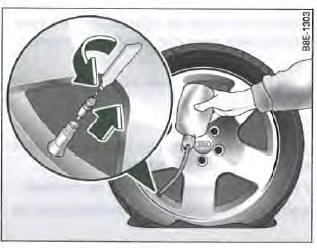
Fig. 250 Repair
Preparation
- In the event of a flat tire, stop the vehicle at a safe distance from the traffic lane, away from other traffic.
- Apply the parking brake to prevent the vehicle from rolling away uncontrolled.
- Engage 1st gear (manual transmission) or move the selector lever to P (automatic transmission).
- Check whether you can repair the tire using the tire repair kit.
- Have all passengers get out and move them out of the danger zone.
- Remove the tire sealant can and the compressor from the luggage compartment.
- Take the sticker "max. 80 km/h" from the tire sealant can and attach it to the instrument cluster, within the driver's field of vision.
Filling a tire
- Shake the tire sealant can thoroughly before filling the tire.
- Screw the supplied filler hose fully onto the can. This will automatically pierce the seal of the cap.
- Remove the cap from the tire valve and unscrew the valve core using the valve core remover included in the tire repair kit.
- Remove the cap from the filler hose and push the hose onto the valve.
- Hold the can upside down, with the bottom facing up, and empty the entire contents into the tire.
- Then remove the hose and screw the valve core back into the valve.
Inflating the tire
- Inflate the tire to a pressure of 2.0 to 2.5 bar and check the pressure on the gauge.
- If the pressure is not reached, drive the vehicle forward or backward about ten meters so that the sealant can distribute itself inside the tire. If the required pressure still cannot be reached, this means the tire is too severely damaged.
You cannot repair it with the tire sealant can.
Final check
- Stop after approximately 10 minutes and check the tire pressure.
- If the pressure is below 1.3 bar, the tire is too severely damaged. Do not continue driving! Seek professional help.
CAUTION!
- If you have a flat tire and traffic is heavy, switch on the hazard warning lights and place the warning triangle. This protects you and other road users.
- Make sure all passengers are in a safe place, outside the danger zone (e.g. behind the guardrail).
- Observe the manufacturer's safety instructions on the compressor and in the tire sealant can instructions!
- If the inflation pressure of 2.0 bar cannot be reached after six minutes of inflating, the tire is too severely damaged. Do NOT continue driving!
- Seek professional help if you cannot repair the tire with the tire sealant can.
CAUTION!
If you have driven for 10 minutes and the pressure is below 1.3 bar, the tire is too severely damaged. Do not continue driving. Seek professional help.
 Warning!
Be especially careful when repairing a wheel on a sloping road surface.
Note
- Do not run the compressor for more than 6 minutes. Otherwise it may overheat. Once the compressor has cooled down, you can use it again.
- If sealant has leaked out, let it dry. You can then peel it off like a film.
- After repairing a tire, obtain a new sealant canister from a specialist workshop. The Tire Mobility System is then operational again.
- Observe the legal requirements.
Test yourself
A quick Audi A4 quiz: every answer comes with an explanation and a link to the manual page.
Was this page helpful?