Catalytic Converter Operation
All engines are equipped with a catalytic converter for exhaust gas purification.

The catalytic converter has a central ceramic honeycomb substrate (3) coated with a washcoat layer. The washcoat contains precious metal salts that act as catalysts. The catalytic converter is secured in the housing (1) by an insulating support mat (2), which also compensates for thermal expansion of the catalytic converter.
Gasoline Engines
The electronically controlled fuel injection system, in combination with the oxygen sensor, allows precise metering of the injected fuel, which reduces harmful emissions. The oxygen sensor is located in the front pipe upstream of the catalytic converter and is exposed to the exhaust gas flow. The oxygen sensor is an electronic sensor that measures the oxygen content of the exhaust gases and outputs the result as a voltage fluctuation. The oxygen sensor signal is sent to the fuel injection control unit. The received value is used to regulate the air-fuel mixture composition. This is necessary due to constantly changing operating conditions (idle, full throttle) and because optimal afterburning of fuel in the catalytic converter occurs only when the exhaust gases contain a sufficient amount of unburned fuel.
For afterburning of fuel to take place in the catalytic converter at a temperature of 300 - 800°C, the fuel mixture must contain more fuel than is needed for complete combustion.
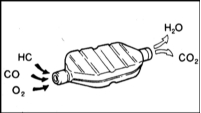
The catalytic converter used is a so-called three-way catalytic converter. This means that, due to the closed-loop control process, carbon monoxide (CO) and hydrocarbons (HC) are oxidized, and the concentration of nitrogen oxides (NOx) is reduced. Refer to the accompanying illustration.
Diesel Engines
Vehicles with diesel engines are also equipped with a catalytic converter. However, mixture composition control is not possible here. The catalytic converter reduces the carbon monoxide and hydrocarbon emissions harmful to the environment to a level considerably lower than that of a gasoline engine. In addition, the catalytic converter reduces the characteristic diesel exhaust odor. The higher nitrogen oxide concentration of diesel engines is reduced by the exhaust gas recirculation system.
Test yourself
A quick BMW 1 quiz: every answer comes with an explanation and a link to the manual page.