Operating principle
REFRIGERANT COMPRESSOR MANAGEMENT
The refrigerant compressor is controlled by the BSI, which takes into account the following:
- refrigerant compressor engagement request (manual or automatic),
- evaporator icing protection,
- refrigerant pressure,
- engine speed,
- engine coolant temperature,
- interface with engine ECU (permission to engage or change the state of the A/C compressor).
A/C compressor engagement request
Function
There are 2 types of A/C compressor engagement request:
- manual request: pressing the button on the control panel (all types of ECU),
- automatic request: the ECU requests A/C compressor engagement based on the needs of the control it performs. Automatic request is only possible with automatic temperature control A/C.
Block diagram for manual A/C
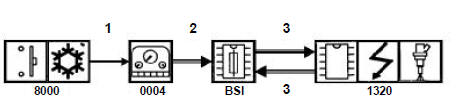
Block diagram for manual A/C
Key:
- single arrow: wired link,
- triple arrow: multiplexed link.
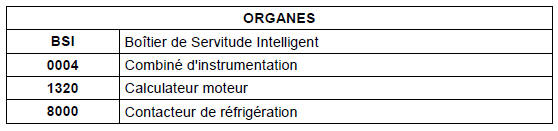
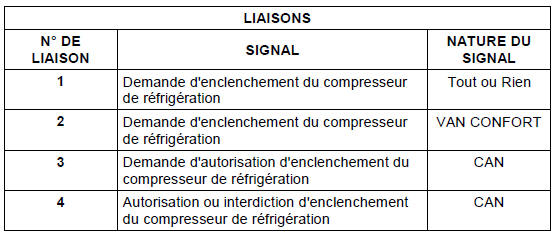
Block diagram for automatic temperature control A/C
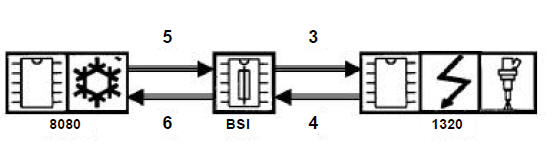
Block diagram for automatic temperature control A/C
Key:
- single arrow: wired link,
- triple arrow: multiplexed link.

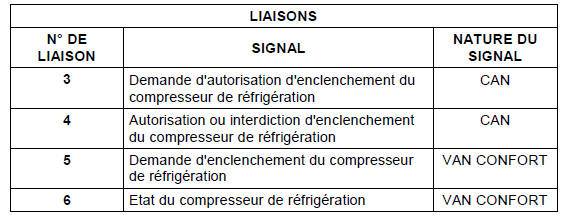
Functional description
The air conditioning control panel sends the A/C compressor engagement request to the BSI via the VAN Confort network. The compressor engagement request can be made in 2 different ways:
- on user request, by pressing the A/C compressor engagement request button,
- on ECU request, for automatic temperature control.
The A/C compressor engagement request is accepted if these 2 conditions are met:
- the engine is running,
- the blower is switched on.
Evaporator icing protection
Function
To prevent icing of the evaporator, the BSI prohibits A/C compressor engagement under certain temperature conditions.
Block diagram
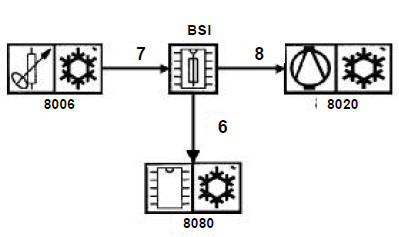
Block diagram
Key:
- single arrow: wired link,
- triple arrow: multiplexed link.
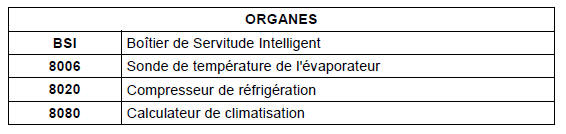
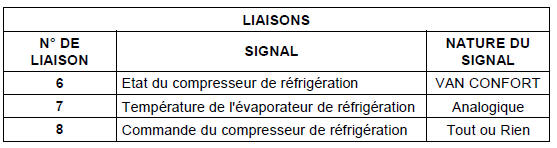
Functional description: icing protection
Evaporator icing protection defines the A/C compressor engagement and cut-out rules based on the following:
- evaporator temperature,
- outside air temperature.
The function is optimised using the following curve:
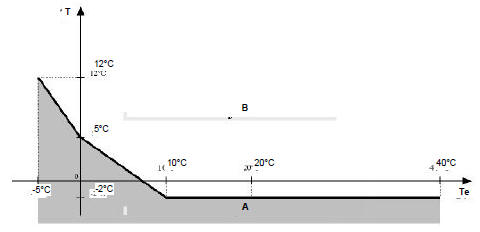
Key:
- Te: outside air temperature
- T: evaporator temperature
- A: A/C compressor disabled
- B: A/C compressor enabled
The evaporator temperature sensor acquisition tolerances are as follows:

Degraded modes
The evaporator icing protection degraded modes are as follows:
- evaporator temperature sensor faulty.
The A/C compressor is disabled.
- Outside air temperature sensor absent or faulty.
A/C compressor cut-out depends only on evaporator temperature, with the following thresholds:

Self-diagnosis
The BSI detects open circuit and short circuit on the evaporator temperature sensor output.
Refrigerant pressure protection
Function
If the refrigerant circuit pressure is too low or too high, the BSI prohibits A/C compressor engagement.
This strategy protects against the following events:
- pressure too low: risk of refrigerant circuit leak,
- pressure too high: risk of refrigerant circuit damage.
Block diagram
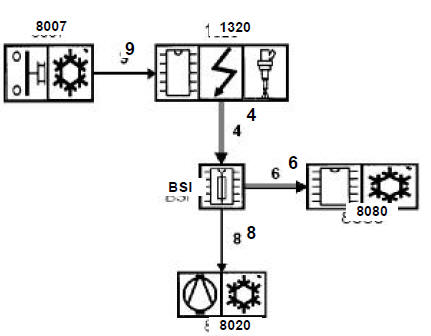
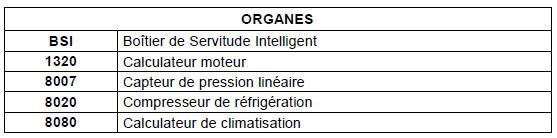
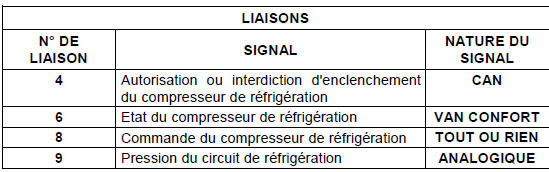
Refrigerant pressure protection
Key:
- single arrow: wired link,
- triple arrow: multiplexed link.
Functional description: low or high pressure cases
Refrigerant pressure protection is managed by the BSI.
A linear pressure sensor is used to measure refrigerant pressure. The pressure information is acquired by the engine ECU via a wired link.
The engine ECU sends the following information to the BSI via the CAN network:
- A/C compressor cut-out state for protection,
- refrigerant pressure.
The pressure thresholds are as follows:

Functional description: insufficient circuit charge case
The minimum refrigerant charge protection consists of permanently cutting out the compressor in the following case:
Key:
- P: refrigerant pressure
- t: time
- C: compressor disabled
- D: compressor enabled
If the pressure is below 1 bar, one minute after A/C compressor engagement, the BSI permanently prohibits its engagement.
Note: The minimum charge protection is reset at each engine start.
Degraded mode
If the refrigerant pressure sensor is faulty, A/C compressor engagement is prohibited.
Engine speed protection
Function
When engine speed is too high, the BSI prohibits A/C compressor engagement so that its rotational speed does not become excessive.
Block diagram
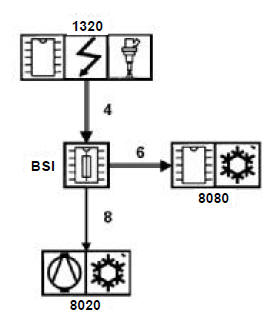
Engine speed protection
Key:
- single arrow: wired link
- Triple arrow: multiplexed link
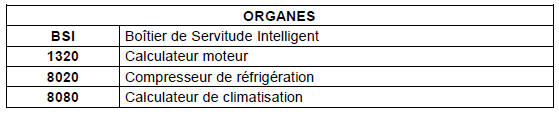
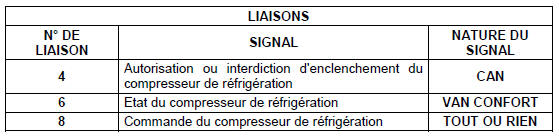
Functional description
To ensure satisfactory protection, A/C compressor cut-out is requested if engine speed exceeds 6250 rpm.
A/C compressor re-engagement is allowed if engine speed falls back below 5650 rpm and pressure is below 24 bar.

Degraded mode
If the engine speed information is invalid, A/C compressor engagement remains allowed.
Engine coolant temperature protection
Function
When engine coolant temperature is too high, the engine ECU relieves the engine of the A/C compressor load by prohibiting its engagement.
Block diagram
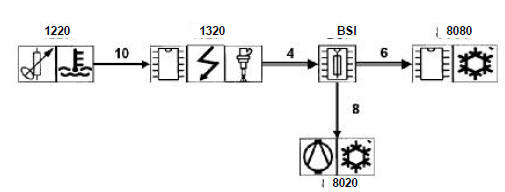
Engine coolant temperature protection
Key:
- single arrow: wired link,
- triple arrow: multiplexed link.
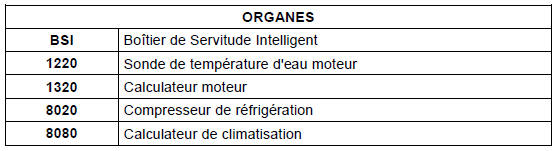
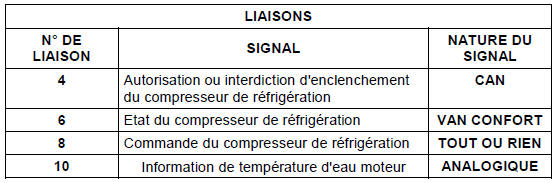
Functional description
Engine coolant temperature protection is managed by the engine ECU.
A/C compressor engagement is prohibited for a coolant temperature above 112 °C. A/C compressor re-engagement is allowed if engine coolant temperature is below 108 °C and the previous cut-out occurred less than 1 min ago.
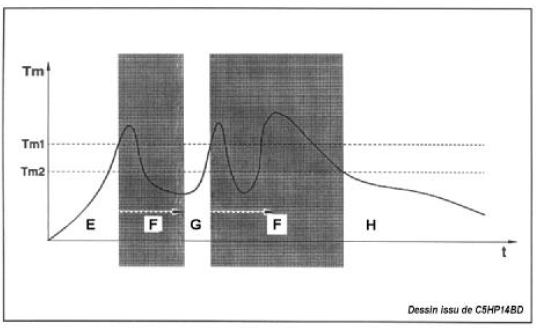
Functional description Engine coolant temperature protection
Key:
- t: Time
- Tm: Engine coolant temperature
- Tm1: Engine coolant temperature = 112 °C
- Tm2: Engine Coolant Temperature = 108 °C
- E: A/C compressor engaged
- F: A/C compressor cut-out
- G: The refrigerant compressor is re-engaged because the temperature is valid after the one-minute delay
- H: The refrigerant compressor is re-engaged when the temperature returns to normal after the one-minute delay
Degraded mode
There is no degraded mode for the engine coolant temperature safety.
If the engine coolant temperature information is invalid, compressor engagement remains permitted.
Gear change safety
Function
During a gear change, the automatic gearbox prohibits a change of compressor state, in order to optimise driving comfort.
Block diagram
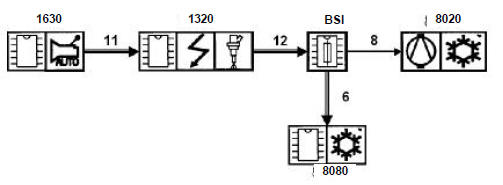
Gear change safety
Key:
- single arrow: wired link,
- triple arrow: multiplexed link.
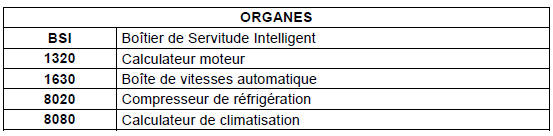
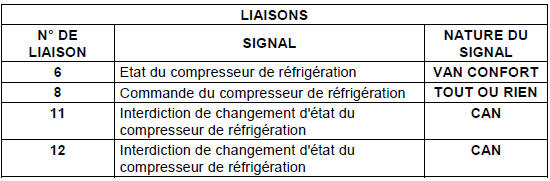
Functional description
The gear change safety operates as follows:
The automatic gearbox sends a gear change prohibition to the engine ECU via the CAN network.
The engine ECU returns this information to the BSI, which does not change its compressor command until the target gear is engaged.
DEGRADED MODES
The degraded modes of the air conditioning function are as follows:
| FAULT SOURCE | SYSTEM BEHAVIOUR |
| Evaporator temperature sensor | Refrigerant compressor engagement prohibited |
| Outside air temperature sensor | Evaporator icing safety now depends only on the evaporator temperature, with an adapted threshold. |
| Refrigerant pressure sensor | Refrigerant compressor engagement prohibited |
| Engine coolant temperature information | Refrigerant compressor engagement prohibited |
Test yourself
A quick Citroen C5 Aircross quiz: every answer comes with an explanation and a link to the manual page.