Operating principle
HYDRACTIVE 3 SUSPENSION
Performance
Hydractive 3 suspension adjusts the vehicle ride height according to vehicle speed and road condition.
Height is obtained by opening or closing the inlet (raise) or exhaust (lower) solenoid valves, together with activation of the pump in the integrated hydraulic electronic unit.
Operating conditions
Ride height changes take place under the following conditions:
| ACTION | CONDITION |
| Vehicle ride height change by manual control | Engine running |
Vehicle ride height change according to vehicle speed |
Vehicle moving |
| Ride height maintenance while driving | Vehicle moving |
| Vehicle ride height change according to road condition | Vehicle moving |
| Vehicle ride height change according to vehicle load | Control unit awake |
Vehicle ride height change by manual control
The vehicle ride height is changed with the engine running.
The driver selects the vehicle ride height by pressing the vehicle ride height push button.
The selected vehicle ride height is only reached if the speed range is compatible with the defined speed thresholds.
If the ride height selected by the driver is outside the authorised range, the selected height is refused and is not stored.
Four heights can be selected:
| POSITION | DEFINITION | AUTHORISED RANGE |
| High | The vehicle rests on the upper stops; this height makes wheel changes easier | From 0 to 10 km/h |
| Off-road | The off-road height provides obstacle clearance | From 0 to 40 km/h |
| Normal | Normal height provides easy access to the vehicle and optimum road holding | Entire speed range |
| Low | The vehicle rests on the lower stops to make loading the boot and checking the hydraulic fluid level easier. | From 0 to 10 km/h |
Display of vehicle ride height
The vehicle ride height is shown by 4 indicator lights on vehicles fitted with a level 1 instrument cluster.
- When the vehicle is in high, off-road, normal or low position, the corresponding indicator lights are on.
- When the vehicle is in normal position, the indicator light is on after a time delay.
When a position selected by the driver is refused, the indicator light for the refused height flashes for 5 seconds.
The vehicle ride height is shown on the B / C or D type multifunction display on vehicles fitted with a level 2 or 3 instrument cluster or an automatic gearbox.
On the multifunction displays, the different positions are represented by vehicle pictograms.
Vehicle ride height change according to vehicle speed
Important: If the vehicle speed information is lost, the default setpoint is the road height
When the vehicle ride height changes automatically, the indicator light for the height being left flashes for 5 seconds.
Improved aerodynamics
The suspension changes the vehicle ride height according to its speed in order to improve the vehicle's aerodynamics.
Raising the vehicle starts at the rear axle; lowering the vehicle starts at the front axle.
The height change starts approximately 8 seconds after the setpoint is applied.
If a height change setpoint appears while the vehicle is being corrected, the correction is completed to the previous setpoint and the 8-second time delay is reset.
The function is active:
- If the vehicle is moving,
- And if the vehicle is in normal position.
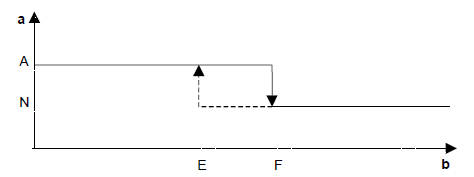
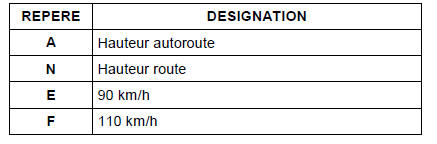
Vehicle ride height according to speed
- vehicle ride height
- vehicle speed
The height difference is ~ 14.5 mm.
Road holding optimisation
To optimise the vehicle's road holding, certain ride heights are prohibited within certain speed ranges.
The suspension control unit changes vehicle height depending on vehicle speed, within the permitted speed ranges.
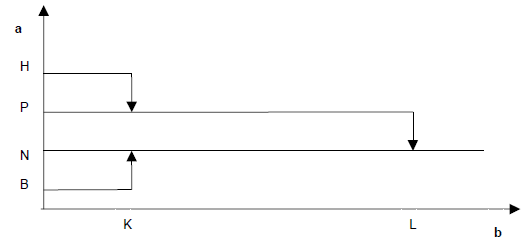
Actual height depending on speed and the height requested by the driver
The graph shows the actual height as a function of speed and the height requested by the driver.
- vehicle ride height
- vehicle speed
The height difference is ~ 14.5 mm.
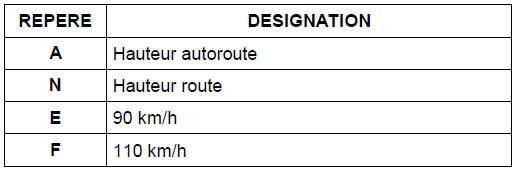
Road holding optimisation
To optimise the vehicle's road holding, certain ride heights are prohibited within certain speed ranges.
The suspension control unit changes vehicle height depending on vehicle speed, within the permitted speed ranges.
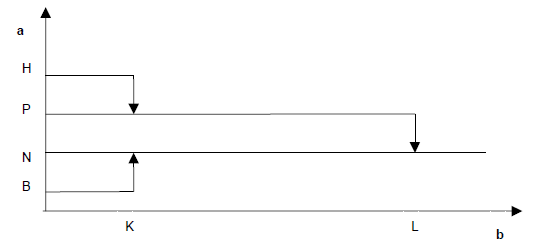
The graph shows the actual height as a function of speed and the height requested by the driver.
- vehicle ride height
- vehicle speed
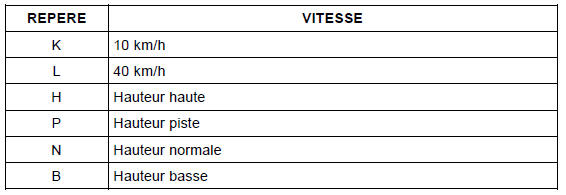
Maintaining vehicle height while driving
The suspension control unit corrects vehicle height variations when they deviate by more than plus or minus 4 millimetres from the target vehicle height.
Height correction is performed, with an 8-second delay, after a vehicle height variation is detected.
The system filters out vehicle height variations caused by road irregularities.
The delay is reduced to 1 second when the engine is started or when the vehicle height push button is operated.
Changing vehicle height according to road condition
When the suspension control unit detects poor road condition, it raises the vehicle height.
The height increase of approximately 13 millimetres preserves passenger comfort, increases ground clearance and suspension travel.
Vehicle speed must be below 90 km/h.
Return to normal position takes place after an 8-second delay when the suspension control unit no longer detects poor road condition.
Changing vehicle height according to vehicle load
Vehicle height adjustment is operational with the ignition off.
The suspension control unit checks vehicle height each time a door or the boot is opened or closed.
The suspension control unit corrects vehicle height if it does not match the target height.
Height correction is performed when all openings are closed.
HYDRACTIVE 3+ SUSPENSION
Performance
The Hydractive 3+ suspension has two states: "soft" or "firm". By default, the soft state is preferred.
The suspension control unit stores state-change thresholds in memory, based on the following parameters:
- vehicle speed,
- steering wheel rotation speed,
- steering wheel angle,
- longitudinal vehicle acceleration,
- lateral vehicle acceleration,
- suspension travel speed,
- accelerator throttle movement.
The change thresholds are adapted to the driver's driving style. The control unit analyses the driving style and determines sportiness coefficients.
By applying the coefficients to the parameters, a suspension adapted to the driver's driving style is obtained.
If the driver presses the Sport mode button, the control unit selects the maximum sport driving detection parameter values.
Pressing the Sport mode button only switches the suspension to firm state when the firm-state parameters are reached.
Stiffness regulator
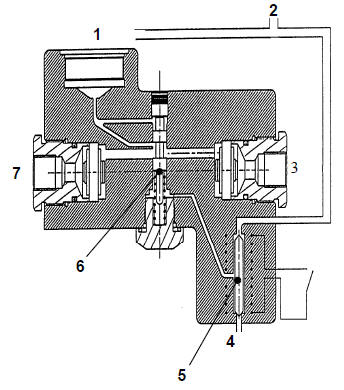
Soft state, solenoid valve not powered
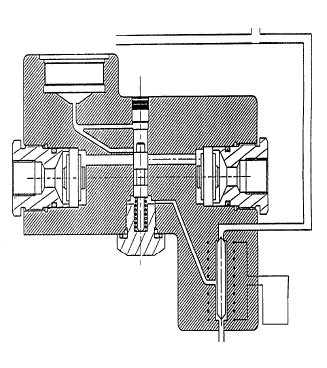
Firm state, solenoid valve powered
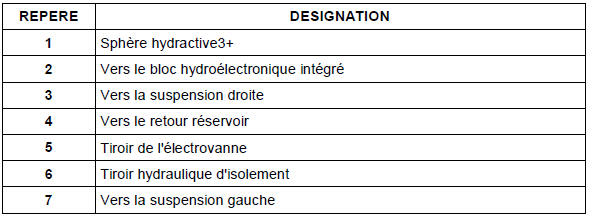
SOFT STATE |
| When the solenoid valve is no longer powered, its spool moves under the supply pressure of the integrated hydraulic-electronic unit. |
| The return to reservoir is blocked. The pressure below the lower part of the hydraulic isolation spool is the integrated hydraulic-electronic unit pressure. |
| The upper part of the hydraulic isolation spool is also at the integrated hydraulic-electronic unit pressure. The hydraulic isolation spool moves under the action of the spring. |
| Hydraulic fluid can flow between the right and left suspension. The Hydractive 3+ sphere is no longer isolated from the suspension. |
FIRM STATE |
| When the solenoid valve is powered, its spool moves, opens the return to reservoir and blocks the hydraulic supply from the integrated hydraulic-electronic unit. |
| The lower part of the hydraulic isolation spool is at reservoir pressure. The upper part of the spool is at the Hydractive 3+ sphere pressure. |
| Due to the pressure difference, the hydraulic isolation spool moves and blocks hydraulic fluid flow between the right and left suspension. The Hydractive 3+ sphere is also isolated from the suspension. |
NOTE: no vehicle height correction is possible when the suspension is in firm state.
Test yourself
A quick Citroen C5 Aircross quiz: every answer comes with an explanation and a link to the manual page.