Vehicle Wheel Alignment Angles
GENERAL INFORMATION.
The main requirement for the steering and front suspension design is
ensuring vehicle safety.
Wheel alignment angles must provide minimum rolling resistance and tire wear.
tires.
Toe-in.
Toe-in (convergence of the wheel rotation planes toward the center of the vehicle).
Ensures wheel rotation in the planes under longitudinal forces acting on the vehicle wheels. Toe-in is required to compensate for small clearances and elasticity of the suspension and steering components. Recommended by the manufacturer.
The toe-in value corresponds to exact parallel alignment.
rotation planes of the wheels when the vehicle is moving. Deviation of toe-in from the nominal value leads to rapid tire wear and increased fuel consumption..
As the suspension and steering components wear, a correction is required in the direction of
increasing the toe-in value. Toe-in is checked and adjusted.
Last.
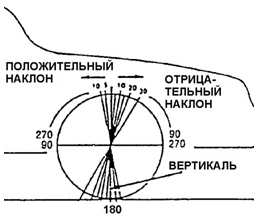
Caster
Caster refers to the inclination of the steering axis of the steered wheel,
which passes through the lower ball joint and the upper strut mount of the front suspension. Caster angle is measured in the longitudinal plane of the vehicle. Positive caster is the angle
corresponding to the position of the upper strut mount behind the lower ball joint.
ball joint. Caster angle affects vehicle handling, but
has no effect on tire wear. Sagging of the front suspension springs or vehicle overloading
changes the caster angle. If the caster angles are unequal
between the left and right wheels, the vehicle tends to pull toward the wheel with the smaller positive caster angle. Caster is measured in degrees and is not adjustable during vehicle operation.
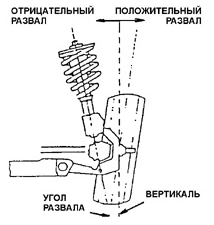
Camber
Camber is the deviation of the wheel rotation plane from the vertical..
Camber angle is measured in degrees from the vertical. Camber angle affects both vehicle handling and tire wear..
Excessive positive camber causes rapid wear of the
outer edge of the tire tread. Similarly, excessive negative camber causes rapid wear of the inner edge of the tire tread. Camber angle,
like caster, is not adjustable during vehicle operation.
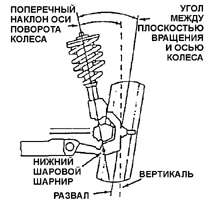
Steering axis inclination
Steering axis inclination is the deviation from vertical of the axis
passing through the lower ball joint and the upper strut mount of the front suspension. Steering axis inclination angle is measured from the vertical..
Steering axis inclination promotes stable straight-line driving of the vehicle and provides stabilization of the steered wheels. The angle
of steering axis inclination is negative.
The angle between the wheel rotation plane and the steering axis.
The angle between the wheel rotation plane and the steering axis is measured in degrees in the transverse plane of the vehicle, see illustration Steering axis inclination. The value of this angle is not checked directly, but is determined by adding
(taking algebraic signs into account) the camber and steering axis inclination angles.
wheel.
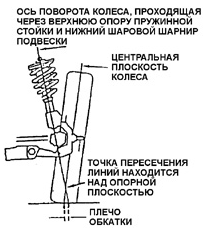
Scrub radius
Scrub radius is the distance between the steering axis of the wheel (passing through
the lower ball joint and the upper strut mount) at the support plane
and the center of the tire contact patch. The value and sign of scrub radius
are determined by the suspension design and are not checked or adjusted during
vehicle operation.
Test yourself
A quick Daewoo Nexia quiz: every answer comes with an explanation and a link to the manual page.