Installing a universal child seat with seat belts
Universal child seats, which are secured only with seat belts, are approved under ECE R44 and are divided into different weight groups.
WARNING The illustrations are provided for installation reference only. The child seat must be installed in accordance with the instructions supplied with it, which must be read.
GROUP 0 and 0+
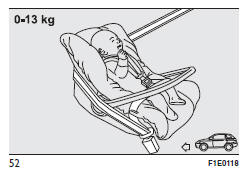
Children weighing up to 13 kg should be transported rear-facing in a seat such as the one shown in Fig. 52, which, because it supports the head, does not put strain on the neck in the event of sudden braking.
This type of seat is secured with the vehicle's seat belts, as shown in Fig. 52, and should hold the child with its own built-in harness.
GROUP 1
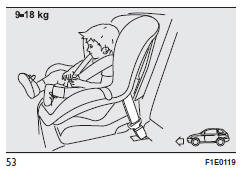
From 9 to 18 kg, children may be transported facing forward, see Fig. 53.
GROUP 2
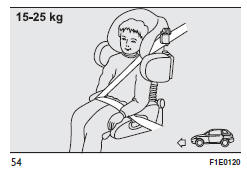
Children weighing from 15 to 25 kg may be restrained directly by the vehicle's seat belt, see Fig. 54.
In this case, the seats serve only to position the child correctly in relation to the seat belt, so that the diagonal part of the belt lies across the chest, not the neck, and the lap part lies across the hips, not the stomach.
GROUP 3
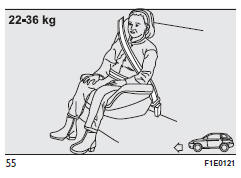
For children weighing from 22 to 36 kg, there are suitable booster systems that allow the seat belt to be positioned correctly.
Fig. 55 shows an example of the correct placement of a child on the rear seat.
Children taller than 1.50 m can use the seat belt in the same way as adults.
Test yourself
A quick Fiat Punto quiz: every answer comes with an explanation and a link to the manual page.