Adapting the passenger seats for use with ISOFIX child seats
The table below, in accordance with European regulation ECE R16, shows the possibility of installing ISOFIX child seats on seats fitted with specific anchorages.
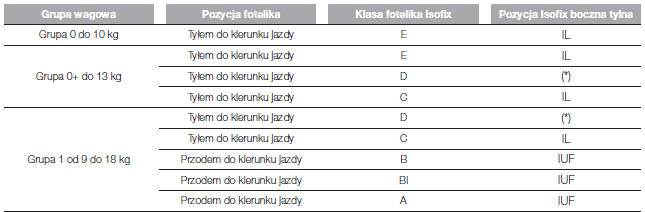
IL = for specific ISOFIX child restraint systems approved for this specific vehicle type.
(*) = for specific ISOFIX child restraint systems approved for this specific vehicle type. It is possible to fit the child seat after moving the front seat forward.
IL = for specific ISOFIX child restraint systems approved for this specific vehicle type.
IUF = for ISOFIX child restraint systems facing forward, universal category (equipped with a third upper anchorage), approved for use in this weight group.
Basic precautions to observe for safely carrying children
- Child seats should be installed on the rear seat, as this is the most protected position in the event of a collision.
- Keep the child seat in the rearward-facing position for as long as possible.
- If a rearward-facing child seat is to be installed on the rear seats, it is recommended to position it as far forward as possible, in line with the front seat position.
- When deactivating the front passenger airbag, always check that deactivation has taken place, as indicated by the warning light on the centre part of the dashboard.
- Strictly follow the instructions provided by the child seat manufacturer. Keep them in the vehicle together with the documents and owner's manual. Do not use the child seat in a manner that does not comply with the instructions for use.
- Each restraint system is intended for one child only: never carry two children at the same time in one seat.
- Always check that the seat belt does not press against the child's neck.
- Always check by pulling on the strap that the seat belt is correctly fastened.
- While driving, do not allow the child to change position or unfasten the seat belt.
- Do not allow the child to place the diagonal part of the seat belt under the arm or behind the back.
- Never hold a child in your arms while travelling, even an infant. In the event of a collision, no one is able to hold a child.
- After an accident, the child seat must be replaced with a new one.
CAUTION
79) SERIOUS HAZARD: When the front passenger airbag is active, do not install rearward-facing child seats on the front passenger seat.
Airbag deployment in a collision can cause fatal injuries to the child being carried, regardless of the severity of the impact.
For this reason, it is always recommended to carry a child in a suitable child seat on the rear seat, as this is the safest position in the event of a collision.
80) The obligation to deactivate the airbag when a rearward-facing child seat is installed is indicated by the appropriate symbol on the label attached to the sun visor. Always follow the information on the sun visor (see the description in the section "Supplementary Restraint System (SRS) - Airbags").
81) If it is necessary to carry a child in a rearward-facing child seat on the front passenger seat, the front and side (side bag) passenger airbags must be deactivated using the main menu of the display, and you must make sure that deactivation has taken place, as indicated by the warning light on the centre part of the dashboard.
In addition, the passenger seat should be adjusted to its rearmost position to avoid possible contact between the child seat and the dashboard.
82) Do not move the front or rear seat while a child is sitting on it or a child seat is installed on it.
83) Incorrect installation of a child seat may prevent the restraint system from working. In the event of an accident, the seat may come loose and the child may suffer serious or even fatal injuries. When installing a child restraint system (including for an infant), follow the manufacturer's instructions strictly.
84) When the child restraint system is not in use, secure it with the seat belt or the ISOFIX anchorages, or remove it from the vehicle. Do not leave it unsecured inside the vehicle.
This is to avoid a situation in which, during sudden braking or a collision, the seat could injure the occupants.
85) After installing a child seat, do not move the seat: always remove the child seat first before making any seat adjustment.
86) Always make sure that the seat belt strap does not pass under the child's arm or behind the child's back. In the event of an accident, the seat belt will not be able to hold the child, and there is a risk of serious or even fatal injury. The child should therefore always wear their own seat belt correctly.
87) Do not use the same lower anchorage to install several child restraint systems.
88) If a universal ISOFIX child seat is not secured by all three anchorages, the seat will not be able to protect the child properly. In an accident, the child could suffer serious or even fatal injuries.
89) Install the child seat only when the vehicle is stationary. The child seat is correctly secured in the anchorages when you hear a click confirming that it is locked. However, follow the installation, removal and adjustment instructions that the manufacturer must supply with the child seat.
Test yourself
A quick Fiat Punto quiz: every answer comes with an explanation and a link to the manual page.