Powertrain
General Procedures - Intake Manifold Vacuum Test
In this manual: Powertrain
7steps
~42min
2/5difficulty
Done 0 of 7
- Bring the engine to normal operating temperature. Connect a vacuum/pressure gauge to the intake manifold. Start the engine at the specified idle speed.
- The vacuum gauge should read between 51 and 74 kPa (15-22 in Hg), depending on engine condition and the altitude at which the test is performed. Subtract 4.0193 kPa (1 in Hg) from the specified reading for every 304.8 m (1000 ft) of altitude above sea level.
- The reading should be steady. If necessary, adjust the gauge damper control (where equipped) if the needle fluctuates rapidly. Adjust the damper until the needle moves freely without excessive oscillation.
Intake Manifold Vacuum Test - Vacuum Gauge Reading Interpretation
- Careful observation of the vacuum gauge readings while the engine is idling will help identify problem areas. Always perform other relevant tests before making a final diagnosis. Vacuum gauge readings, although useful, must be interpreted with caution.
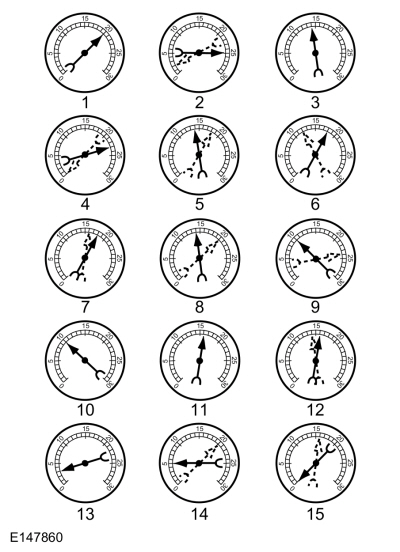
- Most vacuum gauges have a normal range marked on the calibrated face. Possible gauge readings are listed below. Some are normal; others must be investigated further.
- Possible gauge readings are listed below. Some are normal; others must be investigated further.
Visual Inspection Chart
- 1. NORMAL READING: The needle is within 51-74 kPa (15-22 in Hg) and holds steady.
- 2. NORMAL READING DURING RAPID ACCELERATION AND DECELERATION: When the engine is rapidly accelerated (dashed needle), the needle drops to a low value (not to zero). When the throttle is suddenly closed, the needle snaps back to a higher than normal reading.
- 3. NORMAL FOR HIGH-LIFT CAMSHAFT WITH LONG OVERLAP: The needle will register down to 51 kPa (15 in Hg), but will be relatively steady. Some fluctuation is normal.
- 4. WORN OR DILUTED PISTON RINGS: When the engine is accelerated (needle with dots), the needle drops to 0 kPa (0 in Hg). On deceleration, the needle rises slightly above 74 kPa (22 in Hg).
- 5. STICKING VALVES: When the needle (dashed) remains steady at normal vacuum but occasionally flicks (sharp, quick movements) down and back about 13 kPa (4 in Hg), one or more valves may be sticking.
- 6. BURNED OR WARPED VALVES: A regular, even movement of the needle down the scale indicates one or more burned or warped valves. Insufficient valve clearance can also cause this reaction.
- 7. POOR VALVE SEAT: Small but regular drops down the scale may indicate that one or more valves are not seating properly.
- 8. WORN VALVE GUIDES: When the needle fluctuates by approximately 13 kPa (4 in-Hg) at idle, the valve guides may be worn. If the needle becomes steady as engine speed increases, the guides are the likely cause.
- 9. WEAK VALVE SPRINGS: When needle fluctuation becomes more pronounced as engine speed increases, weak valve springs are indicated. Idle readings may be relatively steady.
- 10. LATE VALVE TIMING: A steady but low reading may be caused by late valve timing.
- 11. RETARDED IGNITION TIMING: Retarded ignition timing results in a steady but somewhat low reading.
- 12. INSUFFICIENT SPARK PLUG GAP: When the spark plug gap is too small, a regular, small needle fluctuation may occur.
- 13. INTAKE LEAK: A low, steady reading may be caused by a leak at the intake manifold or TB gasket.
- 14. HEAD GASKET: A regular drop of significant magnitude may be caused by a leaking cylinder head gasket or cylinder head warpage relative to the cylinder block.
- 15. RESTRICTED EXHAUST SYSTEM: When the engine is first started and runs at idle, the readings may be normal, but as engine speed increases, back pressure from a clogged muffler, a kinked exhaust pipe or other causes causes the needle to slowly drop to 0 kPa (0 in-Hg). The needle may then slowly rise. Excessive exhaust restriction will cause the needle to drop to a minimum point, even if the engine is only at idle.
- If a vacuum leak is detected, locate and correct the cause. Excessive air leakage into the system will disturb the air-fuel mixture and cause concerns such as rough idle, lack of acceleration or burned valves. If the leak exists in an auxiliary component, the component may not function properly. Always correct vacuum leaks.
Test yourself
A quick Ford Escape quiz: every answer comes with an explanation and a link to the manual page.
Was this page helpful?