Manual Transmission, Clutch, Transfer Case and Power Transfer Unit
Clutch Controls. Diagnosis and Testing
In this manual: Manual Transmission, Clutch, Transfer Case and Power Transfer Unit
9steps
~54min
2/5difficulty
Done 0 of 9
Inspection and Verification
NOTICE: If a transmission noise is reported, first check the transmission fluid level. Do not drive the vehicle if the transmission fluid level is low. Low transmission fluid level will damage the transmission.
Mechanical drive components produce a certain level of noise. A small amount of noise is acceptable and may be heard at certain speeds or under various driving conditions. Road and weather conditions may increase normal vehicle noise.
The following overview is a guide for diagnosing transmission or clutch concerns:
Verify and document the customer concern.
During the customer interview, if a leak was noticed or if a leak is a concern, check the transmission fluid level. Do not drive the vehicle with a low transmission fluid level.
Check the fluid level and condition.
Evaluate the clutch hydraulic system.
Evaluate the clutch.
Inspect the shift mechanism.
Evaluate the transmission.
Locate the cause of the concern and correct it.
Check the Fluid Level and Condition
NOTICE: Do not drive the vehicle if the transmission fluid level is low or damage may occur.
NOTICE: Excessively high temperature can cause transmission lubricant breakdown. If there is reason to believe the transmission has been exposed to temperatures above 135 °C for an extended period (more than 20 minutes), replace the lubricant immediately.
An incorrect transmission fluid level can affect transmission operation and may cause transmission damage. For fluid draining and filling, refer to Refer to: Transmission Fluid Level Check (308-03A Manual Transmission - 5-Speed Manual Transmission - B5/IB5, General Procedures). Refer to: Transmission Fluid Level Check (308-03B Manual Transmission - 6-Speed Manual Transmission - B6, General Procedures).
A low transmission fluid level can cause poor shifting, gear engagement, or damage. It may also indicate a leak at the transmission seals or gaskets.
Check the condition of the transmission fluid.
Drip transmission fluid onto a white cloth and inspect the stain. Check the transmission fluid for contamination or metal particles.
Evaluate the Clutch Hydraulic System
Make sure the clutch hydraulic fluid reservoir is filled to the correct level.
If the clutch hydraulic fluid level is correct, proceed to the clutch evaluation.
If the clutch hydraulic fluid level is low, add fluid as necessary. Inspect the clutch hydraulic system for leaks and repair as necessary.
Evaluate the Clutch
Depress and slowly release the clutch pedal to check the pedal binding. Make sure the clutch pedal is fully released and not restricted by the floor mat.
Measure the clutch reserve. GO TO Pinpoint Test A.
With the engine running at idle and the parking brake applied, move the gear shift lever to 4th gear. Increase engine speed to 2000 rpm and slowly release the clutch pedal.
If the engine stalls, the clutch is operating correctly.
If the engine does not stall, the clutch is slipping. Repair as necessary.
Compare the clutch evaluation results with the following charts. The following list shows typical clutch concerns.
Symptom Chart
The diagnosis in this manual assumes a certain level of skill and knowledge of Ford-approved diagnostic procedures. REFER TO: Diagnostic Methods (100-00 General Information, Description and Operation).
Condition
Possible Sources
Action
Clutch slipping
Clutch pedal reserve
Worn or damaged pressure plate
Clutch disc facing
Glazed or oil-soaked clutch disc surface
Flywheel
GO to Pinpoint Test A
Clutch rattles, clunks or shudders
Loose or damaged engine or transmission mounts
Oil on clutch disc surface
Worn pressure plate
Clutch disc facing
Loose or damaged flywheel
Worn clutch disc
GO to Pinpoint Test B
Clutch drag
Insufficient clutch hydraulic fluid
Air in the hydraulic system
Clutch pedal reserve
Diaphragm spring
Clutch Disc
Clutch disc splines
Oil on clutch disc surface
GO to Pinpoint Test C
Clutch pedal pulsation
Clutch and brake pedal pivot shaft not properly lubricated.
Flywheel
Worn pressure springs
GO to Pinpoint Test B
Vibrations related to the clutch
Engine component grounding to frame
Accessory drive belt
Flywheel attaching bolts loose
Flywheel
Unbalanced clutch pressure plate
GO to Pinpoint Test B
Harsh shifting
Insufficient clutch hydraulic fluid
Clutch pedal reserve
Transmission concern
GO to Pinpoint Test C
Clutch system leak
Clutch Master Cylinder
Clutch Slave Cylinder
Hydraulic Clutch Lines
CHECK the clutch master cylinder, clutch slave cylinder and all hydraulic system lines for leaks. REPAIR as necessary.
Clutch pedal goes to the floor / clutch does not disengage
Air in the hydraulic system
Excessive crankshaft end play
Slave cylinder/master cylinder
Bleed the clutch hydraulic system. Refer to: Clutch System Bleeding (308-02 Clutch Controls - 5-Speed Manual Transmission - B5/IB5 / 6-Speed Manual Transmission - B6, General Procedures).
Measure the crankshaft end play.
CHECK the clutch master cylinder, clutch slave cylinder and all hydraulic system lines for leaks or damage. REPAIR as necessary.
Pinpoint Test(s)
DIAGNOSTIC TEST A:
A1 CHECK CLUTCH SLIPPAGE
Apply the parking brake.
Start the engine and select 4th gear.
Run the engine at approximately 2000 rpm.
Slowly release the clutch pedal.
Does the engine stall when the clutch pedal is fully released?
Yes
Clutch is OK.
No
GO to A2
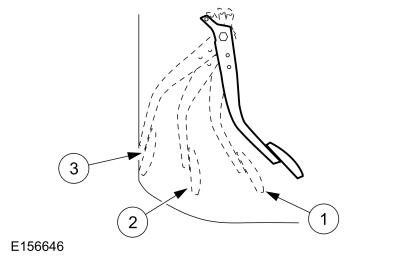
A2 MEASURE CLUTCH PEDAL FREE PLAY
Attach a cable tie to the clutch pedal, then attach a tape measure to it.
Pull the tape measure to the steering wheel. Route it through the steering wheel opening. Place a piece of masking tape on the steering wheel and an index mark with painter's tape.
Fully depress the clutch pedal and start the vehicle.
Shift the transmission into REVERSE, then move the shift lever slightly forward to the position between REVERSE and NEUTRAL. Slowly release the clutch pedal (if the vehicle creeps backward, move the shift lever forward slightly more). The transmission will behave as if in NEUTRAL, but the reverse gear synchronizer will be bypassed.
With the clutch pedal released, carefully pull the shift lever into the REVERSE position. Gear clash can now be heard.
Slowly depress the clutch pedal. Using the mark on the tape as a reference, note the measurement when the gear clash stops or the shift lever moves into the REVERSE position. Depress the clutch pedal to the downstop. The difference between the measurement taken when the gear clash stops and the measurement taken at the downstop is the clutch pedal free play.
Item
Pedal position
1
Gear clash begins
2
Gear clash ends
3
Clutch pedal at downstop
Clutch pedal free play is between 0.0394 in (1 mm) and 0.1181 in (3 mm).
Yes
Clutch pedal free play is within specification. VERIFY the customer concern.
No
INSTALL a new clutch disc and pressure plate. Refer to: Clutch Disc and Pressure Plate (308-01A Clutch - 5-Speed Manual Transmission - B5/IB5, Removal and Installation). Refer to: Clutch Disc and Pressure Plate (308-01A Clutch - 5-Speed Manual Transmission - B5/IB5, Removal and Installation). Refer to: Clutch Disc and Pressure Plate (308-01B Clutch - 6-Speed Manual Transmission - B6, Removal and Installation).
DIAGNOSTIC TEST B:
B1 CHECK ENGINE OR TRANSMISSION MOUNTS
Inspect all engine and transmission mounts for loose fasteners or damage.
Are any engine or transmission mounts loose or damaged?
Yes
TIGHTEN or INSTALL new engine or transmission mounts. CHECK the system for normal operation.
No
GO to B2
B2 CHECK THE PRESSURE PLATE BOLTS
Inspect the pressure plate-to-flywheel bolts.
Is any of the pressure plate-to-flywheel bolts loose?
Yes
TIGHTEN or INSTALL new bolts. Refer to: Clutch Disc and Pressure Plate (308-01A Clutch - 5-Speed Manual Transmission - B5/IB5, Removal and Installation). Refer to: Clutch Disc and Pressure Plate (308-01A Clutch - 5-Speed Manual Transmission - B5/IB5, Removal and Installation). Refer to: Clutch Disc and Pressure Plate (308-01B Clutch - 6-Speed Manual Transmission - B6, Removal and Installation).
No
GO to B3
B3 CHECK THE PRESSURE PLATE
Remove the clutch pressure plate.
Inspect the clutch pressure plate for wear or damage.
Is there any evidence of damage to the pressure plate?
Yes
INSTALL a new pressure plate. Refer to: Clutch Disc and Pressure Plate (308-01A Clutch - 5-Speed Manual Transmission - B5/IB5, Removal and Installation). Refer to: Clutch Disc and Pressure Plate (308-01A Clutch - 5-Speed Manual Transmission - B5/IB5, Removal and Installation). Refer to: Clutch Disc and Pressure Plate (308-01B Clutch - 6-Speed Manual Transmission - B6, Removal and Installation). CHECK the system for normal operation.
No
GO to B4
B4 CHECK THE CLUTCH DISC
NOTE: If the clutch disc internal damper is damaged or contaminated with grease or oil, the noise will sound like "transmission rattle".
Inspect the clutch disc for wear or damage.
Is the clutch disc in good condition?
Yes
GO to B5
No
INSTALL a new clutch disc. REFER TO: Clutch Disc and Pressure Plate (308-01A Clutch - 5-Speed Manual Transmission - B5/IB5, Removal and Installation). REFER TO: Clutch Disc and Pressure Plate (308-01A Clutch - 5-Speed Manual Transmission - B5/IB5, Removal and Installation). REFER TO: Clutch Disc and Pressure Plate (308-01B Clutch - 6-Speed Manual Transmission - B6, Removal and Installation). VERIFY the system operates normally.
B5 CHECK THE FLYWHEEL
Inspect the flywheel for wear or damage.
Is the flywheel in good condition?
Yes
GO to B6
No
REPAIR or INSTALL a new flywheel, as necessary. REFER TO: Flywheel (303-01B Engine - 1.6 L EcoBoost (132 kW/180 L hp) - Sigma, Removal and Installation). REFER TO: Flywheel (303-01A Engine - 1.6 L Duratec-16V Ti-VCT (88 kW/120 L hp) - Sigma, Removal and Installation). VERIFY the system operates normally.
B6 CHECK THE INPUT SHAFT
Inspect the input shaft for evidence of wear, damage or corrosion.
Is there any evidence of wear or corrosion on the input shaft?
Yes
If wear or damage is found, INSTALL a new input shaft. REFER TO: Transmission (308-03A Manual Transmission - 5-Speed Manual Transmission - B5/IB5, Disassembly). REFER TO: Transmission (308-03B Manual Transmission - 6-Speed Manual Transmission - B6, Disassembly). If corrosion is found on the input shaft splines, apply a small amount of grease to the input shaft splines.
No
CONFIRM the customer concern. REFER TO Symptom Chart: Transmission REFER TO: Manual Transmission (308-03A Manual Transmission - 5-Speed Manual Transmission - B5/IB5, Diagnosis and Testing). REFER TO: Manual Transmission (308-03B Manual Transmission - 6-Speed Manual Transmission - B6, Diagnosis and Testing).
DIAGNOSTIC TEST C:
C1 CHECK THE CLUTCH FLUID LEVEL
Check the clutch fluid level.
Is the clutch fluid level between the MAX and MIN marks on the brake fluid reservoir?
Yes
GO to C2
No
FILL the reservoir to specification, CHECK the brake and clutch systems for leaks. CHECK the clutch system for normal operation.
C2 CHECK THE CLUTCH PEDAL FREE PLAY
Manually depress the clutch pedal fully and release.
Measure the pedal travel.
Is the measured dimension within 0.0394 in (1 mm) - 0.1181 in (3 mm)?
Yes
GO to C3
No
Check the clutch for slippage. GO to Pinpoint Test A.
C3 CHECK THE CLUTCH PRESSURE PLATE DIAPHRAGM SPRING.
Remove the transmission. or REFER TO: Transmission - 1.6 L Duratec-16V Ti-VCT (88 kW/120 L hp) - Sigma (308-03A Manual Transmission - 5-Speed Manual Transmission - B5/IB5, Removal). or REFER TO: Transmission (308-03B Manual Transmission - 6-Speed Manual Transmission - B6, Removal).
Does the clutch pressure plate or Belleville clutch pressure plate spring show signs of wear or damage?
Yes
INSTALL a new pressure plate. REFER TO: Clutch Disc and Pressure Plate (308-01A Clutch - 5-Speed Manual Transmission - B5/IB5, Removal and Installation). REFER TO: Clutch Disc and Pressure Plate (308-01A Clutch - 5-Speed Manual Transmission - B5/IB5, Removal and Installation). REFER TO: Clutch Disc and Pressure Plate (308-01B Clutch - 6-Speed Manual Transmission - B6, Removal and Installation). VERIFY the system operates normally.
No
CONFIRM the customer concern.
COMPONENT TEST(S)
Clutch Hydraulic System
Make sure the clutch hydraulic fluid reservoir is filled to the correct level.
If the fluid level is low, top up the fluid as necessary. Inspect the clutch hydraulic system for leaks and repair as necessary.
If the fluid is at the correct level, proceed to the next step.
Press and slowly release the clutch pedal to check the pedal attachment. Make sure the clutch pedal fully depresses and is not restricted by the floor mat. Make sure the clutch pedal return spring is present and working correctly.
Measure the clutch reserve. GO TO Pinpoint Test A.
Apply the parking brake. With the clutch pedal in the up position and the engine idling, slowly move the gearshift lever forward toward reverse until a gear clash is heard. Slowly release the clutch pedal.
If the gear noise stops (full disengagement at 1 in (25.4 mm) to 1.5 in (38.1 mm) from the floor), hold the clutch pedal at the disengagement point and increase engine speed to 4000 rpm. The clutch should remain disengaged; the clutch is good.
With the engine idling and the clutch pedal depressed, move the gearshift lever into 4th gear. Increase engine speed to 2000 rpm and slowly release the clutch pedal.
If the engine does not stall, the clutch is slipping. Repair as necessary. REFER TO: Clutch Disc and Pressure Plate (308-01A Clutch - 5-Speed Manual Transmission - B5/IB5, Removal and Installation). REFER TO: Clutch Disc and Pressure Plate (308-01A Clutch - 5-Speed Manual Transmission - B5/IB5, Removal and Installation). REFER TO: Clutch Disc and Pressure Plate (308-01B Clutch - 6-Speed Manual Transmission - B6, Removal and Installation).
If the engine stalls, the clutch is operating correctly.
?
Test yourself
A quick Ford Fiesta quiz: every answer comes with an explanation and a link to the manual page.