Clutch Control - Overview. Description and Operation
Hydraulic Clutch Actuation General System and Components
The clutch provides a mechanical, forced engagement between two rotating components. The clutch can be engaged or disengaged by mechanical, electrical or hydraulic components.
To disengage the clutch, the force applied by the driver's foot is transmitted through the clutch pedal and the pushrod to the piston of the clutch master cylinder.
Hydraulic Clutch Actuation Operating Principle
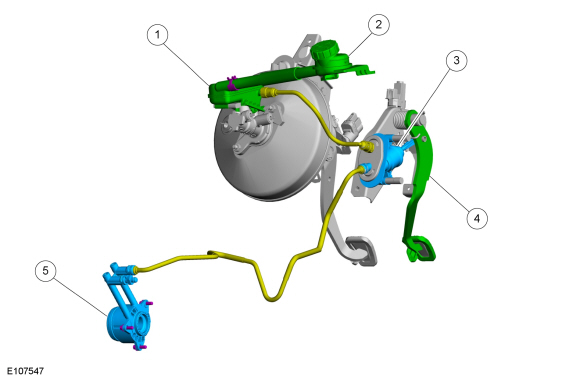
| Item | Description |
|---|---|
| 1 | Brake Fluid Reservoir |
| 2 | Brake Fluid Filler Reservoir |
| 3 | Clutch Master Cylinder |
| 4 | Clutch Pedal |
| 5 | Clutch Slave Cylinder |
The clutch control system is a hydraulic/mechanical clutch system. The clutch control system disengages the clutch when the clutch pedal is depressed and engages the clutch when the clutch pedal is released. When the clutch pedal is depressed, pressure builds in the clutch master cylinder and the release bearing in the clutch slave cylinder is actuated.
Advantages of the hydraulic clutch system:
- The hydraulic clutch lines can be routed in the vehicle so that they are protected.
- The hydraulic clutch allows force to be transmitted even when there is a considerable distance between the pedal and the clutch.
- The hydraulic system is maintenance-free. Only the brake fluid must be replaced according to the maintenance schedule.
- Less vibration from the engine and transmission is transmitted to the clutch pedal.
Brake Fluid Reservoir
The brake fluid reservoir supplies brake fluid to the hydraulic clutch system and the brake system. The hydraulic clutch system and brake system are separate within the brake fluid reservoir. If there is a leak in the hydraulic clutch system, the brake system continues to function without restriction.
Brake Fluid Filler Reservoir
The brake fluid filler reservoir is remotely connected to the brake fluid reservoir. Due to the location of the brake fluid reservoirs, the location of the filler reservoir allows the technician to easily fill the brake fluid reservoir.
Clutch Pedal
When the clutch pedal is depressed, the clutch master cylinder transmits hydraulic fluid pressure to the clutch slave cylinder. The clutch slave cylinder and the clutch release fork transmit the movement of the clutch pedal to the clutch release bearing. The release bearing presses on the diaphragm spring of the clutch disc, releasing the clutch disc. When the clutch pedal is released, the diaphragm spring pushes the piston in the clutch slave cylinder back to its original position. The non-positive connection between the clutch disc and the flywheel is restored.
Clutch Master Cylinder
The clutch master cylinder generates the pressure in the system required to disengage the clutch. When the clutch pedal is depressed, the pushrod moves the piston of the clutch master cylinder. Hydraulic fluid in the clutch master cylinder is delivered through the high-pressure line to the clutch slave cylinder.
Clutch Slave Cylinder
The central clutch slave cylinder is equipped with a release bearing and is attached to the clutch housing with three bolts. The release bearing is a press fit installed in the clutch slave cylinder and is not serviced separately.
The hydraulic fluid forced by the piston into the clutch master cylinder moves the piston in the clutch slave cylinder, which moves the release bearing axially. The inner ring of the release bearing presses on the diaphragm spring. The non-positive connection between the clutch disc and the flywheel is interrupted.
Test yourself
A quick Ford Fiesta quiz: every answer comes with an explanation and a link to the manual page.