Blind Spot Information System
Blind Spot Information System (BLIS) with Cross Traffic Alert (if equipped)
WARNING
The system must not replace the use of the mirrors and the usual shoulder check before changing lanes. This system is only an additional aid.
It does not replace careful driving.
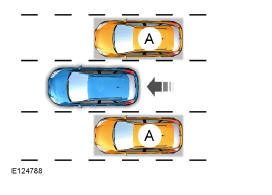
This is a convenience feature that helps you detect vehicles that may have entered the blind spot zone (A). The detection zone covers both sides of the vehicle, from the outside mirrors to the rear, approximately 10 feet (3 meters) behind the bumper. The system is designed to alert you when other vehicles enter the blind spot zone while you are driving.
The Rear Cross Traffic Alert warns you of vehicles approaching the sides of the vehicle when reverse (R) is engaged.
Note: The Blind Spot Information system does not prevent contact with other vehicles or objects. It also does not detect parked vehicles, people, animals, or structures (barriers, guardrails, trees, etc.). It is only designed to warn you of vehicles in the blind spots. Note: Vehicles that pass quickly through the blind spot zone (generally in less than 2 seconds) will not trigger the alert.
Using the Systems
The Blind Spot Information system is activated when you start the engine and the vehicle is traveling at a speed greater than 8 km/h. It remains active when the transmission is in Drive (D) or Neutral (N). If you leave Drive (D) or Neutral (N), the system switches to Rear Cross Traffic Alert mode. If you shift back into Drive (D), the Blind Spot Information system reactivates if the vehicle is traveling at a speed greater than 8 km/h.
Note: The Blind Spot Information system is deactivated in Reverse (R) or Park (P) and does not provide an additional warning when the turn signal is activated. Note: The Rear Cross Traffic Alert detects approaching vehicles up to 14 m away, but the detection zone decreases when the sensors are blocked. Reversing slowly increases the zone and the detection effectiveness.
Note: For vehicles equipped with a manual transmission, the Rear Cross Traffic Alert is activated only when reverse (R) is engaged. If your vehicle is reversing and reverse (R) is not engaged, the Rear Cross Traffic Alert is not activated.
WARNING
The system must not replace the use of the mirrors and the usual shoulder check before changing lanes. This system is only an additional aid.
It does not replace careful driving.
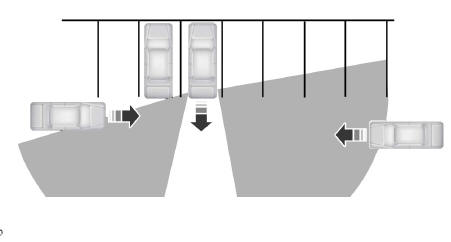
In the first example, the left sensor is only partially obstructed; zone coverage is almost at maximum.
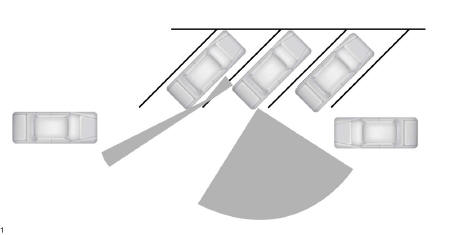
Zone coverage also decreases when the viewing angles are restricted.
In this case, the left sensor is heavily obstructed; zone coverage on that side is severely limited.
System Messages and Indicator Lights
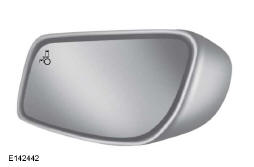
The system displays a yellow indicator in the outside mirrors.
Note: This indicator dims when the ambient light decreases.
The Rear Cross Traffic Alert also emits a series of sounds, and a message appears on the information display to indicate that a vehicle is approaching from the right or left. The Rear Cross Traffic Alert works together with the Rear Parking Assist system, which emits its own series of sounds. See Parking Assist Systems.
System Sensors
WARNING
Before the system detects an obstruction and issues a warning, the number of undetected objects increases.
Note: A blockage warning may sometimes be issued when there is no blockage; this rare occurrence is a false blockage warning. A false blockage condition corrects itself automatically or clears after an ignition cycle.
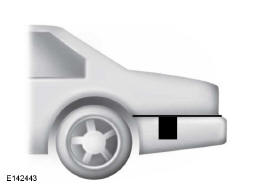
The system uses radar sensors located under the bumper cover, on each side of your vehicle. Do not allow mud, snow, or bumper stickers to obstruct these areas, as this may reduce system performance.
If the system detects that performance has decreased, a sensor blockage or low visibility warning message appears on the information display and an indicator illuminates. You can clear the warning from the information display, but the indicator remains on.
Once any blockage has been removed, the system can reset in two ways:
- if it detects at least two objects during one driving cycle;
- if you turn the ignition off, turn it back on, and then turn it off again.
If the blockage is still present after an ignition cycle and while driving in traffic, check for the blockage again.
| Reasons for Message Display | |
| The radar surface is dirty or obstructed. | Clean the area of the bumper in front of the radar, or remove the object causing the obstruction. |
| The radar surface is not dirty or obstructed. | Drive normally in traffic for a few minutes to allow the radar to detect passing vehicles and clear the blockage condition. |
| Heavy rain or snowfall may interfere with radar signals. | No action required. |
Detection Limitations
Vehicles entering and leaving the blind spot zones may sometimes not be detected.
Possible cases of non-detection:
- Debris accumulated on the rear bumper in the sensor area.
- Certain types of vehicle maneuvers entering and leaving the blind spot zone.
- Vehicles passing through the blind spot zone at high speed.
- Adverse weather conditions.
- Vehicles passing through the blind spot zone following each other at short distances.
The following situations may also limit the performance of the Rear Cross Traffic Alert system:
- Parked vehicles nearby or objects obstructing the sensors.
- Vehicles passing at a speed greater than 24 km/h.
- Reversing at a speed greater than 8 km/h.
- When pulling out of a parking space with a vehicle in the blind spot.
False alerts
Note: If your vehicle is equipped with a Ford-approved trailer module, the system detects a trailer being towed and switches off. If tow bars were not fitted at the factory, you may want to switch off the blind spot information system manually.
A false alert from the blind spot information system or cross traffic alert system may occur, causing the warning indicator to light even though no vehicle is present in the detection zone. Most false alerts are normal; they are temporary and clear by themselves.
Detection errors
If either system detects a fault with the right or left sensor, the blind spot information system indicator lights up and a message is displayed in the information display.
All other system faults only display a message in the information display. See Information messages.
Activating and deactivating the systems
You can temporarily deactivate one system, or both, from the information display. See General information (page 89).
When you deactivate the blind spot information system, you do not receive a warning and the information display shows a message indicating that the system is deactivated.
Note: The cross traffic alert system is always activated as soon as the ignition is switched on. However, the blind spot information system retains the last activation or deactivation setting. The system or systems cannot be deactivated if a MyKey is used.
You may also have one system, or both, permanently deactivated at an authorised dealer. Once deactivated, the system can only be reactivated at an authorised dealer.
Test yourself
A quick Ford Mondeo quiz: every answer comes with an explanation and a link to the manual page.