Vehicle Load Limits
It is very important to know how much weight the vehicle can carry. This weight is called the vehicle capacity weight and includes the weight of all passengers, cargo, and all non-factory-installed options. Two labels on the vehicle can show how much weight it can carry properly: the Tire and Loading Information label and the Certification/Tire label.
Tire and Loading Information Label
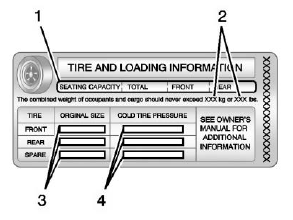
Label Example
The Tire and Loading Information label is attached to the center pillar (B-pillar). The label shows the number of seating positions (1) and the maximum vehicle capacity weight (2) in kilograms and pounds.
The Tire and Loading Information label also shows the original equipment tire size (3) and the recommended cold tire pressures (4). For more information on tires and tire pressure, refer to "Tires" and "Tire Pressure."
The Certification/Tire label also provides vehicle loading information. It may show the Gross Vehicle Weight Rating (GVWR) and the Gross Axle Weight Rating (GAWR) for the front and rear axles. Refer to "Certification/Tire Label" later in this section.
"Steps for Determining Correct Load Limit –
- Locate the statement "The combined weight of occupants and cargo should never exceed XXX kilograms or XXX pounds" on your vehicle's placard.
- Determine the combined weight of the driver and passengers that will be riding in your vehicle.
- Subtract the combined weight of the driver and passengers from XXX kilograms or XXX pounds.
- The resulting figure equals the available cargo and luggage load capacity. For example, if the "XXX" amount is 1400 pounds and there will be five 150-pound passengers in your vehicle, the available cargo and luggage load capacity is 650 pounds (1400 - 750 (5 x 150) = 650 pounds).
- Determine the combined weight of the luggage and cargo being loaded into the vehicle. This weight must not safely exceed the available cargo and luggage load capacity calculated in Step 4.
- If your vehicle will tow a trailer, the load from your trailer will be transferred to your vehicle. Consult this manual to determine how this reduces the available cargo and luggage load capacity of your vehicle."
Refer to Towing a Trailer for important information on trailer towing, towing safety rules, and trailer tips.
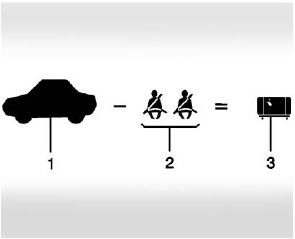
Example 1
- Vehicle Capacity Weight for Example 1 = 453 kg (1000 lb).
- Subtract Occupant Weight @ 68 kg (150 lb) × 2 = 136 kg (300 lb).
- Available Occupant and Cargo Weight = 317 kg (700 lb).
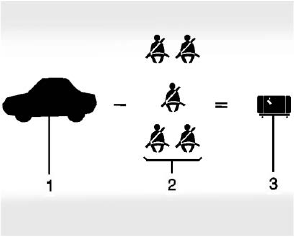
Example 2
- Vehicle Capacity Weight for Example 2 = 453 kg (1000 lb).
- Subtract Occupant Weight @ 68 kg (150 lb) × 5 = 340 kg (750 lb).
- Available Cargo Weight = 113 kg (250 lb).
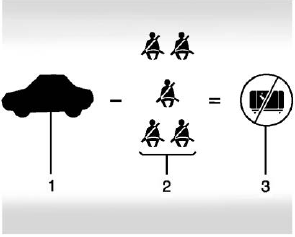
Example 3
- Vehicle Capacity Weight for Example 3 = 453 kg (1000 lb).
- Subtract Occupant Weight @ 91 kg (200 lb) × 5 = 453 kg (1000 lb).
- Available Cargo Weight = 0 kg (0 lb).
Refer to the tire and loading information label for specific information about the vehicle's capacity weight and seating positions. The combined weight of the driver, passengers, and cargo should never exceed the vehicle capacity weight.
Test yourself
A quick GMC Terrain quiz: every answer comes with an explanation and a link to the manual page.