Driving
Automatic Transmission
The Pilot features a smooth and efficient automatic transmission that enhances driving ease and performance. The 9-speed automatic transmission is designed to provide seamless gear changes, ensuring a responsive and enjoyable driving experience. Whether you're navigating city streets or cruising on the highway, the Pilot's automatic transmission adapts to your driving style, delivering optimal power and fuel efficiency.
Additionally, the Honda Pilot's automatic transmission is complemented by the Intelligent Traction Management system, which offers multiple driving modes tailored to different terrains. With options such as Normal, Snow, Mud, and Sand, the Pilot adjusts its transmission and drivetrain settings to maintain stability and control in various driving conditions. This advanced system, combined with the automatic transmission, ensures that the 2023 Honda Pilot is ready for any adventure, providing a confident and comfortable drive every time.
- Select (P) and depress the brake pedal when starting the engine.
- Shifting


 Park
Press the (P) button.
Used when parking or before turning off or starting the engine.
 Reverse
Pull back the (R) button.
Used when reversing.
 Neutral
Press the (N) button.
Transmission is not locked.
 Drive/S Position
Each time you press the (D/S) button, the mode switches between Drive and S position mode.
Used for:
Drive
- Normal driving (gears change between 1st and 10th automatically)
- Temporarily driving in the sequential mode
S Position
- Automatically changing gears between 1st and 8th (8th gear is used only at high speed)
- Driving in the sequential mode

CMBSTM On and Off
- When a possible frontal collision is likely unavoidable, the CMBSTM can reduce the vehicle speed and the severity of the collision.
- The CMBSTM is turned on every time you start the engine.
- To turn the CMBSTM on or off, use the safety support of the driver information interface.
VSA On and Off
- The Vehicle Stability AssistTM (VSA) system helps stabilize the vehicle during cornering and helps maintain traction while accelerating on loose or slippery road surfaces.
- VSA comes on automatically every time you start the engine.
- To partially disable or fully restore VSA function, press and hold the button until you hear a beep.
Tire Pressure Monitoring System (TPMS) with Tire Fill Assist
- The TPMS monitors tire pressure.
- TPMS is turned on automatically every time you start the engine.
- TPMS fill assist provides audible and visual guidance during tire pressure adjustment.
Refueling
Fuel recommendation: Unleaded gasoline, pump octane number 87 or higher
Fuel tank capacity: 18.5 US gal (70 L)
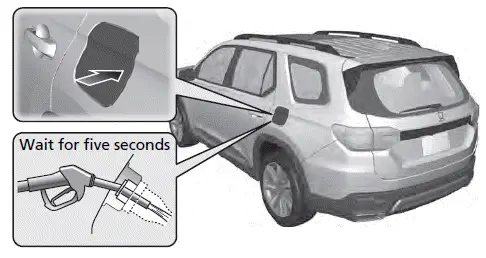
- Unlock the driver's door.
- Press and release the rear edge of the fuel fill door to make it open slightly.
- After refueling, wait for about five seconds before removing the filler nozzle.