Airbag - Supplemental Restraint System
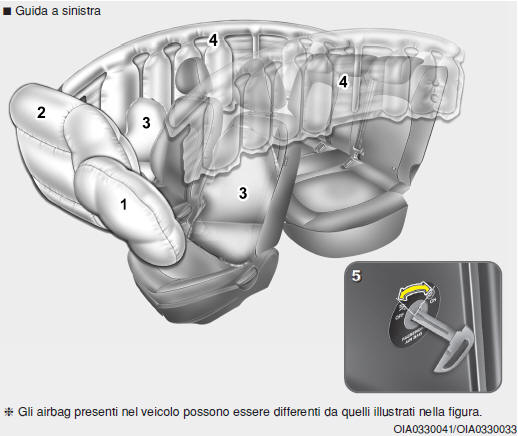
(1) Driver's front airbag
(2) Front passenger airbag*
(3) Side airbag*
(4) Curtain airbag*
(5) Passenger front airbag ON/OFF switch*
*: if equipped
WARNING Even in vehicles equipped with airbags, passengers must always wear seat belts to reduce the risk and severity of injuries in a collision or rollover.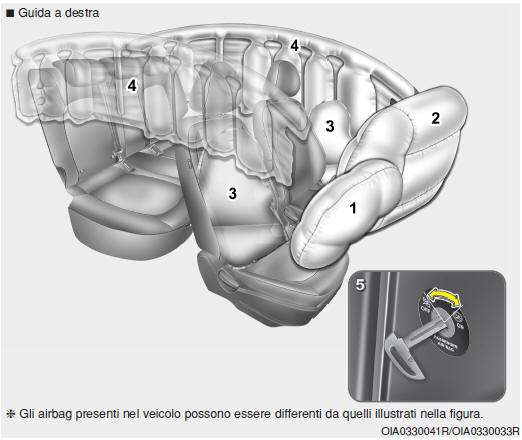
(1) Driver's front airbag
(2) Front passenger airbag*
(3) Side airbag*
(4) Curtain airbag*
(5) Passenger front airbag ON/OFF switch*
*: if equipped
WARNING Even in vehicles equipped with airbags, passengers must always wear seat belts to reduce the risk and severity of injuries in a collision or rollover.This vehicle is equipped with a supplemental airbag system for the driver's seat, the front passenger seat and/or the rear seats.
The front airbags are designed to supplement the three-point seat belts. Seat belts must always be worn while driving so that the airbags can provide protection.
Failure to wear a seat belt can result in serious injury or death. Airbags are designed to supplement seat belts, not replace them. Furthermore, airbags are not designed to deploy in every impact. In some accidents, seat belts are the only protection.
WARNING - AIRBAG SAFETY PRECAUTIONS ALWAYS use seat belts and child restraint systems: for every trip, at all times, for everyone. Even with airbags, you can suffer serious injury or death in a collision if you do not wear your seat belt or if it is not properly fastened when the airbags inflate. Never place a rear-facing child restraint on a front seat. An inflating airbag could strike the infant or child with great force, causing serious or fatal injuries. ABC - Always Buckle Children under 13 years old in the rear seat. It is the safest place for children of all ages. If a child over 13 years old must sit in the front seat, the seat belt must be fastened and the seat must be moved as far back as possible. All occupants must sit upright with the seatback upright, in the center of the seat cushion, with the seat belt fastened, legs comfortably extended and feet on the floor until the vehicle is parked and the engine is turned off. If an occupant is out of position in an accident, the rapidly deploying airbag can strike the occupant with great force, causing serious or fatal injuries. Do not sit or lean unnecessarily close to the airbag or lean toward the door or the dashboard. Move your seat as far back as possible while still maintaining optimal control of the vehicle. It is recommended to keep your chest at least 25 cm (10 in) from the steering wheel.Test yourself
A quick Hyundai i10 quiz: every answer comes with an explanation and a link to the manual page.