Airbag Operation
The SRS system consists of the following components:
- Driver's front airbag module
- Passenger's front airbag module*
- Side airbag modules*
- Side curtain airbag modules*
- Seat belt system with pretensioner*
- Airbag warning light*
- SRS control module (SRSCM)*
- Front impact sensors*
- Side impact sensors*
- Passenger front airbag ON/OFF indicator*
- Passenger front airbag ON/OFF switch*
*: if equipped
The SRS control module monitors all SRS components when the ignition is ON, to determine whether an impact is severe enough to require airbag deployment or seat belt pretensioner activation.
 SRS Warning Light
The SRS (Supplemental Restraint System) warning light on the instrument panel displays the airbag symbol shown in the illustration. The system monitors the airbag electrical system for malfunctions.
The light indicates that there is a potential problem with the airbag system.
WARNING If the SRS malfunctions, the airbag may not deploy properly in a crash, increasing the risk of serious injury or death. If any of the following conditions occur, it indicates a malfunction of the SRS system. - The light does not come on for about six seconds when the ignition switch is turned to ON. - The light stays on for about 6 seconds. - The light comes on while the vehicle is moving. - The light flashes while the engine is running. If any of the following conditions occur, it is recommended that the SRS be inspected by an authorized HYUNDAI dealer as soon as possible.In a moderate to severe frontal collision, the sensors detect a rapid deceleration of the vehicle. If the deceleration rate is high enough, the control unit will deploy the front airbag at the right time and with the force required.
The front airbags help protect the driver and front passenger by responding to frontal impacts in which the seat belts alone cannot provide adequate protection.
When necessary, the side airbags help provide protection in a side collision by supporting the upper body area on the side.
- The airbags are activated (able to deploy if necessary) only when the ignition switch is in the ON position.
- The airbags deploy in a severe frontal or side collision to protect occupants from serious physical injury.
- There is no specific speed at which the airbag deploys. In general, airbags are designed to deploy based on the severity and direction of the collision. These two factors determine whether the electronic sensors send a deployment signal.
- Airbag deployment depends on a number of factors, including vehicle speed, impact angles, and the stiffness and thickness of the vehicles or objects the vehicle collides with. The determining factors are not limited to those described above.
- Front airbags inflate and deflate in an instant. It is virtually impossible to see the airbag inflate during a crash. It is much more likely that you will simply see the deflated airbag hanging from its compartment after the collision.
- To provide protection in a severe collision, airbags must inflate rapidly. The inflation speed of the airbag is the result of the extreme speed of collisions and the need to inflate the airbag between the occupant and the vehicle structures before the occupant strikes them. This speed reduces the risk of serious or fatal injuries in and is therefore a necessary design feature of the airbag.
- However, rapid inflation can also cause injuries such as facial abrasions, bruises and fractures, since its speed also causes a large force as the airbag expands.
- In some circumstances, contact with the airbag can cause fatal injuries, especially if the occupant is positioned too close to the airbag.
Steps can be taken to reduce the risk of injury caused by airbag inflation. The most serious risk is sitting too close to the airbag.
An airbag needs approximately 25 cm (10 in.) of space to inflate. It is recommended to keep your chest at least 25 cm away from the steering wheel.
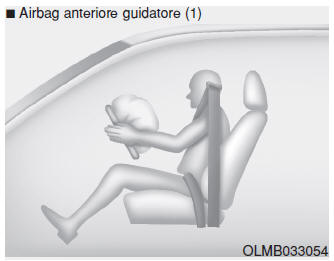
When the SRS control module detects a sufficiently severe impact at the front of the vehicle, it automatically triggers inflation of the front airbags.
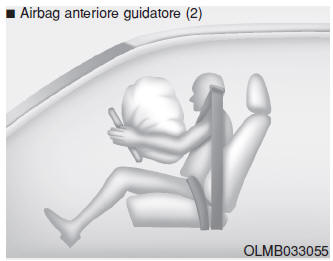
When inflating, the seams located directly inside the trim separate due to the pressure caused by the expansion of the airbags. The further opening of the covers then allows the airbags to fully inflate.
A fully inflated airbag, together with a correctly fastened seat belt, slows the forward movement of the driver or passenger, reducing the risk of head and chest injuries.
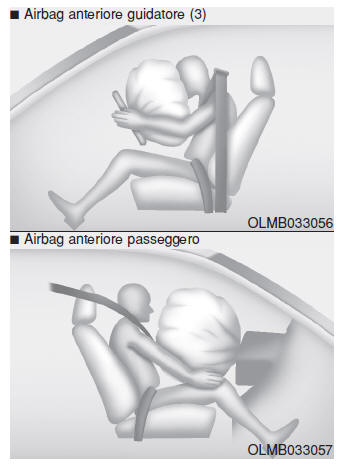
After fully inflating, the airbag deflates immediately, allowing the driver to maintain forward visibility and the ability to steer or use other controls.
WARNING To prevent objects from becoming dangerous projectiles when the passenger airbag deploys: - Do not place any accessories (cup holders, cassette holders, stickers, etc.) on the passenger's panel above the glove box in a vehicle equipped with a passenger airbag. - When installing a drink container in the vehicle, do not place it near or on the instrument cluster surface.Test yourself
A quick Hyundai i10 quiz: every answer comes with an explanation and a link to the manual page.